Formaggio Review - Better than Fromage??
Games in This Video
2 games are featured in this video — they unlock as you watch.

Transcript
It's France in the early 20th century and we're cheese makers. We'll make, age, and sell artisal cheese in Veraggio.
Thank you for joining us at Tantrum House Studio D. I'm Melissa D.
And I'm Kevin Delp. Formagio is a simultaneous worker placement game with several scoring methods. It's for one to four players and takes about 45 minutes to play. It's designed by Ben Rosset and published by Road to Infamy Games. They sent us this copy to review. Now, in this video, we'll give a super quick overview of the game and then share our thoughts. Foragio is a standalone expansion to Formage. You can play it by itself or combine it with Formage. During the game, you play as cheese makers. You have three workers who each make a different type of cheese. You place them on the central board to collect resources and make cheese. The strength of the action determines how long your worker stays on the board.
After each turn, the board rotates one quadrant.
Each turn, players take their actions simultaneously. First, you retrieve any of your workers that are facing you. If you can't see your worker's face, it stays in the board. Then you can place workers on the quadrant of the board that's in front of you. You can place one in the resource section and one in the cheese making section.
In [clears throat] the resource section, you gain one, two, or three of the resources in your quadrant. Berries, livestock, order cards, or structures. It doesn't matter which worker you use, but that worker will remain on the board until the quadrant it points to is in front of you. When you place a worker in the cheese making section, it has to match the type of cheese you want to make. Place one of your cheese tokens on the space and cover it with the correct worker. Bronze spaces take one turn to retrieve your worker. Silver spaces take two turns, gold spaces take three turns, and platinum spaces new in this version take four turns.
After everyone has completed their actions, you rotate the board and start a new turn. You keep taking turns until someone places their last piece of cheese. Then the game ends and you score points.
So each quadrant scores differently. In Bunka, the bank vault, you want cheese in rows and columns. In Venezia, you get points if the gondilas are next to your cheese tokens. In Venetto, you collect tokens to make complete wine bottles. And for the region board, you multiply the number of flags in your cities by how many regions you're in.
You'll also score points for completed orders, your used fruit and jam, and some of your built structures. You won't believe it, but whoever has the most points is going to be the winner.
So, I know that was brief, but we'll go into some more details as we talk about our opinions.
And we're separating the video into four sections. The four C's, our thoughts about components, our critiques, our combinations, and our conclusions. We'll compare the game to Formage as we go along. So, here's a look at the components.
We have the limited edition of Formagio, which has upgraded components. You'll be able to see the difference between the retail and limited edition components compared to the retail version that we have of Formage. Now, all of the wooden resources in Formagio have a different design than the upgraded wooden resources in the Formage Limited Edition.
The four player colors in Formagio are different from the colors in Formage.
Now, there are some components that are specific to Formagio that you won't find in Formage. And one of those are the gondilas that are going to be on the Venia board, little wooden gondilas. And then the wine tiles for the vignettto board.
Also, there's a resource tile that has the four seasons in Formagio. There's the rotating board and the playmat. The limited edition has the playmat. You can also for that use your finger on the indent to move and that actually helps it move quite well. We tried to like move it with moving the board with our hands and it actually works better by using the indent
using it the way it's supposed to be done.
Yes.
Um so there are some things that are similar in Formagio and Formage. You have the player boards that have the asymmetric powers and they're useful because it's where you store all of your resources. There are spots for your berries and your livestock structures, that sort of thing.
There's different inserts for each player count, and they're double-sided for variety. Also, there's an additional printed version for four players on the board,
and that's just like form.
Now, for our critiques. So, my first critique is one that I also had for Formage. So, it may sound familiar if you watch that video that we did, but the resource tokens in the game, I think it's it's fun that they are different shapes and icons and things, whether you have the wooden ones or the regular tokens, but it can be confusing for new players. For example, the livestock icon, every time it's shown on the materials, is just a cow. But the actual tokens could be bulls or goats or sheep. And so sometimes they're like, "Oh, I need the cow." It doesn't matter. They are all livestock. They just have different uh symbols on them. Same with the berries and all of that. It's all fruit. Yep.
Uh it's just, you know, so it's fun, but it also can be confusing,
especially for new players. Overall, I actually think I like the way the different regions score in
Fromage. That's a little bit better than Formagio. I don't know what it is. Maybe they were just trying to make it a little a little too different. Whereas I think what Foragio was like, good. I was like, not all of these are amazing. Actually, the worst one for me is the Venitia board, the Venitia uh region where you are placing the gondilas, which is like when I saw that he's like, "Oh, that's cool.
That's kind of fun looking." And then when you actually play, I'm like, "It's a little confusing." Number one, and as you're placing your cheese, of course, you know, if you played either one of these, there's a little bit of restrictiveness because of the colors of the cheese that you're trying to place in the different regions
and how long you want your worker to stay on. only comes back to you every four turns. So, I mean, number one, you'd have to plan pretty hard to do well in this region. And even in that region, when you place a cheese, um, you know, when you're aging the cheese and you're placing it, you're placing only one gondola in that region. So, then when it comes back to you and you're like, "Oh, I'm going to place another cheese." So, like, you're trying to get a cheese next to where you already have gondilas. It may not happen. And then that kind of ruins in a sense the scoring opportunities that you have because it's the number of gondilas adjacent to the cheeses that are in that region.
I just feel it's a little convoluted. So
it's it's definitely a region that is not as easy to pick up. Like some reasons it's like oh get rows, get columns, put things here
or or majority scoring with their yeah with the different maps or something.
So you have to work for it a little bit more. It'll it's probably going to be more difficult for newer players and experienced players and it may take several plays to for it to really click.
Okay.
Any other critiques?
Um, let's see. This is a game where the end game is triggered by players. So, when someone places their last cheese, so you don't know exactly how many turns you're going to get. And there are some players who like to rush games like Kevin. I'm not rushing. I'm playing my own strategy.
Although, I think most of the times we've played, I've actually ended the game. But anyway, it it can take players
is the best of it.
It it can take players unaware if they're not paying attention that a certain board is not going to get back to them because it's almost the end of the game. I think there was one game where I could have ended it and I and I thought, "Oh, I'll get some points on the next board." and I let it go around, but I didn't calculate how much Kevin
I think I did really good at that game if I remember.
If I had ended it the turn before, I probably would have done better. But anyway, so if it's the type of game that you have to pay attention to other players for the end game.
All right, move to our commendations. I believe the tension in this game is good. Just like in the original formage, you had that. Do I place my worker out
in such a way that I'm going to get a lot of benefit from it? I could get lots of resources or I could get a really good cheese with a higher aging of the cheese, but then I have to wait in order to get that worker back. So, you have that tension of do I want this really big thing or do I want to place my worker so I get them back quicker. So, there's that good tension. And also in this game, we mentioned the platinum um aging that really does I think affect cuz it actually takes four turns for it to get back to you, which is
like a little even more strategic in how that's how that's going. So, I liked that. And the platinum the platinum power itself in most of the um different regions is really powerful if you if you do it and limited in this. Normally there's fewer to me. It seemed like there was fewer places to even put platinum. So, it's almost like a race to get to them quick quicker.
Yeah. And you definitely have to plan because especially since you need certain colors to make the certain cheese.
So, if you've used your blue cheese on that platinum, you're not going to be making blue cheese for a while.
Yep.
So, yeah.
So, I like the tension in this and I think it I think it does it even better than y um I like the addition of the seasons in this version. So, the resource board now has spring, summer, winter, autumn, and there are structures on your player board and some other things that will give you bonuses for doing things during certain seasons. So, I liked that it added a a tiny extra way to get some bonuses and extra things.
What forio also does well is the asymmetrical player boards. So you sort of have a little bit of extra stuff going on, different powers that you can do that other people can't do. So
Right. And Fromage had that too, but this one they're all different.
Yeah, they're all different. Yeah. Yeah. I was saying they're all different. And then also you have the advanced structures which I think are important in this one.
So that kind of ties into my next commendation is if you want to combine the two games, you're going to have so much variability. That's eight regions that you can mix and match for your score.
Can't do all eight at once.
Maybe you pick your favorites. And Kevin never plays with gondilas again.
I really liked the wine bottles collecting the tiles cuz then it's adding this like set collection aspect.
There's a little wild resource too that you can collect.
You get benefits. So like that was probably my favorite region from Formagio. But basically, the ability to mix and match, to have those eight player boards with different powers, to have all those different structures. If you like variability, if you like each game feeling slightly different, then having both boxes is going to give you that in loads.
Great. Let's move to our conclusions. I think players who enjoy simultaneous play and they enjoy sort of that worker placement aspect. So those two things combined, I think you would enjoy fromio. I think you'll enjoy that type of a game. Now for me, I [snorts and laughter] think you should play from first before you even pick up foragio. That's my personal opinion. So play Formage and then if you like it then get Formagio. Now, I when I was thinking about my conclusions, I don't have a strong opinion about which one you should play first. So, my suggestion is that you look at the scoring boards for each game, the ones in Formage and the ones in Formagio,
and then you'll choose Fromage. And whichever boards seem most interesting to you, like, oh, maybe the gondilas that Kevin doesn't like, prove me wrong, is something that you think is really cool. Or, you know, oh, I'm putting cheese in a bank in a bank vault because there actually are banks that take cheese.
We'll say it's cool. Um, yes, you may think Formagio is the one that you want to start with, or you really want, hey, I like that thing about the seasons. So,
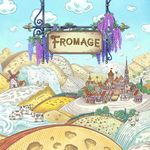
or do you just like the box cover better in Formagio?
So, I I would say that the game play is in general similar enough that either box would be fine to start with based on whichever one you think looks most interesting to you.
Have you played Formage? Let us know down in the comments. Or do you like games about food? Let us know what your favorite one is. Thanks for watching.