The Red Cathedral Review - Chairman of the Board
Games in This Video
1 game is featured in this video — it unlocks as you watch.
Transcript
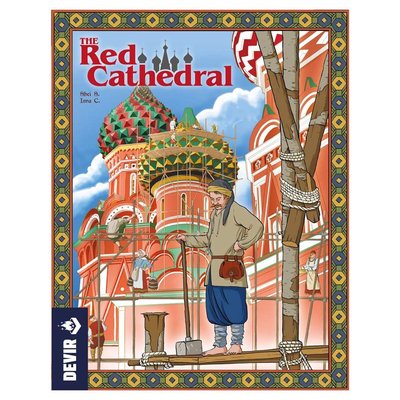
Hey everyone, today I'm talking about The Red Cathedral by Devir Games. It accommodates one to four players and takes about 80 minutes to play. I mean, the box says that and from my experience, that's what it does take to play. Um this one is a um I suppose it's a resource management um and area majority style game um with a very cool way of gathering resources using this um rondel um by moving dice from region to region and collecting resources. Um this was one of my most anticipated games of the year and um obviously finally managed to get to play it and um here are my thoughts. So, first off, I was really impressed about how um how boiled down into some simple actions the game was um the game was condensed to. So, you're only going to take one of three main actions and you've got a couple of kind of bonus actions you can take if you really want to, but I didn't think you're going to do those too often. Um but the the main one is going to be I suppose the the USP of the game where which is the way you actually collect your resources. So, the the main board is this um rondel made up of uh eight different sections and on each of these sections, dice are assigned um and in order to collect your resources, you're going to pick up one of those die and you're going to move them um an equal number of of spaces in a clockwise manner um equal to the pip value. So, say for example, I had a two on it, you'd move it two spaces and wherever you end up, you will collect that resource. So, you've got um you've got your stone,
you've got your bricks, you've got money, and you've got points, you've got gems, um and you've also got gold as well. But not only are you collecting um a resource for the dice you've just moved, if there's an existing um die already in that spot, you take that bonus doubled and if there's three in there, you get it three times over and there's no more space for more than three. Um and on the back of that as well, you also get to um take the action of one of the, I think they're called, um um, professionals or something, I don't know. Uh, or guilds, um, with cards um, relating to, uh, two of the spots. So, every kind of quarter of the board is, um, is associated to a certain guild, um, where you can do a follow-up action such as converting goods into other goods, or converting money into points or something like that, you know, different little little tweaks or little bonuses that you can use to your advantage.
Um, so, yeah, that's going to be the the main kind of just on the board, and there's also another follow-up action which I'll um, talk about in a second. So, the the second action is actually going to be to claim one of the spots on the Red Cathedral. So, at the start of the game, you've got this, um, set up of this this massive cathedral of all different kind of, um, tower sizes, um, made up of different cards. And those cards are going to be different sections of the cathedral which you're going to build throughout the game. And they're all going to have a certain type of resources that they need in order to build them. And once you commit the resources to build those sections, then they're flipped over, and you're rewarded points and rewarded money in return. Um, and the more you build these sections, you're going to place your markers on them in order to control the each tower, um, at the end of the game.
And then each kind of, or depending on the length of the tower, you are going to get prestige points at the end. So, you've got that idea of trying to build as much as you can, um, or spread yourself, um, as well as you can in order to get majorities in each of those different towers. But, whenever you claim one of those towers in order to say that I'm going to be the one who's going to build it, you take one of these additional, um, tokens which can go onto your player board by paying a a small fee, uh, in coins. And that means that whenever you use a certain color of die, then not only are you going to get your resources and you're going to going to be able to use the guild action, you also get a a follow-up action as well. So, it could be things such as, you know, getting a coin or getting a gold or a gem or even a they could have a dice on them or a die on them where you would take another resource based on where that color of die is. So, you've got this bit of an engine you're building up throughout the game as well and, you know, that kind of snowballing effect works well as you build more and more on your player board. So, whatever color die you take, you are going to take a follow-up action as well. So, that's really nice. I really like the way the player boards work because not only for that reason but also because your resource pool or your kind of storage for resource that you're accumulating is limited. So, you're going to start with I think it's six spots because four of them are already preoccupied by the flags you're going to place on the buildings.
And as you kind of claim more and more buildings, you're opening up more spots. But, there's this real tight restrictions where, you know, you don't want to be inefficient and just wasteful of taking resources in where you can't actually store them. So, you've got to weigh up, you know, I I you also use the guilds to be as efficient as you can to get the resources in and out of your storage area as quickly as you can so that you're not, as I said, wasting the the collection of resources. And the third action is going to be where you're actually going to assign your resources to the cathedral. So, from from the areas you've already claimed, you're going to say, for example, it might say this this section of the cathedral needs two stone and a gold in order to build it. Then, you can commit up to three resources from your player board onto that cathedral and obviously if you complete that section, you flip it over and and it's done.
So, yeah, that's going to be the the three key mechanisms as well. Something this game does quite well I thought I can't really think of much or any other game that uses this mechanism where you have two different types of points that you're getting but in the same fashion with only one marker as as So, you've got these prestige points and I think you also have I think I think it's called faith or something where one of them is based on just a single point, you know, point-by-point movement, but the prestige ones, if you gain a prestige point, you actually jump a section of that score track at a time. And as the game goes on, the kind of increments between those scores is going to get smaller and smaller and smaller. So, getting prestige earlier in the game could be quite a useful way of getting quite a bit ahead which is really interesting and I I do really like that.
So, yeah, very impressed about how the game plays in terms of its simplicity and streamlined, you know, mechanisms, but at the same time I I I think the the resource wheel and the rondel is so dynamic and constantly in flux, you know, you're waiting for people to move certain dice so that you can, you know, use use it yourself and get the resources you need. With your own player color, you can pay money in order to move that die further around the the rondel and the same with the white die as well. So, you know, you've got to be careful of wary of am I going to seize this opportunity to get the resource that I want now while while I can or am I going to you know, there's two dice here. So, am I going to use that die in order to get that reward three times? Yes, it's not going to be the most, you know, I need right now, but it can come in useful in a lot of use later for me.
So, I love I love that decision of, you know, are you going to take the the, you know, what I need right now or am I going to be just completely take advantage of the situation when I can. Yeah, really love that resource wheel. I think it works in a great way. Obviously, when you do move the dice, you re-roll them so constantly changing. Using the guilds and using the follow-up actions, it just feels like you're getting a lot done on each of your turns. So, that's always a good thing for me at at The jostling for the area majorities is also has an additional wrinkle to them as well because you on your player boards, you have um, these ornamentations that you can commit to the Red Cathedral as well on already built areas. So, you've got like these uh, the cross that you can put on the top of the columns. Um, you've got the um, the doors and you've also got the I suppose the decoration. Um, where by doing so, not only are you increasing your influence for the end of the game in terms of scoring the majorities on the tiles, but if you embellish those um, ornamentations with gems, um, you can actually get a a lot of prestige that way.
So, again, more decisions you have to make and uh, you know, things you're going to stretch yourself in terms of your coverage on that Red Cathedral. So, yeah, I love the way that the um, you know, a lot of these games or all these kind of resource uh, management games, you are getting your resources and just complete these contracts in order to get points. But, this one you're doing that, but when you complete these contracts, you're actually um, investing in the area control for end game scoring, which is quite a big portion of the end game points. So, I I do like the way that these two are completely um, synergized with each other, which adds a bit more weighting to the areas that you're going to commit to um, in order to, you know, to get your points in lots of different ways. Um, balance-wise, you are yes, you're subject to um, the the dice rolls, but you have got manipulation there. Um, and again, capitalizing on the state of the board is so, so important. Being the first to, you know, get the areas of the cathedral you want is great. Um, not only because of the I said the area control, but also when you take the um, you know, the the engine building tile, um, you know, you might want very particular ones. So, again, there's there's that angst of getting everything first and I think that's completely essential for a Euro game.
Um, time investment, you know, 60 to 80 minutes maybe to play this one. I think it's just about right. Definitely doesn't outstay its welcome and it's engaging. Um, uptime as well because the game is pulled into three simple main actions. Um, not much scope for analysis paralysis. Um, and again, turns tick by quickly enough to keep you interested and no, you know, no lulls in play or dragging out and anything like that. Uh, replayability um, you've got different setups of the cathedral. Obviously, all the all the um, engine building tiles are going to be um, varied in every different game to game. Um, yeah, obviously the the different regions as well are um, obviously mixed up in terms of the resources, but also the guild cards um, because the game comes with more guild cards than you're you're going to use from game to game.
So, you've got a bit of variability there as well. So, yeah, variability is decent um, with this one. Um, player interaction in in in terms of the resource wheel, yes, there's some interaction there just passively. Um, but also there is a quite a cool twist in terms of the cathedral building because if you start a region of the cathedral and you don't finish it before someone above you finishes it, then you suffer negative points for doing so. So, you are encouraged to um, build things quickly or you could be punished for being a bit lazy about it. So, that's um, that's really cool. Uh, nice bit of um, interaction there um, on top of the passive things that I mentioned before. Um, theme, I think it works well. I love the aesthetic of the physical or the physicality of the cathedral as it's built, you know, you're physically watching it or turn and being made, which is which is quite a a nice thing to see. Um, and components as well and the artwork is is really good. I love the way the game looks. A nice bright looking um, you know, a nice bright aesthetic, nice colorful pieces, player boards extremely um, you know, user-friendly while being while still being quite involved, you know, in terms of the of the engine-building spots. And so, very intuitive and a great use of the components in terms of the player boards. The the resource wheel itself looks great, really colorful artwork. I love that kind of flat look, cartoony yet still um, somewhat realistic
artwork. It looks really great. I love I love that aesthetic. Um, so yeah, components-wise I think it's top-notch and you probably wouldn't believe the size of the box that this game comes in. Um, I'll grab it here. So, this is a pretty full-size um, Eurogame and the game comes in a box that big. So, a a real unique twist in terms of or it goes to show that you can make a a pretty involved medium-weight Eurogame in a small box. So, um, yeah, that's really impressive. Um, and setup and teardown time is um, absolutely fine. You're just setting up the cathedral based on these different card setups and obviously setting up the board and your player boards. So, nothing to uh, worry about there whatsoever. Um, progression of the game is really good um, because of those additional tiles you're putting on your player board with the follow-up actions. Um, the tension of claiming the cathedral spots you want obviously ramps up. So yeah, a a really good sense of progression. Um, scalability as well. I don't see any issue with playing this at any player count. Um, it's going to work well uh, anyone. Um, I haven't played the solo mode so I can't testify to that one, but it does have a solo mode um, with the with the base game. So, that's nice um, if that's your cup of tea.
Um, um, and comparison-wise, yes, there is a lot of these Eurogames where you're collecting resources and just buying things, you know, going through that motion again and again and again. But, those additional layers of the resource wheel, which is I've not seen before, and the additional layer of the uh you said the contracts being a part of the um area control itself is is really good. I I love that, and it just adds enough for me to differentiate this from a lot of the um I suppose mediocre Eurogames out there. I think this one is a step above those um because of those reasons. So, yeah, overall, I think this game is is really good. I I had high hopes for it, and it certainly lived up to those hopes. Um very streamlined mechanisms. I don't know too much about these designers.
Uh Israel Israel C and Shay S is what they're called on the box. Not familiar with what they've made, um but this is um a great design, one with next to no fat on it whatsoever. Um There maybe is more going on in this game than you first realize, um but because it's boiled down to these simple mechanisms, it flows beautifully. Um For me, it's all about that resource wheel. I love I love rondels anyway, and the as I said, the angst of the board being in a certain state when you're waiting for it to come back around to your turn is is really fun. So, yeah, for me, a fun Euro resource management game with um familiar mechanisms, but also used in a new light. So, highly impressed. This is um yeah, it's definitely a keeper for me, and I'd love to see more game companies make their Eurogames in in boxes this size because I'd have a lot more space on my shelves. So, I I hope you enjoyed this review. Um this game certainly gets a a seal of quality for me um because I really enjoyed it. So, if you have enjoyed the review, please hit like and subscribe to my channel, and check out my other videos, too. For everything else, I'll see you next time on Chairman of the Board. Bye.