Keyside Review: A Bridge Too Far
Games in This Video
1 game is featured in this video — it unlocks as you watch.
Transcript
Hey everybody, I'm Tom Vassel.
I'm Wendy Ye.
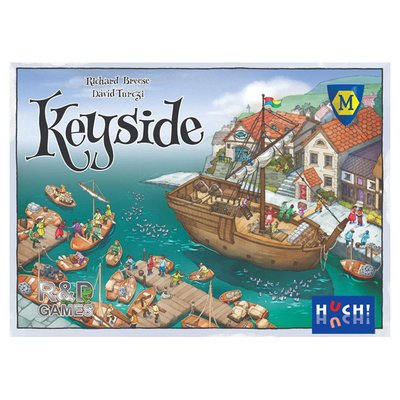
Today we're taking a look at the a game called Keyside. This is from R&D Games designed by Richard Bree. And you might say, have you already reviewed this? No, it's newish. came out
in October. There's a lot of key games. Key Flowers, the most famous, Cathedral, Key Dum, Key Town,
and all the boxes look about as dated as this one.
Yeah. And also all the pieces inside are pretty much the same. If you lose a piece to one key game, it might be in one of the other key games. Your luck.
This is also co-designed with David Turtzy, best known for solo gaming, uh, but also for complex.
He likes complex stuff. This has a lot going on in it. So, I'm going to give you the most cursory of uh overviews here. Let's take a look. There is a lot going on in this. So, I'm going to be giving you a very basic overview of how the game plays. There's so much randomness here in how the game can be set up because you have these different harbors that can go in different spots and there's different scoring tiles that can be placed on each of these harbors. There's these three boats with meeples and each player each round of the game is going to get diceed. You'll have a number one through a number six. You can do it randomly. You can do it according to these the sheet that is holding them or you can choose which colors. On your turn, you will well for the first half of each round, you'll pick a die. You get to move a boat that many spaces in either direction. Drop this person off and then put your die in that spot. And then anyone else who has a die that is that same number or lower can also put a die there. It means they'll get fewer main actions if they do that. When you drop that off, you're going to be moving up on tracks here wherever you drop it off.
And these are going to give you bonuses. You also have the opportunity to move your own little dudes to this spot. There's all kinds of spots that you can move these people to so they can collect resources or trade things for other things. Um, so you again keeping all that in mind after several turns of this where these ships drop off, all these things are dice. Players will then be taking turns scoring an area, pulling the guy off of it if they have a mele there and doing whatever the action is according to the die that they have there. So for example here, if I have a one or two die here, I get two wheat. A three to five, I get one. And a six, I get three wheat that's here. Now all that and your people that are there which you can leave there and move around at the end of the game will cause you to score. So for example here every three sheep I have gives me four points.
Has nothing to do with the bottom of this. And so if I have three workers here then I would get four times every three sheep with a maximum of 12 points. For each one I could get 12 points. I could get 36 points for doing that. And so that's kind of the way the game is going to activate. You're moving to boats, putting out dice, getting the resources from spots or doing whatever it says, and then also dropping people off so that you can then score for those same tiles at the end of the game. Meanwhile, have your own spot here where you're keeping resources. Some things are going to give you victory points. Moving up this track, you'll be pulling gems from a bag. You also have the opportunity over the game to build buildings in each of your spots that will give you bonuses. Like this one here just simply is two points. Or if I upgrade it now, it's worth four points. but maybe instead I want to build one that gives me a point for two fish that I can upgrade to give me two points for two fish. And so there's lots of different resources you're getting. So that again, like I said, is the main view of the game. There's also other little spots that can get stuck in between the harbors that you can build and those are other ways to get resources and things when you activate a harbor next to them. So, there's a lot going on here and it's all going to change and modify based on your starting setup of the game. But like I said, each turn has those two halves. Moving the boat, dropping people off, and then a die and then moving people into that spot. You only have so many people. You have a chance to get more as the game goes by. And you're doing that to take the action, but also to get those
victory points at the end.
So obviously that was very generalized. And and here's the thing, the game itself doesn't the like the basic structure feels like an outline going out to point one, two, and three.
There are no difficult basic concepts in this game. Like everything is pretty straightforward.
Yeah. But you just don't understand why you're doing anything. Yes. You move boat, drop mele, place die. Other people may also place die if it's lower than that die or equal to or lower to that die. You then may move people in. Rinse and repeat. All the stuff's out.
Yeah.
Pull things off. Activate all these. And they even have a rule that if you have nothing to pull off, which could happen,
um then you get to move up the tracks or some other bonus, which is good. and then everything in between there. At halfway through the game, you go, "Oh, it's really important that my workers in these harbors to score points."
But because every harbor is in a different position in every game and because every harbor is in a different I mean every spot is in a different position and where you put your side stuff is in different positions and the stuff in the middle is in different positions. This game does cazillions of setups and I'm not 100% sure it needed to.
No, it didn't need to. And this is my issue with this game is there is so much information to intake at the beginning of the game that you then need to strategize around and it's not like things are guaranteed to fit together. So you're trying to parse through how many action spaces are there? What is that like 12 15? So like 12 or 15 action spaces and each one of those action spaces has a separate type of scoring val or scoring thing. And so you're trying to connect enough of them together so that at the end of the game, you're still getting the stuff that you want to improve your points and ending up on spaces so you can actually score those points. And it it's so it's too much for me at the beginning. It's just straight up too much for me.
It's definitely a game that takes place as you go by. So at the beginning, you're like, "Well, what do I do? I don't know. I'll go here. This gives me some some pigs." Oh, and the scoring is for having the most wheat. Okay. So now I'm going to go get wheat. And by getting the wheat, the scoring for that is doing this. And there's so at some point you're like, okay, I am getting a lot of pigs. Therefore, that's the strategy. I need to get as many workers onto that tile as I can to get the maximum points because you that is a huge amount of scoring. But the game has lots of little fiddly things like moving the people all over the board which you know I I I want to you get to move a lot but you can move like three spaces which is almost everywhere but not quite. So then why even
not if you're already on a location like if you're already on one of those dock spaces you can only get to the adjacent spaces next to you or the middle like that right you can't go across the map. I almost wish there was just and it almost feels like the workers don't matter. So, this is where Keyside has fallen for me. I liked it and I like it, but there's a lot of problems with it. And I feel like a lot of the problems with it are it's doing a whole lot of stuff, but it doesn't have to.
Yes.
The moving the workers, for example, why am I doing all that? Why can't I just say I put a cube from in front of me on that spot to show I have a spot? So it can be another dock and they could put a number in the the foot thing so they can change it.
Yeah. And Right. Then you
It's almost always three.
But but it's just it's kind of like another thing that the game does even the dice. So the game tells you roll random dice or No, I'm sorry. Take the board and you one two three four five six or you can choose.
Sure. In fact I was like I will choose because then I will do something different. So, I don't know where I stand on that. Um,
I think the way that all of these things that they've put in it, if I take an individual one out and I say, oh, the boat's going around and putting the people down and people following, like that combination sounds like fun. Or if I do like the, oh, interesting, there's a different action and different scoring. Mix those together. That sounds like fun. Like, if I take all the different parts together, who collect animals, it's fun. But when I put it all together in such a hodgepodge mix of just stuff that you can do, none of it is fun enough to make a full game. It honestly the sum of all the parts is less for me than what I was definitely from what I was hoping for something like this.
I think that's right. I'm giving it a six. Um because it's again I like lots of it. My initial rating was a seven, but it went down a bit again because there's just so many moving parts. Oh, build a house. That's cool. I have a special ability no one else has. Or a way to score no one else has.
But it was so much effort to get to that point. And then there's like a quarry if you control the quarry.
Okay. There's like there's like they it's like they stuck parts to four different games in here.
There's so many things going and I like most of the stuff. It's your typical go here, get this, do this, change that for this. I like all that, but it doesn't come together. It's too much. the amount of work you have to put into playing the game. And I don't even think it's that hard to understand. I understand it.
But when you look at these dazzing array of things, they're not all exciting things. There's just a lot of them. And it doesn't come together into an amazing game.
Yeah. And I feel like every little benefit and bonus that you get is so minimal that it doesn't feel it doesn't feel worth all that mental effort you put into it. So, I'm giving this one a five. Um I I went I was like, "Okay, it's been a little bit since I played. I'm going to replay it again." and I got through the first round and I was like, "No, my feelings are the same. If anything, a little bit lower from before." Um, yeah, I just there's just so much going on and I love playing heavy games. I love playing complicated games, but I want to feel like from the beginning I have a direction and this literally gives you nothing. Like it is just like go. and I can't even pick a couple things to focus in on because everything is attached to something else and none of it fits together and there's just not exciting moments. Like even that third round, that third round seems like it would be exciting because that's when I'm really trying to get those spaces um so that I could have more multiplier scoring than you. Oh, we both have animals. I want to get to those ones first. It sounds really exciting, but the whole time you're also trying to still build up your engine of stuff. Not even engine, but just like you're trying to build up your stuff. So those points are worth it because the first two rounds you're just kind of doing stuff and trying to get things and that third round you're like, do I get stuff or do I not? So yeah, five for me. I'm not going to come back to this. It's just
Yeah, it's too bad. Full of little mini games and stuff, but
yeah, it's a it's a bit of a mess. So there you go, folks. That's Keyside. I'm Tom Vasel.
I'm Wendy.
We'll see you next time. Hey everybody, thanks for watching this video. If you like this review or whatever you just watched, wasn't it amazing? Uh, check out our channel, Dice Tower. We have all kinds of things. We review games, we do top 10s, we play games live. It's all about board games, but especially the people who play them. Check out Dice Hour YouTube channel.