
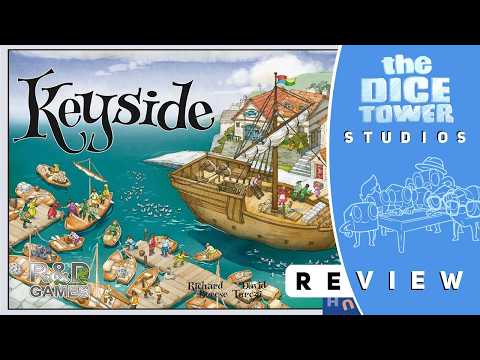








Keyside Deep Dive
What the Community Thinks About Keyside
Keyside arrives as one of the most ambitious titles in Richard Breeze's long-running Key series. Reviewers are deeply divided. Some see a masterwork of interconnected systems and rich strategic depth, while others perceive a game struggling under the weight of its own complexity, where individual mechanics fail to coalesce into a cohesive whole. What unites these perspectives is recognition that Keyside represents something bold: a design that refuses to simplify, pushing the Key series into more austere and demanding territory than earlier entries.
The game's reputation among enthusiasts centers on a single achievement. Watch It Played's reviewer praises it explicitly for evoking "the warmth and coziness and wholesomeness" the Key series is known for, and for appearing to recapture something special in the lineage of Keyflower. Yet the Dice Tower's co-hosts note that despite appreciating individual mechanisms in isolation, the sum feels fractured. A game that attempts so much may paradoxically deliver less satisfaction than a game with greater restraint.
Core Mechanics That Define Keyside
Dice Placement and Boat Navigation
Keyside's foundational action unfolds in two distinct phases across three years of gameplay. In the landing phase, players spend their dice to move boats around a twelve-harbor island. Each die represents a choice: which boat to move, how far to push it, and which harbor to visit. The mechanic's depth lies in denial and follow-up. When a player places a die in a harbor, other players can join that harbor if they hold dice of equal or lower value. This simple rule creates cascading strategic implications. The Dice Tower's reviewers observe that players must carefully track opponents' available dice to freeze them out of valuable locations, but Rahdo emphasizes this is "just the beginning" of the puzzle. A low die might seem prudent for movement, but using it surrenders the harbor to opponents; using a high die prevents others from joining you, but wastes numerical value on movement alone.
The second half of each year pivots entirely. In the harbor phase, the lead player chooses which harbors to resolve, activating them in an order that benefits their own position. Other players who placed workers in that harbor gain benefits too, but the lead player's choice matters enormously. Dice value determines what reward you unlock when a harbor activates. A harbor with a lower total die value yields fewer resources than the same harbor at higher value, meaning players must have foreseen which actions they'd prioritize and built their dice placements to create the numerical values they needed.
Resource Management and Variable Scoring
Players gather goods, build structures, and race for endgame objectives, all while the board itself shifts game to game. The random placement of twelve harbors, eight markets, and five fields (plus scoring tiles with two sides each) means no two games create identical economic opportunities. A harbor that pairs well with your player power in one game might be useless across the island in another. This setup variability is Keyside's second pillar. Rahdo notes that even before a single turn resolves, "the unique variable setup changes everything up." Goods convert into buildings; buildings unlock asymmetric player powers that reward certain resource types or open new paths to scoring. The interplay ensures that players have not simply solved the game after one play, but must constantly adapt their core strategies to the layout deal they receive.
The Keyside Experience
Rich, Demanding Decision-Making
Keyside is a game for players who relish complex choice trees. Every decision branches into cascading consequences that unfold over subsequent turns. When you use a die to access a harbor, you commit not only to the immediate action but to the flow of activation order in the harbor phase weeks from now. Rahdo emphasizes this quality directly: "So, that's just the beginning. I'm just starting to scratch the surface of the depth of decision making you have to make in this game taking into account everything your opponents can do." Each turn requires calculating not only your immediate benefit but the ripple effects on rivals' options and the window it opens or closes for future maneuvers.
Potential for Cutthroat Play
The game's core mechanisms lend themselves to deliberate sabotage. If you recognize that an opponent desperately needs a particular harbor to activate, you can strategically choose a different harbor, prolonging their wait and potentially damaging their strategy. Rahdo's co-host Jen observed moments where players can "freeze out" or "mess with" opponents through smart activation order choices, reminding players of Stefan Feld's Bora Bora in its capacity for clever kingmaking. This element elevates the experience for cutthroat players but may alienate those seeking more collaborative or solitaire-like goals.
What Makes Keyside Stand Out
Exceptional Replayability Through Asymmetric Setup
Richard Breeze and David Turtzy designed Keyside to never feel identical across plays. Unique harbors, markets, and fields in different board positions mean that optimal strategies shift dramatically. Beyond random placement, each player can use an asymmetric board variant that modifies their core capabilities. One player might excel at generating gems; another gains free recruitment and movement options. These powers are not superficial bonuses but integrated into the endgame scoring in ways that encourage specialization. No two playthroughs prioritize the same resource combinations or favor the same harbor sequences, guaranteeing replay variety for dedicated groups.
Sophisticated Engine-Building With Multiple Routes to Victory
While Keyside can overwhelm newcomers with its density, experienced players discover that the game rewards planning across the full three-year arc. Accumulating resources, placing workers strategically, and timing the activation of high-value harbors all contribute to endgame scoring through different pathways. Building headlands (structures on the map), collecting livestock, acquiring skill tiles, and recruiting workers all feed into victory points through multiple, interdependent scoring systems. Watch It Played's reviewer highlights that "There's loads of like routes to victory," a quality that elevates the game beyond a single dominant strategy.
Potential Drawbacks
Overwhelming Complexity and Information Load
The Dice Tower's co-hosts grapple openly with the game's weight. Tom Vassel and Wendy Ye note that "there is so much information to intake at the beginning of the game that you then need to strategize around," with approximately twelve to fifteen distinct action spaces, each offering separate scoring conditions or effects. The ruleset encompasses dice selection modes (random, pre-set, or secret simultaneous choice), multiple resource types, asymmetric powers, endgame bonuses, headland building, livestock placement, and market mechanics. Parsing this constellation of options requires sustained cognitive effort even for experienced gamers. Wendy observes that "it's just straight up too much for me," a sentiment many players may share, especially on their first exposure.
Diminishing Returns and Marginal Benefits
The Dice Tower's reviewers contend that many individual bonuses feel underwhelming relative to the effort required to access them. "Every little benefit and bonus that you get is so minimal that it doesn't feel worth all that mental effort you put into it." Moving workers one space might unlock a marginal resource gain or a single victory point, yet planning that move required anticipating future board states and opponent actions across multiple turns. For players accustomed to decisive choices with immediate, obvious payoffs, Keyside's incremental rewards may feel hollow, leaving "not exciting moments" in their assessment.
If You Enjoy Keyside
Keyside shares DNA with the rest of the Key series. Players drawn to Keyflower will recognize similar worker placement concepts and shared benefits for multiple players' actions. Keyside distills some of Keyflower's spirit but layers on substantially more mechanical depth. Those seeking even weightier experiences may look to Bora Bora, another Stefan Feld design with auction systems that can enable cutthroat play and multi-layered decision-making, or Age of Steam, which rewards long-term planning and route optimization through network-building. Fans of variable setup and asymmetry should explore Pandemic for cooperative strategy or Go if seeking pure positional mastery with infinite replayability through emergent, simple rules. For those specifically interested in Richard Breeze's other designs within the Key line, Keyper and Keydom offer lighter alternatives.
What Reviewers Are Saying
"So, that's just the beginning. I'm just starting to scratch the surface of the depth of decision making you have to make in this game taking into account everything your opponents can do."
— Rahdo Runs Through
"It's like they stuck parts to four different games in here. There's so many things going and I like most of the stuff. It's your typical go here, get this, do this, change that for this. I like all that, but it doesn't come together."
— The Dice Tower
"It just has a warmth and coziness and wholesomeness to these games. Keyflower is just frankly a miraculous game. It's so fun. And this one looks really interesting."
— Watch It Played