














Key Flow Deep Dive
What the Community Thinks About Key Flow
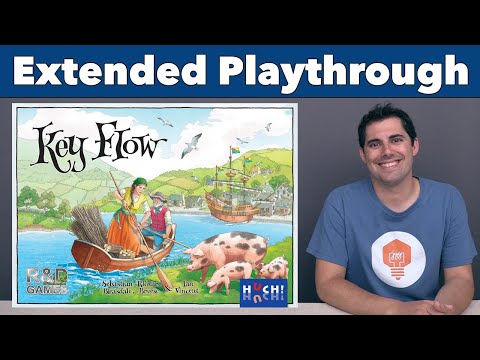
Reviewers consistently frame Key Flow as a streamlined descendant of Keyflower, the beloved euro with a stressful auction at its heart. Getting Games explains the swap directly: where Keyflower relies on bidding with hidden workers behind screens, Key Flow replaces that tension with hand drafting in the style of Seven Wonders. Each season the cards are dealt out, every player takes one, and the rest pass to the left or right depending on the season. Everyone then uses the chosen cards at the same moment to build out a riverside town.
Sir Thecos places the game near the top of a personal ranking and sums up the design in a few words. The reviewer calls it a drafting game with a work placement element, all built around cards and a small number of tokens. Getting Games has ranked Key Flow as its number two game of 2018 and described it as a game it could return to repeatedly because it teaches quickly and plays well across player counts.
Core Mechanics That Define Key Flow
Card Drafting With Simultaneous Reveals
Drafting is the engine of every season. The Getting Games playthrough shows the rhythm clearly: players look at their hand, choose a card, pass the rest, and then flip their picks over together. Some cards are one-shot effects, while others are buildings that a worker can activate again and again. Because the pass direction changes between seasons, a card that is useless to you now may return to your hand later, so reviewers spend a lot of their turns tracking which cards are still in circulation.
Resource Management Through Upgrades and Flips
Iron, stone, wood, and gold flow into the barn and the buildings of your town, and buildings can be upgraded by spending specific resources on them. Upgrades can then be flipped over, and flipping an upgrade generates additional gold. The Getting Games tutorial makes this loop easy to follow, and the playthrough shows how a single activation can cascade into several upgrades in one turn. A building can only be activated a limited number of times, which keeps every activation meaningful and forces players to plan their final turns carefully.
The Key Flow Experience
Quick, Accessible Euro Flow
Getting Games reports that the game rarely runs past an hour and can be taught in about fifteen minutes. The reviewer describes each session as a wonderfully dense hour of decisions, and notes that the game scales to five or six players without the downtime that plagues many larger euros. That combination makes Key Flow a practical choice for a full game night or a shorter gathering where a group is waiting for one more player to arrive.
Interactive Tension Across the Table
Even though every player builds a private town, the table stays engaged because each turn can reach into a neighbor's area. Workers can be sent to buildings owned by the players on either side, which gives those players a benefit but also hands them a worker that may score for them later. Getting Games frames this as a constant balancing act: a card may be too strong to pass along, or it may be worth giving away to deny an opponent the building they were planning around. The result feels lively even when the game itself is quiet.
What Makes Key Flow Stand Out
Gold as a Flexible Wild Resource
Gold is the glue that holds the economy together. Getting Games highlights how a single gold can be spent toward an upgrade on one building or saved for an alternate use elsewhere in the village. That flexibility means players rarely feel locked into a plan, and it gives the final rounds a satisfying scramble where every leftover gold is worth scoring somewhere. The playthrough shows how gold keeps reappearing as the engine turns over, which makes it one of the game's most useful resources.
Endgame Scoring Variety
Winter brings a wide range of scoring cards, and each one rewards a different path through the game. Getting Games describes cards that pay for gold at a higher rate with a jeweler, cards that reward combinations such as pigs paired with tools, and cards that score for the workers a player has accumulated over the game. The playthrough illustrates how a single winter card can carry an entire scoring plan, which keeps the late game open to multiple strategies rather than a single dominant route.
Potential Drawbacks
Setup Changes With Player Count
The game is most streamlined at six players, because the full card deck is dealt without modification. With fewer players, certain cards have to be removed according to the rulebook. Getting Games notes that the setup is not difficult, but it does require careful attention to the instructions.
Dense Endgame Tallies
Final scoring asks players to review every card in their town and determine which scoring condition each one satisfies. The Getting Games playthrough walks through this process card by card, and it shows how a card can only score under one condition at a time. For players who prefer to see clear point totals as the game unfolds, this late-game bookkeeping can feel opaque. The reward is a satisfying reveal at the end, but the final minutes demand patience from everyone at the table.
If You Enjoy Key Flow
Keyflower is the obvious next step. Sir Thecos mentions owning Keyflower as the bigger brother of Key Flow, and Getting Games compares the two directly, noting that a first Keyflower game with its auction and hidden workers ran past two hours with plenty of analysis paralysis. Players who enjoy the town-building and resource loop but want a deeper bidding system will find much to explore there. For players drawn to card-driven worker placement with a growing tableau, Underwater Cities is another strong recommendation. Getting Games describes it as a worker placement game built around playing cards that trigger conditional effects, and it highlights the satisfying moment when a well-built engine finally produces more resources than anyone can spend.
What Reviewers Are Saying
"I like the flexibility of having that single gold which we can use to try and upgrade this or potentially something else in our village"
— Getting Games
"it's a really cool drafting game and also work placement"
— Sir Thecos
"I think yeah key FL is pretty cool"
— Sir Thecos