War Story: Occupied France (Review)
Games in This Video
1 game is featured in this video — it unlocks as you watch.
Transcript
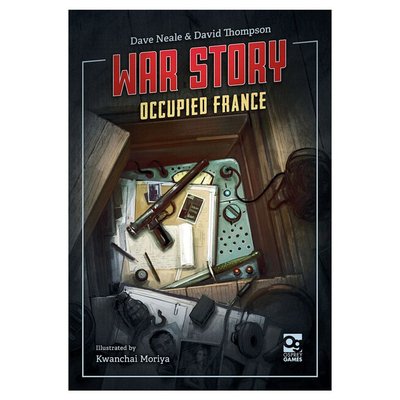
Hey folks, welcome back to the dungeon dive. Daniel here. I hope you're doing well and if you're not, I hope you are soon. Okay, games based off of realworld kind of war conflicts without something weird or fantastical happening are usually out of my wheelhouse. but during one of our Zoom Dungeon Dive meetups. And hey, if you want to join those, you can join the Dungeon Dive Patreon and get access to those. They are so much fun. And we talk about all kinds of games. And this is one of the games we talked about uh during one of our meetups. And one of the Dungeon Dive patrons started talking about this. And I thought it sounded really, really interesting. It sounded different. It sounded unique and uh the price wasn't very high, and it was available on Amazon. So I decided to take a chance on it. And that game is called War Story Occupied France. And this is designed by Dave Neils and David Thompson with wonderful illustrations by Quanchai Maria. Let's read a little bit about War Story. So this says that a this is a choose your own adventure board game set in World War II occupied France capturing the stakes and tension of espionage and resistance warfare. So yeah, this is kind of a hybrid uh choose your own adventure game book mixed with tabletop components. As far as the game book element goes, I would put this on the on that spectrum of game books in the somewhat on the somewhat
complex side. You know, over on one side you have just your basic choose your own adventure. And then as you move over on the spectrum, you kind of get into Destiny Quest and maybe things like Fabled Lands. And then maybe on the far end, you have something like War Story. Now, that doesn't mean it's a complex game. I'm just talking about the uh the spectrum of game book complexity. And this is a really interesting game and I am so glad that I took a chance on it. So, I'm going to just kind of go through what you get in the game and then talk about some of my favorite things. Because this is such a narrative game and the importance is is really on discovering what is going on uh during the game. I'm not going to give a uh a lot away. I am going to show one example of one of the tactical maps just so I can talk a little bit about how the game handles handles its tactical side, but I will do that without giving you any context for what is going on in the story on that map. So, you will still have that discovery. Now, one caveat I should say, one thing I should let you guys know is this game takes place in France during World War II. my French p pronunciation is next to none. And so there if I'm going to be reading some stuff, there will probably be quite a few words in this video that I do not know how to pronounce. So in this game, the player, you will be taking control
of agents of the special operations executive, the S OE. And these are kind of underground resistance fighters in France, part of the French uh resistance. and you are standing up against the Germans. And I really like the setting. I really like the tension in this game. The tension is almost unbearable for me. When I was playing through the first mission the last time, I was filled with anxiety about what was going to happen. So, you will have three mission books. This game is is kind of a campaign game. You have three different missions. You can play these standalone. You could just play mission one, but then you can play from mission one to two to three, or you can play any of the missions standalone. But it's probably best to think of this as one game book divided into three chapters. And typical game book fashion, you will have a bunch of paragraphs with choices. But what this game does, it offers up a lot of ways for the game to remember what you've done. So your decisions feel like they have real impact. And let me tell you, they do have real impact. you will be making very very tough decisions and having to live with the consequences of those decisions. You will also get this team roster sheet and the team roster sheet is divided into your three missions and each mission has its own space to keep track of things. On each mission, you will bring four agents as your group, as your squad, and you will keep track if they survived or if they
were killed or if they went missing in action. And as you progress through the chapters, if your squad members, if your agents are killed or MIA, they can't be taken into the next mission. And so you might get down to mission three and only have two of the eight original agents left to choose from. And you probably won't do very good in mission three if you don't have a full squad. So that's super cool. I like games like that. I really did like that aspect about Warhammer Quest Blackstone Fortress where you had a pool of of heroes of explorers that you could send in, but as they died that pool shrinks. And so you kind of have to think about your your agents a as a resource to covet and to cherish. Uh you will also keep track of time. And so in this first mission takes place from October 19th through October 21st. And you will keep track of whether or not it is a day or night. You will have two objectives. And in this last game, I succeeded on objective one and I failed objective two. But all of my agents survived. So that was really cool. You will also keep track of tracking points. And tracking points is uh you keep track of how many points you have and that uh dictates how um aware the German forces are to your presence.
And at certain times you will be told to track your or to check your tracking points. And the higher the total, the worse things go for your squad. And then you also have up here you have your state tracker. And these are letters that you will be told to circle after you make certain decisions. And this is one of the main ways that the game remembers what you have done because as the chapter progresses, as you progress through the narrative, you will be asked, you know, is in circled? If it is, go to this paragraph. If it's not, go to this paragraph. And so every time you circle one of those letters, it's kind of important for the narrative for you to kind of remember why you circled K, why did you not circle G, and so on, just so you know, so you can kind of keep in your mind, keep in the back of your mind what is happening. You will also have these three dossas, and each one of these corresponds to one of the mission books. And so when you start playing, you will take your mission book one and you will take your dossier and you will open that up and that will have your your your letter here that is detailing your objective and what you need to do with some people or some places that you might need to remember because you need to investigate. And remember this is a this is all about espionage. And so you are trying to gather information. you are looking for secret uh hideaways and you are trying to take out little small groups of Germans and keep your presence on the download. And so this will detail what
you're trying to do in the mission. And then you will have a number of different maps. And this is kind of like your main map here when you uh when you start mission one. And you can you can kind of choose how you want to enter either by boat or by airdrop. And then you will be exploring these different places. is you will be moving around this map in a narrative way and kind of figuring out what's going on. And then you also have these battle maps here. And when I first saw these, I thought that this would be a game split into two segments or split into two types of gameplay. One would be reading and making choices in the adventure book in the kind of choose your own adventure book. And then I thought there would be another aspect of the game which would be kind of a moving dudes around a map playing a tactical a little tactical skirmish game. But that's not the case. And what it does is something really unique and exciting.
And I liked it a lot more than a little tactical skirmish game. When you go into a battle or when you go into a direct conflict, you will be told to draw one of the maps. And then you will be allowed to place your agents at certain letters such as A, B, C, D, or E. And each one of these will have different qualifications that need to be met. So some of your agents will only be armed with pistols, with short-ranged weapons. And so those are marked with the triangle with the little dot there. And so this means that at letter A, I would when coming to this map, I would have to place one agent armed with a pistol at letter A. Conversely, letter E here says zero to one. So I could place zero agents or one agent. But if I do place an agent, this little crosshair in the triangle that denotes that I have to place an agent with a long range weapon there or a sniper uh rifle. And so they are on the lookout. They are kind of guarding. They are looking for any ambushes or anybody who's maybe trying to escape. Then you can also place agents in other areas. And then what happens is once you have made your plans, once you have placed your agents out on the map, then you actually return to the narrative book and you go through each letter in order and it tells a little story about what happens at each area based on the agent you put there,
based on the weapon they have, based on their skills and their stats, and based on choices that you make during the narrative part of this conflict. It is super super cool. I love that. I'm glad that it's not just a little tactical skirmish game. Everything is narratively focused in this game and it does a fantastic job of creating tension. And like I said, the tension that I was feeling was almost unbearable. Okay, we also have this secret envelope. Now, I've opened mine because I always like to open secret envelopes because I always I always like to know what I'm working towards. Um, at the end of the video, I will show you what's in here. And then we have two decks of cards. So, the main deck of cards here is are the eight different agents that are part of your squad, part of your SOE group here at the beginning of the game. So, we have a number of of men and women. And, you know, for people who think, "Oh my gosh, they tried to force women in. This game is woke." Uh, no. Just put that notion aside because it's stupid. And uh there were many women involved in the in the French resistance movement. But um here we have their basic stats. So we have how good they are at firearms. And we have four different skills. We have awareness, influence, stealth, technical. And those numbers will range from 1 to three. Now you might be looking in the box here and realize that there are no dice. So there's really kind of like no luck in this game. A lot
of game books will have you rolling uh one or 2d6 and and then adding numbers and then the the results will bas will will will dictate what happens. No, in this game it's very important to keep track of who is good at what and assign them to the proper roles throughout the game because you might come to a paragraph that says um the agent assigned to letter A. Check their awareness. If their awareness is two or more, turn to this page. If it's two, if it's one or or or zero, turn to this page. And so there really isn't any luck. You always kind of know how good your agents are going to be at the thing they're doing. But there are also these skill tokens, and there are skill tokens and boost tokens and firearms tokens.
And these will be a kind of currency that you will start the game with and that you can earn at certain times. And you will be able to spend these to add to those skills. So you can spend uh these skill tokens here on anything including firearms to boost it by one. You can spend your firearms tokens to boost your firearm skill by one. And you can also spend these boost tokens here at certain points during more tactical uh during the more tactical parts of the game. It's a really, really simple, elegant system that creates a lot of tension. And tension is really what you want in this kind of game because you want every decision to be meaningful.
And let me tell you, every decision you will make in this game is meaningful. You will also have a small number of of uh equipment cards. And at the beginning of the game, each one of your agents will be armed with a wellrod Mark 2 pistol. So that is their main short range weapon. You also have all kinds of different weapons, a pencil detonator, an MG32. We have some binoculars, a medical kit, a carbine, a grenade, and also a sniper rifle. So those are uh a lot of the gear that you will be taking into each mission. And sometimes you will find gear while you are exploring, while you are looking around. The other main deck of cards, these are called, I think these are called the action cards, I believe, uh, mission cards. So, these are mission cards, and there are 44 of them. And these are going to be used to kind of augment the narrative paragraphs in the book. So, you might read paragraph one, it'll tell you what's going on, and then it'll say to draw card one. Okay, card one is a large farmhouse. And so this will say a house in a good state, a house in a good state of repair with some new farming equipment. It's possible that occupants have seen the mache, but getting them to talk probably won't be won't be easy.
Okay, so here's an action you can take at the farmhouse. You can visit and then you have two different outcomes depending on if it is night or day. And there are a whole bunch of different types of these action cards. Some of them will change the map. Some of them will give you different things to do, different ways to interact. Uh maybe some of your agents might die. Uh maybe you'll have a new map for a home. So, all kinds of different things the all kinds of different ways for these cards to interact with the mission books depending on the mission that you are on. You also have a number of tokens here. We have some cubes here. Usually the cubes, the red cubes are used to keep track of how many um enemies are on a map. you might have to to to to kind of uh uh wear those down. You know, you you might have seven Germans and you can't progress until there are only two left or something like that. And then you also have some of these blue tokens, these blue cubes. And what I think is really cool about that is the way that the game will allow you to split up your squad. It's very easy, but it's very elegant. So, if this was my squad here and I had the opportunity to send one or two of them to do something different than the other two, then I could use these blue cubes to keep track of different subgroups of my squad. And when you go through the mission book, you might see these little blue icons on the side of a paragraph.
And that tells you that this right here is only affecting the agents with those blue cubes. Super super cool. I loved that. And there are a lot of opportunities to split up your squad to kind of handle a couple things at different times. I think it's fantastic. That was so much fun. And I haven't see the white cubes in the main mission that I just played. The white cubes are used to keep track of of friendly soldiers who are helping you during a big battle. I haven't yet used the yellow cubes or the black cubes. So, I'm not quite sure what those are used for. The other pawns in the game, you will assign uh a color to each of your agents. So, we have yellow, red, blue, and green. I think for colorblind reasons it might have been nice to add a symbol to these because some of the colors are quite similar. They are all kind of that pastel color. So I might I imagine people who are color blind might have trouble. So if you are you might want to take these and add like you know a plus on one on the on the head of one a triangle on the ahead of another and so on. But these will be used for when you are on those tactical maps. So if I want to send this yellow agent to uh point A there, then I can tell who is there. You know, the blue agent at point C, the pink agent at point E, and the green agent at point B. And so then you can just look at who is where. Very very elegant. This game is, man, I I love the
design of this game. It is so so cool. But um yeah, you know, it's this is a game that's really hard to talk about without giving stuff away. And I know some people will ask about, you know, what's the replay value like? Um, I feel like there are quite a few different paths through even just mission one that you could probably get, I don't know, maybe three to five very different playthroughs through mission one. But when you also think about you could combine different uh different agents to have a somewhat different playthrough. You can make different decisions. There were definitely things on some of the cards that I didn't see. Like there were a few different places where I could explore and I was really only successful in finding something beneficial in one of the places. And so I don't know if there was stuff hidden in the other places that I just wasn't able to find because my agents weren't good at looking or they weren't good at stealth.
They they lacked the technical. I know there was at least one time where I had to try to pick a lock and I had to pick two agents to go in and like I picked these two and it said that if one of your agents has a technical skill of three or more, you can pick the lock. Well, I couldn't. So, I was just kind of locked out of of what was there. And um I thought that was cool. I was like, so I don't know what is in, you know, that barn or that building and maybe I'll find out later. Uh, you can make choices that take people out in a violent way or in a nonviolent way. You can make dialogue choices. There is a whole heck of a lot of different ways to interact with the book, the cards, the tokens, the things on the map, and your your team roster sheet. And so, it ends up being a very interesting kind of game book experience with board game and tabletop game components.
And when those two things combine along with the almost unbearable tension of seeing the repercussions of your actions of the decisions that you have made uh that all goes a long way to make war story occupied France a very very fun very tense and exciting game and I kind of love it. I think this game is super super cool and the price was right I want to say it was around $40. I might be misremembering. I I I'll check and put the price here so you can you can double check. But yeah, I just got it on Amazon and man, I am so happy. Is this It's from Osprey Games. Now, I would I would I would love to see a game just like this rethemed into a theme that I like more. And that would be something fantastical, something with fantasy, or maybe something a sci-fi game. I think kind of a sci-fi squad game could could work really well. You know what would be an amazing game? If they could somehow make a Space Hulk version of this, that would be awesome. Sending your squad having this kind of narrative uh Space Hulk crawl would be super super cool.
The game plays very easily. You the the rule book is well written. You will have no problems learning the game. You can kind of learn the game as you play. And so when I say it's complex, I don't mean it's hard to learn. I just mean it's complex when you compare it to something like a basic choose your own adventure. And uh yeah, there will also be times where there will be vehicles. Uh I was able to uh during this one battle, you know, I had I had a whole bunch of choices to make, but each one of those choices took some time and it was this battle preparation moment. And I could choose to, you know, jam the Germans uh communications or I could choose to uh to plant some some mines that would blow up their tanks while they were coming in. Or I could uh choose to send a a scout over to learn some information.
There were four or five things that I had to do to plan and I only had the time to do one of those things and I had to to to carefully I had to choose which one to do and it really paid off. the one I did really paid off. And because of some other information I had learned during the mission during while I was uh out scouting around and talking to people, I was able to gather some more intel about how the Germans which uh from which direction the Germans were going to be approaching this hideout. And I I felt really cool planning my planning my huge battle and seeing how it how it it uh it be it was a success. my my planning was successful. I lost a whole bunch of my my help. I lost a whole bunch of the resistance fighters who I was supposed to protect, unfortunately. And so, I did end up losing objective two uh completely a complete failure on objective two, unfortunately. I lost way too too many of my little soldiers, but I did I was able to complete objective one. But I think the writing is pretty good. There were a couple times where I saw the same paragraph in some of the longer entries.
I saw the same paragraph uh doubled up and so but I didn't really see any any errors. There was never a point where I was told to turn to an entry and it was the wrong entry. That's always kind of like the bane of these kinds of books where you're you're chugging along having a great time and suddenly you get to an entry that just doesn't tell you where to go or it gives you the wrong entry and then you have to go and track down an FAQ to figure out what's going on. But I never really felt like that. There the kind of not really the iconography but the language of the game book makes a lot of sense. Anytime there is a dotted line you do the first and then the second. Anytime there is a solid line, you choose between the two. There are if then things. So if K is circled, turn to this entry, else turn to that entry. So it's very easy. It's very elegant. There are a lot of creative uses of components and the way that the game remembers is super cool.
And so yeah, even even if you don't like kind of realworld war and that kind of conflict in board games, I think this game offers enough that you can get over that and just enjoy the game like I did. Of course, I would love to see a fantasy version of this where you are putting together, you know, an adventuring party and you are going out on quests, maybe going on a dungeon dive or something like that or some kind of uh a more science fiction tactical game, just something to uh add a little bit more of escapism. But uh being these little covert agents in the French resistance is pretty cool. So yeah, I really do like this game. Uh stay tuned if you want to see what's in this uh secret envelope here. And if you don't, well, you can stop the video now. Just know that I think this game is great. I don't really have any complaints about it. I thought the price was right. I think it offers just enough game for replay. And hey, when I'm done with it, I'm just going to pass it on to my friend. I have a couple of friends who I know would absolutely love this game. So, thanks for watching. Now, we'll look at Envelope X here. So, do not open until instructed to.
And in here, you just have a bunch of different agents that can join your squad. And so, four four new agents. I'm not sure if these are unlocked at the end of a campaign to when then you can play the game again with these new agents. I don't know. Um, but the agents can be damaged and they can be killed. And some of the agents also do have a special ability. So, there you go. That's what's in secret. The secret envelope. This is what you are working towards. And again, I don't know if these are given out one at a time or if they are given out for maybe having both objectives completed. Maybe one of these was somebody I could have rescued in mission one and I failed to do that. So, I don't know. Again, I believe there is quite a bit of replay in this box. So, that was the spoiler part of the review.
We will talk to you later. And bye-bye.