5 Family Friendly Game Reviews - Gloomies, Tulikko, Codenames: Back To Hogwarts & More!


Transcript
Hey, I'm Alex from Board Game Co. And today I'm going to be reviewing five family-friendly games. We have Way Too Many Cats, We Have Tuliko, Codenames: Back to Hogwarts, Gloomhaven, and Scory Up. Five family-friendly games all targeting, I would argue, either families, gateway gamers, in that range. Maybe Tuliko and Gloomhaven might be a drop above. Either way, we'll be going into all them, giving you a brief overview of how the game is played, as well as my thoughts, opinions, and score on all of these. Before we dive into this, this channel is sponsored by All Play. If you go to allplay.com, you can find a variety of family-friendly games. One of the things that All Play is particularly good at is condensing games into tiny little rulebooks, handful of pages, anything from their One Minute to Master series to things that are, oh my gosh, all of four pages long of rules, incredibly accessible and easy to dive into. Go ahead and check out any of those games at allplay.com. But with that, let's go ahead and dive into these. What order do I want to do today?
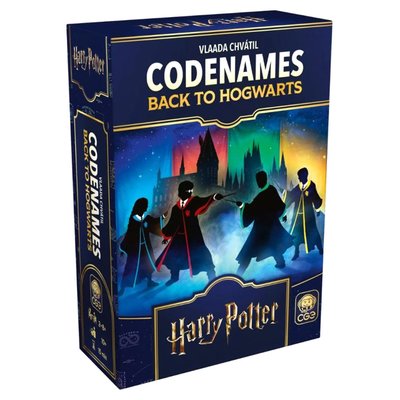
I always have an order, either like alphabetical, left to right, highest to lowest. Let's go with um I don't even know. Let's see, alphabetical today. Alphabetical today. So, we have Scory Up, Gloomhaven, Codenames. Codenames is probably going to be first over here. Let's do Codenames. Codenames: Back to Hogwarts. This is the new IP version of Codenames. There already was a Codenames: Hogwarts. This one takes it and tries to put more than just an IP onto it. Rather, this time they have all the various things, so you have Ron Weasley, Hermione Granger, you have the world of Hogwarts on the Codenames cards instead of standard words that you'd have on Codenames. But they went above and beyond with this one. Instead of just being a themed Codenames, as many themed Codenames exist, they're going to have a few new elements. Specifically, they have the house the house abilities over here. So, you could play a regular version of themed Codenames. But you also have various abilities for each house. There's four houses, that's four abilities, but each one has an ability to go first or second, so that's eight different abilities, giving you some sort of edge. Whether it's a Minesweeper-like ability that tells you how many cards of your house are around, whether something that gives you a freebie kind of guess if you're Slytherin, free guesses that don't actually count against you, so it's kind of like no-risk guesses. There's all these different abilities you have in the game. You also have this little board that keeps track of the house cup.
As a faction wins, as a house wins the game, you mark that they have gotten 10 points for Gryffindor, and they move up this little tally board that is basically a cute way of keeping track of things game to game. It doesn't actually matter in any way. It's just nice to like kind of look at it and be like, oh my gosh, Gryffindor's currently winning, Slytherin's winning, what are we going to do as you go ahead and face off with new houses in your next game. Overall, it's Codenames. It has all the fun that Codenames has, but worse because it's an IP version of Codenames. My own personal opinion of Codenames, any IP of Codenames, is that effectively it takes the general wide-open world of word association, which can be so satisfying, and then it distills this by condensing it into something that's specifically within a theme. It is much more interesting to try to connect, I don't know, game, Iceland, Russia, Moscow. I don't know, I'm doing a bunch of places. Hawaii, temperature. It's more interesting to kind of just put together random words together than it is to try to figure out how to connect Ron with Hermione, but not including Harry. I find that when a themed Codenames exists, it just puts you in a box, making the game system less fun. I do like the abilities, and I do like the house scoring cup aspect to it, so it is the better version of Harry Potter Codenames, but ultimately it still is a themed Codenames, and rating-wise is always tough on these because I love Codenames as a system, and an inferior Codenames is still better than a lot of games out there. So, my rating's not going to be a number on this one. My rating's going to be get regular Codenames instead. It's a better game system. That means Codenames: Pictures, Codenames: Regular, or Codenames: Duet,
or possibly the newly announced Codenames: Critical Role. Although I don't know have a full opinion on that because it's IP, but it's kind Let's talk about Critical Role some other time. Either way, get a different version of Codenames. This is still has nice elements to it. If you're a huge fan of the Harry Potter IP, this is a better version of the Harry Potter Codenames, but regular Codenames is still better. From there, in alphabetical order, we have Gloomhaven. Gloomhaven is going to be next over here. Gloomhaven is from Ravensburger, and this is a game of planting flowers and harvesting said flowers. The game takes place in two phases. You're going to start by planting flowers by gathering cards and plant them in these rows until eventually full the full portion of the board before the line has flowers planted. Along the way you're going to be gathering bonuses, whether they are things that are going to be scoring, whether little assistants that help you, little Gloomhaven that will help you out. All these various bonuses, or rather it's the the the scoring cards that you're going to be trying to fulfill in round two. Because when you're done planting all the flowers, you're going to use all the cards that you used to plant, shuffle them up, and then you're going to use those to harvest the flowers from that same exact grid. So, the same grid that you just built with the other players, you're now gathering those flowers, trying to fulfill the various order cards, which will give you the best return on points for those various flowers that you gather. Although the entire game is all about timing, timing of the played cards, timing of when you try to harvest, timing of what you actually put into your deck, knowing that you're going to be utilizing that in phase two. Investing in wilds sometimes seems like overpaying, but it gives you a lot of flexibility going to the second round, where otherwise you can get stuck. I would say that overall the game is cute, charming, easy to play, fairly accessible. I'd give it a 3.5 out of 5. It's a decent amount of
fun, and it's definitely very family-friendly accessible. From there, moving on to I guess Scory Up is next. R S T. Scory Up. Scory Up is our next in alphabetical order. This is coming to from Up, I guess. Is Up the publishing company? I guess. I don't I don't entirely know. But Scory Up is a game of bluffing, negotiation, and trying to work together while just enough betrayal in there to mix mix the mix things up a bit. Basically, in the game, plays across 20 minutes, you're going to be working your way up this tree, going through the various phases of these cards, the blue cards and the yellow, then the pink, each giving you more rewards as you go. You're going to be revealing a number of spots equal to the number of players. In a four-player game, you reveal four spots. Some of the spots have multiple places. And then you sit there and talk to the players if you want. You don't have to. You can say I'm not saying anything. You talk to the players about where you're going to go. I'm going to go to the first spot. I'm going to go to the third spot. I'm going to work together with you on the second spot because that one spot requires multiple squirrels to go. So, you sit there and tell people what you're going to do, and then you either lied or you didn't lie.
You secretly reveal your dice, showing where you went, and that's where the negotiation part comes into play. Because ideally you're trying to work it that you get the things you want. But sometimes I want to go to spot three. It's the best spot. There's only room for one squirrel. You want to go to spot three. You say, I'm going to go to spot three. I say, I'm going to go to spot three. I tell you if you go there, you're going to bust because I'm definitely going there. You say the same thing. We reveal our dice. Turns out neither one of us went there because we were both afraid the other one would go there, and we didn't want to bust. Or maybe we're working together with other partners, and our partner tells us, no, I'll help you out at spot four. We'll work together and get the goods. But it needs two squirrels, and he was lying, and so you go to spot four all alone, getting nothing, unfortunately. The game is all about, across those seven rounds of play, you're trying to figure out how to get the most goods while telling other people what you will or won't do, and selectively lying where it does and doesn't benefit you. Overall, if you like games like Sheriff of Nottingham, or that kind of push-pull of bluffing and a little bit of betrayal, Scory Up has that in a 20-minute game. Overall, I enjoy it. The biggest critique I have is for a game that's kind of has this low stakes to it. Ultimately, the game tends to go one of two ways. Either 90% of the things you say are true because it is in your best interest to not develop a reputation for lying too early on. So, you want to pick and choose where you lie, which kind of it evolves into a lot of low stakes aspects where we all kind of agree and hope we're gathering the most points because different things score in different ways. Do you want berries? Do you want the acorns? Do you want flowers? There's different things that score, and they all have different scoring systems to it. So, the first part of the game mostly comes down to just trying to mostly agree and not backstab each other too much. And then inevitably, in the last two or three rounds of the game, when these stakes get a little higher, when those yellow
and pink cards have more things on them, that's when a bit more of the betrayal and backstabbing comes into play. That last round of play almost always has someone lying to somebody else. Whereas the first four rounds of play, it's fairly infrequent because it's just not worth it. So, I do find it kind of follows a little bit of a safe progression. That might be different if playing with strangers. I don't know if I'd want to play this with strangers. I think it would just be a miserable experience all the way around to just have people lie and cheat the entire way through. Well, I mean, cheating in a legally allowed way. Next up, oh, rating. Rating-wise, I'm going to go I'm going to give it a three out of five. I think it's charming. I think it's fun. I think ultimately there's a it's a very it follows a fairly safe formula as you go through it. Moving on to Tuliko. Tuliko over here from Pandasaurus. This again might be targeting a slightly higher age range. That and Gloomhaven I think have a bit more to the game experiences. But Tuliko is a game of tile placement.
Basically, what you're going to be doing is you're going to have this grid in the center where you're sliding tiles in, and that's going to give you a color of tile out that you put onto your board based on the matching symbol where you slid that tile out from. When you place it onto your board, you're either creating sets of like tiles, which will allow you to place animal tokens on them, or different tiles, in which case you place river tokens to separate those terrains. Meanwhile, you're trying to fulfill a bunch of scoring objectives. Are you the first one to score all of the symbols of a certain type? Or alternatively, are you using the variable scoring objectives that will give you different things to do, different patterns to make, river patterns, tile patterns, things like that that you're trying to accomplish in order to get rid of your animal tokens. The first person to get rid of all the animal tokens, again, through either either through creating like groups of fours on their board, or through accomplishing any of the goals, that's going to be the player who wins the game. There's a few special powers, and there's just a lot of things to try to be mindful of as you try to get all those tiles out. I enjoy the game, but overall I just found it wasn't particularly incredible as far as this type of game goes. I like point-scoring variability.
I like multiple things to consider. But first of all, I didn't like the fact that you're not actually filling out your grid. So, it feels a little anticlimactic. You're trying to work your way towards different things, but you won't get to do all the things in the game. And overall, there's not enough things that really mix it up to make it that interesting to dive into it again and again. You have the different variable scoring cards that help, but outside of that, it's the exact same thing every single time without enough real nuance to the system that is that engaging. I still enjoyed it. It's fine, but it's a three out of five. It's a decent game. I had a fun time with it. But it's one of those games that once you play it two or three times, you've kind of seen everything the game has to offer. Which brings us lastly to Way Too Many Cats. Way Too Many Cats is another tile-laying game, sort of, sort of. A cat cat-acquiring game. You're basically trying to gather various cats onto your personal player board, and then each cat is going to be scoring for a variety of different things. You see, each cat has a different scoring metric in the top left corner, ways to gain or lose points based on certain requirements fulfilled. But then outside of that, the cats also have certain types, and each type scores in different ways. Some are simply worth points, some want adjacencies. There's also kittens and toys. Toys help fulfill objectives and cats, and kittens can either score on their own or can go into certain spots which can help you fulfill the rewards of other cats. a lot to manage as you go through this game trying to gather cats. Meanwhile, every single round you're choosing either piles of kittens and toys or cats and pairing up which ones you get. You're actually choosing both, but the system as far as how much you get of each type. Overall, the core concept of the game is doing I thought was pretty decent. I was excited to dive into this one. The challenge I found with this is that there's so many different scoring objectives happening
in the game, then they're all on the individual cards. So trying to have a good feel or sense of what's happening, and the iconography, the color palette of the game, the way things pop out, I just found it very hard to visually see what's going on on the table at a glance between the kittens, between the abilities, between the four different scoring types of the cats, between the fact that it's not I mean it's on a player aid next to you, but it's not super obvious when looking at them, and between the way the top left corner is really not simple. The top left corner is one of the scoring objectives on the cards. I just found it wasn't really um the iconography wasn't super intuitive. So I wanted to like this one, but I found it more of a frustrating experience to visually take in everything that's going on the table. I will say if you do enjoy solo, there's also um like four or five different solo opponents that give you different challenges to go through as far as that. So if you can find your way past the absorbability of all the things happening on the table, there's a bunch of solo modes as well as the competitive play to go through. For me, I'm going to give it a 2.5 out of 5. I wanted to like it a lot more. I just found that my um ability to comprehend at a glance what's going on was very stifled. When I say mine, I mean everyone at the table kind of had the same opinion. It was definitely a shared dynamics kind of thing as opposed to just my own personal experience. Anyways, those are your five family friendly games and my thoughts on them. Just going through them again left to right, Way Too Many Cats want collect the concept, found it too hard to obviously see what's going on. Tuliko is a totally fine game, but it just didn't wow me in any particular capacity.
Skurry Up has a lot of fun, but it's a lot of fun in a system that there's a lot better games out there that I thought were more interesting. Skurry Up kind of plays it safe. It's a great excessive if you're looking for something easy to get your kids into that kind of betrayal and backstabbery. I think it's very good for that. For me, I want a little more out of it. Gloomhaven is easily my favorite game on this table with a fun little planting system as well as harvesting system and multiple things you're trying to do as you balance all those needs. And then lastly, Harry Potter Codenames Back to Hogwarts, as much as I do enjoy it, I just would rather play Codenames, regular Codenames, any day of the week. In any case, until next time. I hope you found these five short reviews helpful. I'm Alex Radcliffe from BoardGameCo, and I hope you have a good one.