Three Sisters: Harvest Edition Review - Peas Don't Forget the Corny Pun
Games in This Video
1 game is featured in this video — it unlocks as you watch.
Transcript
Hello and welcome out to the Dice Tower. I'm Wendy Yee.
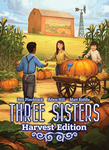
And I'm Chris Yee. And today we are going to be reviewing Three Sisters the Harvest Edition. So this is a obviously second edition of a game that's already been out. Adam Hill, Ben Pinchback, Matt Riddle Matt Riddle make this whole series of games from Motor City GameWorks and it's distributed by 25th Century and this is a very involved roll and write. In fact, an even more involved edition that just comes with the basic game but like I think it's nine extra modules basically.
chapters.
12 chapters, yeah.
Chapter one is the base game. Chapter two and three, anyways I'll go through it in the overview what all the different chapters and stuff are but yeah, there's more to it. Anyhow, we'll talk about that and we'll be back here for our review in a minute. In Three Sisters Harvest Edition, this game comes with the base game as chapter one in the scenario book but then there are 11 other chapters so 12 total that have different scenarios, different things that you can do to change up the base game of Three Sisters. The base game takes place across eight rounds. At the beginning of the round someone is going to roll the dice. Anything that matches is going to go in the same action space and starting with Farmer John moving from lowest to highest you're going to fill up the action spaces with dice then Farmer John's going to move to the end. Players will then take turns drafting dice and when they draft a die they can choose to plant or water based on the die number and then based on the action space where they took the die they can take different types of actions.
Once everybody has drafted a die then the lowest die that is left over is going to be used by everybody for both the planting / watering and the action space as well. Then finally at the end of the round, you're going to get the shed action in the first round. So anyways, there's some sort of bonus action at the end of each one of these rounds. And then you move on the next round, you re-roll and you start all over again. Now just for a brief explanation, over here this is where you're going to be planting. You're planting corns, beans, pumpkins. As you plant them, they will grow as they get watered. If you connect these pumpkins, so if you fully complete and harvest pumpkins around, you can get these little perennial bonuses and that's what's down here.
These perennials you work from bottom to top. Eventually you'll get the points at the top, but you get little bonuses along the way. On this paper over here we have the apiary, which are the bees. You're going to work bottom to top and then when it branches out over here, you're going to go ahead and choose how you want to branch. Then we have the yard where we get fruit. This is going to give you different bonuses and when you fill in one of these circles, that's going to be considered a harvest and that matters because of some of the bonuses you receive over here in the shed. Now the shed is where you're going to be doing all of your engine building and getting your special powers. You're going to work left to right on any one of these little sections. They usually end with points as well as some sort of ability. For example, after it rains, you can water an additional zone.
Now all throughout this game, there are these little good orange icons around here. You get them from completing pumpkins, some of the perennials, the raspberries and such. And as you gain those, you're going to be filling in your goods from left to right, top to bottom. Whenever you go to fill in a star, that means that you're going to get a bonus action and you can use those to take a bunch of these different actions throughout the board. Now the goods are also useful for when you go to the farmer's market. You don't spend them, but instead it just depends on how many you currently have and you get rewards that increase as you have more goods. Now the farmer's market is one of the action spaces over here, as well as one of the bonus actions that happens at the end of three of the rounds. All right, that's the gist of the basics. Let's go ahead and move on to expansion content. In the scenario chapter book, uh each chapter is going to have some different scenarios, new setups, new abilities, uh new boards, and items that you're going to actually place out. And what's nice is at the end of the book, it actually breaks it down into similar chapters. For example, the chapters two and three add lesson cards. These cards are just new objectives that you're kind of racing towards, and there's different ways to meet these objectives, and they just kind of give you a focus as to what to work on in the game.
In chapters four through five, we have the groundhogs, um and they work a little different in both chapters, but what you're going to be doing is you're going to be uh revealing these tiles down here as you go throughout the rounds, and they're going to pop up in your gardens, your perennials, and your yard. And when they pop up, they get in the way, so you can't do stuff in that area. So, that these scenarios don't sound all bad, there are unique ways to get perennials, uh which is kind of nice. Next up is the great pumpkin, and in this, you're adding a whole new garden board. This has a giant pumpkin in the middle, and it has your normal plants on the side, so you have the pumpkins over here, like your little pumpkins. You have your corn and your beans as well, but then there's this great pumpkin in the middle. And to be able to fill him in, you have to be able to fill in from each one of these garden sections around, and then you're going to fill in middle to out as he grows, so he'll grow bigger and bigger and bigger. And as you complete in a whole circles, you're going to receive rewards and benefits.
On to barn raising. Now, you're still using your normal sheets, but instead of the shed area, you're going to cover it up with these tiles. And as you take shed actions, you can actually place out cubes on these tiles until they're fully filled up. And then once they are filled up, you get to flip them over and then you have new permanent abilities that are going going for the rest of the game. In chapter nine, we have the pepper festival, which introduces a new shed and yard and apiary board. It also introduces this idea of peppers. So, instead of harvesting fruit, we have peppers over here. Uh and they gain their own similar rewards. And then we have the shed, which are new items. It also introduces a red dye, which will be rolled, which specifically works to limit some of the shed items that are over here.
Chapter 10 has its own section, but it's very similar to nine. You still use the pepper board, but then you have these little objectives over here. So, if you happen to have two waxes, a jalapeno and a yellow bell pepper, then you can place your cube over here for nine points if you're the first one, and then everybody else after that makes that particular item, uh gets four points. Finally, in chapters 11 through 12, we have the mill projects. And what it this is going to add is it's going to add these little project cards that you have over here. As you complete the project cards at the end of the round, you can move up on the project that it lists at the bottom. For example, we have the gears here, which are for mechanics. As you move up, you gain the benefits, the points on the right, as well as immediate benefits as you cover those spaces. Well, there you go. That's a brief look at Three Sisters: Harvest Edition.
All right, Chris. So, it was seven modules. Seven modules.
Well, one's like chili peppers part one, and then chili peppers part two. It's like Stadium Arcadium disc one and disc two. Yeah.
the same Stadium Arcadium. Sure. I'm just going to I should have pretend that's not not a real thing. You're the one who claimed that your glasses are made of ones and your ears are made of zeros. I don't want to hear it.
know what? All right. So, let's talk about the campaign. So, 12 chapters. That's significant. Um and one thing that I've noticed is that each chapter doesn't feel like it's revolu- revolutionized the game, right? It's not like, "Wow, chapter two is a whole new thing. I've to learn all these new rules." But instead, it changes something that's relatively small. It's a few paragraphs of rule reading, and I appreciate that. In fact, I think there's more story than there are rules on some of the chapters. Yeah, and I and I think that you said that all of the chapters, all the different modules feel that way. None of them are a huge change. I thought that seeing one that was like The Great Pumpkin Charlie Brown page, I was like, "Oh my gosh, this is going to change everything." No, it changes like one interesting aspect of the game. Like no matter which module you're playing with, nothing is that wild. So, for people who are brand new to the game, this is the edition you should get.
There's no doubt about it, I don't think, because this comes with everything from the first edition base game and new module new modular ways to play. So, 100%. If you already have the basic game, that's a different question. It depends how much I guess these modules are going to entice you to come back and play it more. Yeah, I think if you want variety, you want diversity, you want some options to mix and match and change things up, this is fabulous for that. And I appreciate that it doesn't have that much heavy lifting. Also, if you really enjoy campaign games and if it's going to be a reason for you to pull this out more, so you get your money's worth, um I think that that is really useful, but you also don't have to follow the campaign. You can totally jump around. You can skip whatever you want to skip. If you hate groundhogs and you think that it sounds terrible, don't play groundhogs. Well, and you know, it's funny because in the in the last page of the campaign book, it says free play mode. Once you've completed the campaign, you can play any modules you want to. Well, I mean, you could just play them any one you want to. Whatever, right?
with mixing and matching. It's okay. Yeah, and in fact, I think one of the things that we talked about was I think that there's about three of the modules that I would feel very comfortable introducing to new first-time players. If you're in the position where you often teach games to people and you're like, "Ooh, can't wait to play some of this new fun stuff." You know, like, "Oh, I have to teach this to groups of people first so they know the basic game, then I can play the module stuff, and then I go teach that group of people." Like, "Oh, no, back to base game." Mhm. Now, I think I think at least three of them would be extremely easy to throw in, and the other three wouldn't be that hard either. Right. So, the lessons, which is like chapters two and three, those adding in just a couple cards, I think are actually really nice for beginners because it gives you a direction. So, you're not just staring at these two pieces of paper going, "I don't know what to do." So, it gives you kind of an arrow to point towards and a race to to work towards. And so, I appreciate that, especially as a beginner. In fact, I did play that with some new people that had never played.
Um the other one is the other two that I think would work really well. Um one is the great pumpkin. It does add in one extra step, but because it's a whole new piece of paper and everything that you need is on that piece of paper, you could easily teach it from that point. Um and just don't tell them that there's another paper so they don't get freaked out. Just start with that.
Sure. It's just that's just the game. It looks like it's just the game. And I think the peppers works, too. The only thing is is that the conversions between um knowing that the apples are or the peaches are habaneros and the apples are the red reapers. Yeah, anytime you get a bonus that says apple, you're like, "Well, it really means this thing." Yeah.
that's a little confusing. So, that's like question mark beginner level. Where's the
first play level. There's like the alternate tiles for the shed Mhm. and the the barn. And you know, I mean, that's easy enough to be like, "Hey, when you get a shed action, just this is your shed area."
Yeah, put a cube out. Yeah. And so, I think that's the only I any of those work. I I wouldn't teach the groundhogs to a first-time player because they're a nuisance and they're you know what shockingly though I don't hate them. I thought I would really dislike this module cuz it does I was like oh does it add any fun or is it just nuisance? Actually, it does add a little bit of fun. It does. However, it is my least favorite when it comes to upkeep because you've got just extra things you have to do between each round. You've got the normal die rolling. You've got all that kind of stuff and then you have the whole board that you have to deal with. So, I think it's my least favorite module just cuz it's it is negative and it's more upkeep. I think that's the biggest nuisance is the upkeep. Now, in terms of the basic game, if you're coming to this review and you're saying hey but do you like the basic game a lot? Yes, I I think we should have made that maybe uh clear earlier. I think it's a tremendous tremendously cool roll and write game.
I've played multiple from these designers and from this uh publishing combo. Uh the the three of them worked together originally on Fleet the Dice Game which came out from a different publisher. Uh I think that was Eagle-Gryphon and then the other three have been from this this particular combination here. And I think they're all very good. I this one is often regarded as the best of them. The Motor City uh Motor City Motorworks or that's not what it's called. Uh and then the French Quarter. Like this one's often the kind of the most well-received and I can really see why. The theme is pleasant. The gameplay is is pretty smooth. There's a little bit of interaction with that central board dice drafting and all that stuff and what do you leave for the other player? Like all of this is a great elements. Yeah, it's interesting because I this is my first one of this series of games. I don't think I played any of the other ones. And in fact, I hadn't played the three sisters until this edition. Yep.
So, I am just like completely fresh start. Now, I have wanted to play this game forever because I love the theme. I love the combo-licious nature of it. Um for the game itself, I think one positive or negative is the combos. So, if you are someone that just loves like this action leads to four other actions and now I have to keep in my brain these four other actions and each one is going to like move into two actions possibly. Like there are moments where you can get a ton of bonus actions and you have to keep track of everything. Now, after a few game plays, I finally realized that I'll just put a dot wherever that bonus is and then I'll fill it in when I've completed it so I can mostly keep track of everything. But, that is a positive and a negative because it is a lot of like stuff to keep track of and I'm pretty sure I've cheated multiple games by not giving myself something or giving myself something twice. They probably balanced out in the end, too.
That's true. Uh because this has like the little modules where you use the cubes like to complete the recipes first and whatnot, you can also put cubes out which come in this box now and just like put them in the free actions and kind of remind yourself, "Oh, I still got a star action by filling in so many goods and all that stuff." So, that's been helpful.
that cuz that's easier to see than a teeny tiny dot. Yeah. So, I think that this I think this is just a clearly better version of the game in so many regards uh in with usability and all that. Comes with the same drawbacks. It's It's outside of that dice drafting, which I think is a nice little moment of coming together interaction, and then you're just kind of playing on your own sheet for quite a while and there's no way you can possibly audit each other and make sure each other are playing fair. But, if you're okay with those types of roll and write games where there's a lot of combos and a lot of moments to kind of get lost in, but also that same excitement, this is great. This is really good uh and I think it's one of the best of this ilk. So, what are you coming in score-wise? Score-wise, for uh reviewing this as a whole box, right? The expansion modules, the basic game, and all that stuff. I'm coming in at eight. I think that this is superb. I think it's very strong. I think that there are definitely moments where you're just kind of like lost in your own little thing and you're like, "Hey, sorry guys. I'm I'm I'm back." And you realize everyone else is still going.
Who who who the free action. Done. You know what I mean? So, it's it's It it Yeah, I don't know. It gives you plenty plenty plenty to work with. I like all the modules. None of the modules shake up the game so drastically uh that it's like that it excels this, you know, even higher for me, but I think that it's just it's a great package because of how much modularity you get. Play with the things you enjoy. Don't play with the things that you don't. Good package. Okay, I'm coming in at a nine. I think this was absolutely fabulous. I enjoyed it, and I feel like it lived up to the hype of what people had talked about Three Sisters being, and then this just took it from that was a really cool game to wow, it's an amazing game because I have so much variability. I have so many options. And I love that you can mix and match. In fact, we just did last night. We mixed a couple of the scenarios together to see what that was like. And when you talk about like it makes little changes here and there, that's true. However, if you add multiple of those modules in, like we did the Great Pumpkin, we did the Peppers, and then we did the Recipes.
Like we added those three together cuz the Recipes is basically just the Peppers. It works well with the Peppers, yeah.
Yeah. Yeah, they it goes together, right? Um and so, doing those three together, I was like, this feels like a totally different game, but I didn't have to do that much rule learning in addition because I got a whole new roll and write game that works exactly the same. Yep. So, it's just fascinating. All right. Well, so that's a nine for me, which is a seal of excellence from us at The Dice Tower. Mhm. So, there you go. That's Three Sisters Harvest Edition. Make sure you go check this one out. My name is Chris Yee. I'm Wendy Yee. And uh go pick a peck of pickled peppers. Hey everybody, thanks for watching another video from The Dice Tower. Hey, you want to learn more about us, communicate with us? We have a Facebook group. We have a Discord channel. Lots of different ways to get involved with The Dice Tower. You can find that in our link tree link below. So, just click that, it will take you, and you can communicate with us on Facebook, Join our Facebook group. There's lots of cool things that you can find and become part of the Dice Tower.
Thanks so much for watching. I'm Tom Vasel. SD cards, what do they have metal on the inside? Is that what they're recorded on to? Don't ask me that question.
into plastic?
It is literally unknowable to me.
I don't understand technology.
Zeros and ones. You're not actually seeing real crystal when you're seeing a facsimile made of zeros, ones, RGB, and CMYK. Yours are zeros and my glasses are ones. Cuz that's how programming works, right?
brain.