/pic8654327.png)
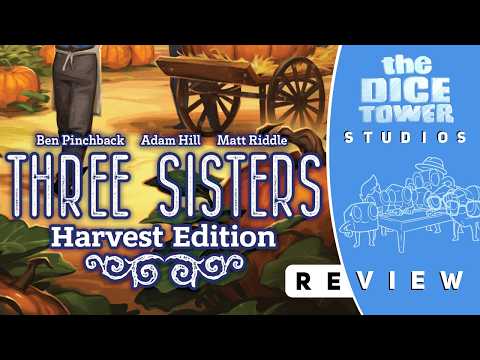













Three Sisters Harvest Edition Deep Dive
What the Community Thinks About Three Sisters Harvest Edition
Coverage of Three Sisters Harvest Edition leans strongly positive across the channels that have picked it up. Grant Lyon frames it as a straightforward win for anyone who already likes the roll-and-write series, noting that the base game plays largely the same as the original Three Sisters while layering in fresh content. The Board Game Garden streamed the game and kept coming back to it, praising how much the new material adds to a game the channel already knew. At The Dice Tower, Chris Yee and Wendy Yee scored the release an eight and a nine, calling it superb and saying it lived up to the hype surrounding the original.
The one real point of disagreement is whether existing owners of the base Three Sisters need to buy in again. BoardGameCo initially assumed Harvest Edition was little more than a reprint with new Andrew Bosley art, then corrected that assumption on camera once the added campaign content became clear. The Dice Tower is blunt that newcomers should get this edition without question, since it folds in the entire first edition base game, but is more measured about double-dipping, saying the decision comes down to how much the new modules entice a returning player to pull the game back out.
Core Mechanics That Define Three Sisters Harvest Edition
Dice Drafting Across Eight Rounds
The base game plays out across eight rounds, as walked through in The Dice Tower's review. At the start of each round a shared pool of dice is rolled, matching numbers are grouped into the same action space, and players then draft dice one at a time, choosing to plant or water crops based on the number they take and the action space it came from. Once everyone has drafted, the lowest leftover die is used by every player at once for both the planting and its action space, then a bonus action closes out the round before the dice are rolled again. Players build out corn, beans, and pumpkins on their personal sheet, work bottom to top through perennial and apiary tracks for bonus rewards, fill a yard of fruit, and spend time at the farmer's market, where the reward scales with how many goods a player is currently holding rather than spending those goods outright.
Twelve Campaign Chapters Built as Small Modules
What separates Harvest Edition from a straight reprint is its scenario book, which The Dice Tower describes as twelve chapters covering seven distinct modules layered onto that base game. Lesson cards in the early chapters add simple objectives to chase. Groundhogs tiles pop up in the gardens, perennials, and yard and block those spaces. The Great Pumpkin swaps in a new garden board built around a single giant pumpkin that grows as players fill in the surrounding sections. Barn Raising covers the shed with tiles that convert into permanent abilities once fully filled. The Pepper Festival introduces a new shed, yard, and apiary board along with peppers and a die that limits certain shed items, and Mill Projects closes out the campaign with project cards tied to ongoing bonuses. Grant Lyon adds that once the campaign wraps, that same content can be pulled back out and used as standalone expansion modules for any future game of Three Sisters.
The Three Sisters Harvest Edition Experience
A Moment of Interaction, Then Heads-Down Farming
The Dice Tower calls out the dice draft as the one moment of real interaction in a round, since players are watching the shared pool and deciding what to leave for the table before settling in to work their own sheet in relative isolation. That rhythm repeats each round: a shared decision up front, then a stretch of quiet, parallel farming as everyone fills in their own paper. Grant Lyon frames the appeal of that loop around choice, pointing out that a given game of Three Sisters only ever uses a fraction of the paths available, so players are constantly deciding which third or half of the board to chase.
Chasing Chain Reactions Across the Sheet
The Dice Tower is candid that the game's combo chains are both the draw and the challenge. Completing a pumpkin or filling a goods track can trigger a cascade of bonus actions that need to be resolved in turn, and after several plays the hosts settled on marking bonuses with a dot on the sheet so nothing gets missed in the moment. Getting swept up in that chain is part of the fun described across the coverage, whether it is Grant Lyon highlighting the game's many paths to victory or The Dice Tower calling the base game a tremendously cool roll-and-write on its own, before any of the campaign content gets added in.
What Makes Three Sisters Harvest Edition Stand Out
New Art From Andrew Bosley
BoardGameCo singles out the new Andrew Bosley artwork as the first thing that pulled attention back to the game, calling it fantastic. That art alone was enough to make BoardGameCo consider buying the game again after already owning the original, and it became the entry point for discovering that Harvest Edition was carrying a lot more new content than a cosmetic refresh.
A Campaign That Never Overwhelms
The Dice Tower's central praise is how gently the twelve chapters introduce new rules. None of the modules is described as revolutionizing the game; each one is a few paragraphs of reading rather than a new rulebook, and the hosts note there is often more story than rules in a given chapter. That design lets The Dice Tower recommend Harvest Edition without reservation to anyone new to the series, since it bundles the complete original base game with a stack of modular ways to keep changing it up.
Potential Drawbacks
A Lot to Track, and No Way to Check Each Other's Work
The same combos that make the game exciting can also make it hard to manage. The Dice Tower describes moments with a ton of bonus actions stacking up that have to be kept in the player's head, and admits to probably having miscounted or double-counted a bonus across multiple plays. Because each player is filling in a private sheet, The Dice Tower also points out that there is no way for players to audit each other and confirm everyone is playing fair, calling that a real drawback alongside the otherwise smooth, interactive dice draft.
Groundhogs and Confusing Conversions
Among the seven modules, The Dice Tower singles out Groundhogs as the least favorite, since its extra tiles add upkeep between every round on top of the normal dice rolling and would not be the hosts' pick for teaching a first-time player. The Pepper Festival module draws a milder complaint: its reward tokens are reskinned versions of the base game's fruit, so a bonus that reads as an apple actually means something else on that board, which the hosts found a little confusing to keep straight.
If You Enjoy Three Sisters Harvest Edition
The Dice Tower traces the design team's earlier collaboration to Fleet the Dice Game, the roll-and-write the same three designers made together before this series, for anyone who wants to see where their combo-driven style started. Grant Lyon and The Board Game Garden both frame Harvest Edition around its relationship to Three Sisters, the original release the new edition builds on and eventually replaces for new buyers, so fans who already know that base game have the clearest read on what the new content adds.
What Reviewers Are Saying
"I think this was absolutely fabulous. I enjoyed it, and I feel like it lived up to the hype of what people had talked about Three Sisters being, and then this just took it from that was a really cool game to wow, it's an amazing game because I have so much variability. I have so many options."
— The Dice Tower
"I streamed Three Sisters Harvest Edition and I've been playing it here and there and I've really been enjoying the stuff that is adding to the original game of Three Sisters. So, if you're a fan of Three Sisters and you want to get that version of the game or if you've wanted to get into Three Sisters, I definitely recommend you check out Three Sisters Harvest Edition."
— Jenna, The Board Game Garden
"This is essentially a standalone replacement for the first game that just has a lot of this extra content, but the base game is largely the same as the original Three Sisters game. If you like combos, if you like making choices about how you want to score points, because there's a lot of different ways to score points, then Three Sisters is a good one."
— Grant Lyon