/pic6204967.png)





























Welcome to the Moon Deep Dive
What the Community Thinks About Welcome to the Moon
Across the channels that have actually sat down with the eight adventure sheets, the consensus on Welcome to the Moon runs strongly positive. BoardGameCo called it the best iteration of the wider Welcome To line and said it keeps handing players fresh versions of the same system rather than making them feel like they are repeating the same roll, going so far as to say the series is overdue for another entry built the same way. Rolls in the Family put it even more bluntly, saying Welcome to the Moon has replaced the original Welcome To in their collection because the core flip-and-write formula is stretched across so many different boards. Tabletop Tolson ranked it as their number two game of the year, and toally tabled placed it at number ten on a personal top-ten list despite admitting a general fatigue with roll-and-write and flip-and-write games as a genre.
Not every take is uncomplicated. The Board Game Garden enjoys the gameplay but is upfront that the space setting is not a theme they gravitate toward, and that it makes some sessions harder to get excited about compared to the housing theme of Welcome to Your Perfect Home. On the duo channel Ilia and Tyler, one host names Welcome to the Moon as a personal favorite in the series while the other still prefers the original Welcome To, a disagreement that plays out live in the episode. slickerdrips loves the game enough to call it "so good," yet in a head-to-head bracket format still ranked Feast for Odin and Shipyard above it when forced to choose just one.
Core Mechanics That Define Welcome to the Moon
Flip three cards, pick one number-and-action pairing
toally tabled describes the base loop plainly: three cards are drawn, each pairing a number with a symbol, and players pick one card to use the number and a different card to use the symbol, recording the result on their own sheet, usually keeping the numbers in ascending order. Tabletop Tolson frames the same system from the table's point of view, noting that everyone flips the same three cards and chooses a pairing simultaneously, which that channel called a real treat because nobody has to wait through a turn order. Rolls in the Family adds that whichever pairing you skip still matters later, since the board gets more constrained as the game goes on and early choices shape how much room is left near the end.
Eight maps and a built-in solo AI
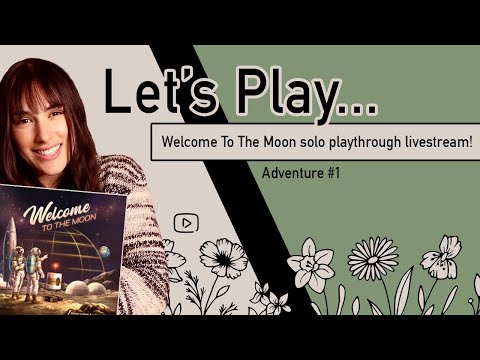
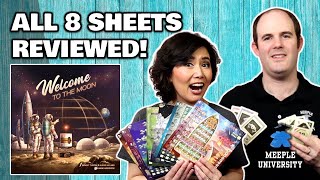
What separates Welcome to the Moon from a single-board flip-and-write, according to toally tabled, is that it packages an entire campaign into the box across eight different maps, each with its own twist on the shared card system. The Board Game Garden walks through how the solo mode layers on top of that: instead of two players each taking a card, a solo player draws three cards and hands the one they do not use to an AI opponent, who scores it at the end, so part of the tension is choosing which card to deny the AI rather than only optimizing your own sheet. That channel also notes the AI ships with several difficulty levels that change how many points it scores per card type, which is how a first play at level two still ended in a close 62 to 64 loss.
The Welcome to the Moon Experience
Constant second-guessing as the cards flip
Tabletop Tolson describes the moment-to-moment feel as frustratingly delightful, since every new flip of three cards brings a fresh round of wondering whether the pairing just taken was the right one, followed by relief on the rounds where the choice lines up perfectly. Rolls in the Family echoes that same tension from the other side of the table, saying the game includes a bit of push-your-luck as your board gets more constrained, so a player can choose to lock in an action they want even while knowing it narrows their options going forward.
A tight half hour that still wants a rematch
Rolls in the Family says the whole experience usually plays out in about half an hour or less, and credits that pace along with the simultaneous flipping for giving the game an addictive quality. Tabletop Tolson goes further, saying a single sheet of Welcome to the Moon tends to leave a player feeling a little unsatisfied on its own, and that the design seems built to pull people back into the next board in the eight-sheet campaign rather than to be a one-and-done play.
What Makes Welcome to the Moon Stand Out
One card system, six very different boards
The Dice Tower sums up the appeal as six games in one box, praising how the same flipped symbols get reused across multiple maps to produce a totally different feel and totally different things to explore each time. That channel contrasted it favorably with Sonora, a dexterity-driven roll-and-write it wished had been expanded with more boards the way Welcome to the Moon was. Ilia and Tyler make a similar point about value, calling it a lot of game packed into one box and recommending it to anyone who already enjoys the wider Welcome To series.
A solo mode built to scale
The Board Game Garden singles out the range of AI difficulty levels as one of the best things about the solo mode, since the same opponent card behaves differently depending on which level and scenario is in play. toally tabled agrees that the solo mode holds up on its own, describing it as solid with scalable difficulty and an opponent that behaves differently depending on the scenario being played, on top of a campaign built from eight distinct maps.
Potential Drawbacks
A space theme that will not land for everyone
The Board Game Garden is the clearest voice on this point, saying space is simply not a theme they gravitate toward and that it makes Welcome to the Moon a game they often find challenging to get excited about compared to other entries in the series. The same channel found the solo objectives genuinely difficult on a first play, only completing one of three and losing by two points to the AI.
A six-player cap and a genre some are already tired of
Rolls in the Family points out a practical limitation next to the original Welcome To: the base game has no real cap on player count, while Welcome to the Moon tops out at six unless a group buys multiple copies. toally tabled adds a broader caveat, admitting that flip-and-write and roll-and-write games in general are a genre that channel is largely done with, even while calling this particular entry one of the favorites of all time in that category.
If You Enjoy Welcome to the Moon
Rolls in the Family draws the most direct comparison, weighing Welcome to the Moon against Welcome To, the original game in the series, and concluding that the only real reason to reach for the original is if a group needs to seat more than six players, since the base game's pacing could also end before the most interesting part of a session arrived. The Board Game Garden makes a similar in-series comparison, saying they love Welcome to Your Perfect Home even more than Welcome to the Moon, largely because its housing theme suits them better than a space setting. slickerdrips, ranking games in a head-to-head bracket, pitted Welcome to the Moon directly against Feast for Odin and, after saying they loved Welcome to the Moon so much, still gave the final edge to Feast for Odin's larger box of interlocking systems.
What Reviewers Are Saying
"There's also that on the other end, on the other side of the coin is you get the really perfect. You're like, this is lined up and then that really, oh my gosh, this is the easiest choice ever. But more often than not, there's the friction of that fewer and fewer dwindling choices as the game gets closer and closer to its end when you really have fewer and fewer spots and you need those Hail Mary long shots and you just don't get them."
— Tabletop Tolson
"The Moon takes the formula and puts it through a bunch of different variations across kind of different boards in the game, and it just has such an addictive quality to it. The rhythm of the game is just so nice because you're all playing simultaneously. You flip those three cards. It's which of these three pairs of number and action do I want to use, and then the game has this great arc of, as you're going, your board is getting more constrained."
— Rolls in the Family
"I've always enjoyed Welcome to the Moon, but obviously I don't love the space theme. If you've been around on the channel, space is definitely not a theme that I gravitate towards. So I often find it challenging to play this one."
— The Board Game Garden