Deep Regrets - 5 Things to Know Before You Play!
Games in This Video
1 game is featured in this video — it unlocks as you watch.
Transcript
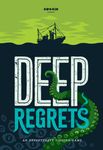
Deep Regrets is what's on our table. Ryan and I just played it and we wanted to share with you not only a little overview of the game, but we wanted to give you five things to know before you play Deep Regrets so that you don't have Deep Regrets for playing it. Okay. Uh, no, there's some little things that we want you to know, but just to give you a quick overview of what the game is. This is a fishing game, so it could be viewed as a fishing simulator, but it's got a Cthulhu vibe. If you're familiar with the video game Dredge, very much inspired by that. You're going to be choosing to either go out and fish on a day or go to port. When you go fish, you can kind of push your luck. More on that in a second. To go down deep, you're going to get some normal fish or what they call fairish or fowl, which are more of the Cthulhu based things. You're going to bring them back to port, sell them off, gain more equipment, get points from all the fish that you've collected by the end of the game, maybe even put some in a trophy case, things like that. Uh, and hopefully gone mad or not gone mad, depending on which way you want to go, right? That's a pretty succinct explanation. I mean, all all of that is what's is basically what's going on. And they do like a lot of people have called this a pusher luck game.
They call it a pusher luck game. And while I will say it does have pusher luck, don't come into this expecting like traditional pusher luck. You're not going to these decks of cards and like digging through and flipping and flipping and then saying stop before I bust. No, this not like Quacks of Quiddlin burn or like blackjack where you're like flip seven. Yeah, it's not that kind of push your luck. So, you need to know going into it. The game utilizes this depth system and that's where a lot of the luck comes into play. Now, if you look at this board, and while you're looking at this board, I do want to point out just how how great this looks. I mean, let's start with that. But you probably already know that if you've already got it set up. So, yeah, it's a great looking game. It has a nice cartoony look, but also kind of a really creepy cartoony look that really fits things. But like Ryan said, the first thing we wanted to tell you is, is there luck involved? Yes. Is it traditional push your luck? Maybe not.
It's more of like a riskreward thing like Ryan alluded to. You could go deep, but what you're risking there is you're going to encounter more foul creatures. So, if you encounter more foul creatures, you're going to take regrets. It's a big system in the game. As you take regrets, it's going to be tied to gaining more madness. Now, again, gaining more madness is not necessarily a bad thing. More on that in a second. One of the big warnings and the next thing we want to talk about uh that you really should know is that if you feel that you want to build up a big turn in this game because there are things you can do to gain more dice and sort of set up like okay this round I'm going to take a bunch of actions and do all these things and that can happen but it can also be foiled because the way the system works around the table if you're the last person to pass. So, if you're playing a four-player game and three people have passed and it's on you and you still had several things you wanted to do, you can only do two of them because you get two more turns at the end of that. So, particularly in a two-player game, if you set a big turn up and the other player goes, "Oh, I'm going to spend all of my dice to get this one big fish. I'm done. I pass on my next turn." If Ryan was expecting to do four or even five more things, you know, catch a bunch of little fish, things like that. There are some interesting ways where you can catch fish and use a lifeboat to go back to port and do some things. There's a lot of stuff to do at port. So, if you haven't done those and you only have two turns left, you're going to get caught without being able to do them. So, just
be warned if you want to set up a big turn. It may or may not happen. Yeah. I mean, that's a big crux of the game is deciding when you're going to go back to port, when you're going to come out to the deep. And when you come out to the port, there's a bunch of stuff you can do. You can do each action once. And there's like five, six things you can do in the port. And like David said, that whole riskreward, the re the reward of coming down to the third level, the third depth is getting some huge fish that are worth a ton of points, have some cool abilities. You can eat some of the fish that you catch, and some of them have really powerful abilities when you eat them. But the re the risk is that you might not have enough dice or you use all your dice. So, if David goes to port thinking he's going to do every one of those actions, and I've caught one big fish in past, you have to choose the two of those because, as you see at the top here, there's a number of days.
And you can play a long game or a short game. The short game takes off one day. And that's what David and I did. And actually, my third tip is play the long game. Yeah. Honestly, I I feel like they say you can play a shorter game. It didn't shave off a ton of time. We don't think it shaved off a ton of time because your early turns are faster anyway. But what it did shave off was an opportunity to go to port. And I think there's a flow here, and you'll see when we talk about our next tip, why it's important to get to port early. And they do give you this card that you can use to go back to port at any time. But when you're only playing five days or four days as opposed to 5 days, I mean, you you miss that fifth day. Well, five versus six. Five versus six. Five versus six. And if you uh it just disrupts I think the natural cycle that the design wants people to experience in terms of how many times they're going to be at sea, how many times they're going to be at port because in a shorter game you are far more likely to use this lifeboat so that you can get to port one more time than you normally would. The other thing we want to talk about while we are at port is the equipment. And we want to say that all fishing equipment is not built equally. You've got rods, reels, and supply here. And you're going to have an opportunity to interact with these when you're at port. You can only interact with one shop once. So the rod once, the reel once, the supply wants while you're in port. When you interact, you can mitigate things. You could just spend $1 if you've just got $1 to spend and take the top card of the rods and you get what you get. Don't throw a fit.
Uh or you can spend more money and dig. you get like for instance the top five cards and you can choose any two of those to keep. Like I don't know if all these decks are like this, but I know the real deck has 10 cards in it. So if you spend $5, you're seeing half of them. And like we said, some of these things are far more powerful than others. These are not like, oh, it's all balanced. And I think that's by design. It's not by a mistake on the part of the designers. You want to get there early and get you want to get there early and get the better one. For instance, Ryan had the rod of infinite that allowed him when he cast to catch fish. He could look at the three cards off the top of the deck where he was fishing and choose one of those effectively. Put them back in any order. There's another rod that does the exact same thing, but two cards, right? So, literally, when we say that it's not all created equal, it's not just like you can argue that some are better than others. There are literally multiple versions of the same effect and some are just better. Yeah.
There's reels that let you set your dice to a value. And there's reels that let you reoll your dice and hope for a better d value. One of those is obviously better. And the first person to get to port and get to choose those is probably going to have a little bit of an advantage. So if this is your first game, I'd say you want to get to port early. Getting a rod and reel can really help you. If you wait till like Friday to get your rod and reel, you're going to say, "Man, I really could have benefited from this for all the fish I caught over the last couple days." Yeah. And the last thing we wanted to mention is madness. Madness. In this game, if you've just read the back of the box, you might think, "Okay, you don't want to go mad. You don't want to take regrets." That's not exactly the case because if you go mad and you read the rules a little bit more, and particularly after you play, you'll see Ryan went very mad. In fact, he was actually all the way down. 13 of these cards, these uh madness cards, red cards. I had one in the end. Now, the madness has a couple effects. One, whoever has the most madness at the end of the game, and this is probably the most punishing part of it, has to lose one of their trophies. If you're playing with more than two players, they have to lose their highest value trophy. And the trophies are fish that you've put in your trophy case. They're going to have a multiplier, so that they can be some pretty big points. Um, but even in a two-player game, you're going to lose one of your trophies, and that's it's not fun. It hurts. Now, the upside though is if you go really mad, you're going to be rolling a ton of dice and you're going to want to shift over from like looking for fairish to those foul fish. You kind of want to go the Cthulhu route, if you will, and try to get some
of those really creepy things that you're pulling out of the ocean. Uh because they're going to be a higher value because there's modifiers for the values when you sell them and for the points at the end of the game. Yeah, I think it's good to note right from the start of the game if you find yourself getting a lot of these cards, a lot of these regret cards. And if you especially if you've used your ship, if you use your lifeboat, it turns into a 10 value regret card that you can never get rid of. If you find yourself getting these instead, you can like what David did was he found a bunch of ways to mitigate that and get rid of them. Or you can just lean into it and say, "Okay, well, I'm going to take advantage. I'm gonna stop looking for the fairish. I'm gonna start looking for the foul fish. I'm gonna get more points at the end of the game. Although, you're going to get less points for trophies." Now, in David, in in my game, I went the full madness route and he didn't. And while I did ultimately win because I had so many foul fish by nine points, it was nine points because he had so many points in his trophies and I had to get rid of one. And so, I think that the the trophy cost, all of that cost, like the the points you're getting is affected.
So, he was getting plus two to every one of his fairish and he had three fairish whereas Yeah, I'm getting, you know, plus two to mine, but I only had two right up here at actually I had a fair one. Yeah. because I didn't follow that advice because when we first started I put one foul and one fair because I wasn't sure. I thought I would maybe into the middle but I ended up ending full madness. So I kind of lost some points by doing that. I think it's okay to commit. And the thing is in a four-player game if you have two players going full madness both trying to get that 13 plus madness. You just have to have less total madness than them. Yeah. So if they have madness or madness value which is when you add up all the the points on these deep regret cards. So, you know, you could potentially reach that point and still keep all three of your prizes if somebody just had maybe more cards than you over the course of the game. And there is probably the biggest element of pushing your luck in this game, which probably comes, like Ryan said, in more of a higher player count game. But that is Deep Regrets.
There's a few other things about the game that we wanted to go into. It does look really cool. It's got an interesting interesting sense of humor. Uh, I wanted to point out one of these. Here's one of the things you can catch. It's a human. Uh, this is a foul card, by the way. Also, the example of character art, uh, the double-sided player boards. You've got Bert on one side, you've got Burp on the other side. So, all of one side are sort of the human characters. The other ones are, I guess, more of the foul creatures. They don't have any sort of impact or anything on gameplay. But the game is really, really fun. Uh, it's got a lot of luck in there. You can mitigate it. There's mitigation. Uh, but I think what it sets out to do, it does well. If you have any questions about it, please make them in the comments below. We'll get down there and answer whatever we can.
Until next time, make sure everyone has fun at the table and we'll see you then.