Schadenfreude | How to Play | Learn to Play in 5 Minutes! | A Unique Trick-Taking Card Game
Games in This Video
1 game is featured in this video — it unlocks as you watch.
Transcript
Hello everybody, my name is Ilya.
name is Tyler.
Together we make up Colory, a couple that loves to play board games.
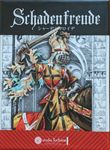
And today we'll be teaching you how to play Schadenfreude.
Schadenfreude is a three to five player game designed by Studio Turbine and published by Office Dog who helped sponsor this video.
Let's go to the table and let's learn how to play.
As always, you'll begin by setting up. Place the score tracker in the middle of the table. Each player chooses a score marker and places it next to the tracker. Then each player takes the matching reference card and flips it to the side matching your player count. Next, you'll prepare the deck depending on the number of players. In a five player game, you'll use all 50 cards and deal 10 to each player. With four players, you'll deal 12 cards to each player and place the remaining two cards face down off to the side. And with three players, you'll first remove the -2, -1, and nine cards of each suit from the game. Shuffle the remaining cards, deal 12 to each player, and place the final two cards face down off to the side. The player who most recently laughed at another's misfortune becomes the lead player and you're now ready to play.
In Schadenfreude, you'll play through a series of rounds trying to score the most points without ever going over 40. Each round, you'll take turns playing cards from your hand matching the suit played if you can. Together, these cards make up a trick, but instead of the highest card winning the trick, the second highest card wins. Winning tricks earns you cards that make up your score at the end of the round. Get as close to 40 as you can, but go over and you're out. Now let's dive into the details of the round. To begin a trick, the lead player plays any card from their hand. The suit of this card becomes the lead suit for the trick. Then, going clockwise, each other player will play one card from their hand. If you have a card matching the lead suit, you must play one of those cards. If you don't, you can play any card instead.
Once everyone has played, you'll determine who wins the trick. Only cards matching the lead suit are considered and rather than the highest card winning, in Schnapsen, it's the second highest card that wins. Any cards played from other suits do not affect who wins. And if there's only one card matching the lead suit, that card wins automatically. Now, there's also two special jester cards in the deck, the zero and the 10. These can be played at any time, even if you have a card matching the lead suit, and they always count as part of the lead suit. For example, if red was led, and a red four, red seven, red nine, and the 10 jester were played, the 10 is now the highest card, making the red nine the second highest, and therefore the winner.
If a jester is used to lead a trick, the next standard card played determines the lead suit instead. Now, once you determine the winner, you'll figure out which cards they collect. The winner always takes the card they played, placing it face up in front of them. They'll also take any non-jester cards that did not match the lead suit. All other cards in the trick are discarded. If everyone followed suit, you would simply collect your own card. There is one important rule when collecting cards, though. You can never have more than one card of the same number in front of you. If you collect a card of the same number as one you already have, both cards are discarded, regardless of their suit. This can also happen when cards are collected during the same trick. If you collect two cards of the same number, discard both of them. And if you collect three, you'll discard two and keep one. So, throughout the round, the cards in front of you will change as you collect new cards and potentially cancel out the ones you already had. The player who won the trick now leads the next one, and you'll continue playing this way until everyone has played all of their cards from their hand. At that point, the round ends. It's now time to score.
You'll add together the values of all the cards remaining in front of you. Then, move your score marker based on your total. It is possible to go backwards on the score track if your score is negative, but your score can never go below zero. If everyone is still at 40 or below, you'll play another round. Gather the cards, prepare, and deal them again just as you did during setup. This time, the player with the lowest score will lead the first trick. If multiple players are tied for the lowest score, ignore those players. The player with the next lowest score leads instead. If everyone is tied, choose a lead player at random. And that's the game. You'll continue playing rounds until at least one player ends the round with more than 40 points. As soon as this happens, the game ends. Any player who scored more than 40 points is eliminated from winning. Of everyone remaining, whoever has the highest score at 40 or below wins the game.
If multiple players are tied for the highest score, those tied players are eliminated as well, and the next player with the next highest score wins. This does mean that it is possible for nobody to win the game. And finally, there is one exception. If every player goes over 40 during the same round, the player with the highest score wins instead. And that's Schadenfreude. If you have any questions, leave them in the comments down below. We'll get back to you as soon as we can. And of course, if you found this video helpful, make sure you hit that thumbs up button. Hit that subscribe button if you're new here cuz we love talking and teaching board games. And hit that little bell cuz you know our next video's coming out. We can all partake in the joy of board gaming. Now, for our question of the day, tell us a word that many people don't know.
Ooh.
And tell us what it means cuz we can share the information. How fun is that?
Yeah. Let us know your answers down in the comments below, but until next time, we'll see you later.
Indubitably.
Bye.