TDG: Midway Solitaire
Games in This Video
1 game is featured in this video — it unlocks as you watch.
Transcript
Hello ladies and gentlemen and welcome to the discriminating gamer. You know, I had to fire my fruit delivery guy yesterday. I hate to let the man go, but he was driving me bananas. Ladies and gentlemen, today we're going to go ahead and take a look at Midway Solitaire from Worthington.
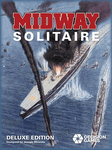
In Midway Solitaire from Worthington Publishing, the player takes on the role of the United States Navy as it attempts to thwart the plans of the Japanese in June of 1942. This is another one of Worthington's kind of travel solitaire games. It's a very small game, a very simple game. Uh what you do is essentially you put out a grid map of the Pacific Ocean. And what you're doing is you have a Japanese board that illustrates the three different combat groups they have. You've got the American board which represents the two task force task forces that they have. And you of course put the corresponding units on the board. You've got task force 16 and 17 which are comprised of different carrier groups. And then you also have a Midway uh aircraft token that you can potentially use to bomb the Japanese fleet. Now, the Japanese, as I say, they have an Alaskan invasion force, their carrier strike group, and their Midway invasion force.
Now, in addition to that, on the board in various places, you have Japanese submarine icons that are coming into play in these different grids. And you also have red grids that are essentially danger zones representing other surface ships, other Japanese military assets they had in the Pacific at this time. You also kind of have a blue line in the west, which are in the east rather, which indicates the kind of furthest extent of the Midway uh air patrol group, those air bombers that are coming off of Midway Island. Now, for the task force boards that you have, each American task force has three extra fuel that they can burn. Normally, they can just move one space per turn, but they can they do have the option three times in the game to burn extra fuel in order to move two spaces. They each also have two long-range attack tokens.
Now, the first thing you do when you play this game is you actually select a scenario. The in the the game box uh the game rulebook rather has different scenarios that you can do. Perhaps you're trying to just sink the Midway invasion force without losing any of yours. Maybe you're trying to sink all three of the Japanese forces without losing any of yours. There's all sorts of different uh scenario conditions that you can play. So, you you decide what you're going to play for at the beginning. Now, what you're going to do, the very first thing, is you can move your units. So, as I say, you can move your task forces one space. Now, they can move orthogonally. They cannot move diagonally. But you move them all one space. Again, if you want to spend the extra fuel tokens, they can move two spaces. Then, you can place the Midway aircraft anywhere uh east of the blue line. You place that anywhere on the board. Now, the next thing you're going to do is draw a card from the action deck. Now, this is going to have a lot of information on it. The first thing it's going to do is tell you how the different Japanese units move. They may move, you know, forward and up. They're generally going to be moving in an eastward direction. Uh but you essentially you just follow them left to right, top to bottom, where they're going, what they're going to do.
Sometimes it may give you specifically, you know, like I said, they move left, up, down, north, south, whatever. Uh if ever they're at an edge of a you know, of the board and, you know, if they're top of the board and it says move up, you just do the opposite. You move it down. So, you just do opposites when they're at the edge of the board. But there may be some that say move toward this task force or move toward this objective, in which case you just take the shortest ability shortest route to move it toward that that space. Now, the next thing, if there's any kind of events to resolve, you go ahead and you resolve those then. And then finally, there may be hazards. Now, as I say, you sometimes will have your task forces in these spaces that have Japanese submarines. If you draw a card that says, you know, submarines attack, uh you go ahead and you roll a die. And on a roll of five or six, these Japanese forces will do one damage to your task force. Now, if you are in the danger zone, those are those those red hex uh squares, if you're in one of those and you draw a card that says danger zone on it, same thing. These Japanese surface ships spot you, you have an engagement, you roll a die, on a five or a six, you take a damage. Critically, with submarines and danger zone attacks, the United States forces don't strike back.
When you move, if you move your units into a in into a space with Japanese units, nothing happens. You can move into that space, you can move through them, nothing happens. But as the Japanese move, when they move into a space that contains one of your units, either your task forces or your Midway aircraft, then you have kind of the the the combat there. Now, if they move into space uh the the Midway aircraft, you get a free shot at them. You can roll on a five or six, you do damage to them, they don't shoot back at you. But, if these ships are in the same space at the end of the Japanese turn, you have ship combat. And essentially, how ship combat works is you do two rounds of fighting. You essentially uh roll the die uh for the Japanese to see if they get any hits on you, any fives or sixes, and then you roll the die to see if you get any hits on them, five or sixes, and you do that two times.
Now, if ever a Japanese ship ends its turn adjacent to one of your task forces, you can spend one of your two long-range attacks in order to attempt to attack the Japanese planes. You have to spot them first, what that means is you roll a die. On a one to four, you spot the Japanese and you can engage them. On a roll of five or six, however, you have some issues and it causes damage to your own task force. Now, if you successfully spot the Japanese, you can go ahead and engage them in one round of combat, which means they've spotted you, too. You roll a die to see if the Japanese do any damage to you, then you roll a die to see if you do any damage to the Japanese, and again, hits are on fives or sixes. Now, if ever the Japanese ever reach any of their objectives, either Alaska, Midway, or Hawaii, uh the game immediately is over, you lose. If ever both of your carrier groups, or one, depending on the scenario, are destroyed, then you lose.
But, if you can succeed in fulfilling the specific scenario objectives, then you win. Midway Solitaire. We'll get back to the review in just a moment. I want to take a minute to ask you to check out my other channel, that is Cody Carlson, PhD, where we talk about history, books on history, military history. I even post some of my uh lectures for my classes on there. Please check that out. Please subscribe to that channel, and now, back to the review. All right, ladies and gentlemen, Midway Solitaire. Now, this is one of these travel games, these small-box travel games that the that were the Nintendo has made, they made a lot of them lately. And I got to tell you, uh I've liked them all, I've enjoyed them all, some more than others. But what I love about them is they are all very, very accessible and and relatively simple to learn and easy to play and quick but they tell great stories.
Very abstracted but they're still fun and they're still nail-biters and I really, really like them. Now, this one I was really excited for it because I love kind of the the carrier battles. I love games about the carrier battles. They did a book war game for the Coral Sea solitaire a while ago that I love. It's probably my favorite of the book war games. And this one is a lot of fun. I really liked Midway solitaire. Uh Midway solitaire, again, just tells these great stories in a very easy to learn, easy to play manner. But I love how I mean, the first part of the game, the first few turns is pretty much just I'm going, they're going and we're we're kind of maneuvering here. And you don't know exactly where the Japanese are going to end up. So you do almost get that kind of frustration of you got an idea where the Japanese are but you don't know where they're actually going to be and you're trying to get them to battle, you're trying to bring them to battle. And so I really like that aspect. I think it does a good job of kind of, as much as it can in this kind of a game, simulating a fog of war.
So I really like that. I like to the fact that, you know, you've got dangers like the danger zone, the submarines that you got to watch out for that are just these kind of free Japanese attacks if the card draw goes in their favor. So I, you know, I like that and sometimes you got to go into those submarine waters. You don't want to but you've got to. And so it's if that's always fun, you're always kind of, okay, what's going to happen? And then the the die roll. And very tense and very fun. And I really like to the decisions of using those long-range attacks when you got the opportunities because again, there's a, you know, one in three day danger that you're going to take a hit, but there's an opportunity there and even if you get the opportunity, you're still going up it's still a die roll to hit them and they get a die roll on you. But really, you've got to bring these guys to battle. That's the name of the game. You've got to hunt these guys down and bring them to battle and it's and it's fun. It is very very very fun. Um the cards the card plays fun seeing what the movements are going to be of the Japanese and you know, great artwork and and and some of the [clears throat] events that play out kind of can screw you up and that's fun, too.
This is just a really really fun solitaire game. Um I I I'm going to go ahead and I'm going to say it. Out of all of these small box World War solitaire games that the Worthington has done, this one is my favorite. I loved it. The first game I played of Midway Solitaire, I just played the the easy games to learn it. And I won it. And I'm always a little leery when I play a solitaire game or a cooperative game and I win on the first time like uh Is it easy? Is it too easy? So I'm like nah, I played the easy mode. So then I decided well, I'll play the the next one. And boy, I'll tell you that next one they got [snorts] me. Uh they managed to sink um one of my task forces and I had to keep my both my task forces afloat. And it it is fun. This is great. Every every game of this I've played as I say it just they tell great stories and I really get sucked into them and they're nail-biters.
Worthington, I don't know what it is that Worthing how Worthington does this, but they keep making these games that are light, that are quick, and are incredibly fun. And this one is. Like I say, my favorite of these small box Worthington games. Really like this one. It it was just tremendous fun. On the Cody scale, as a solitaire game as a light solitaire game, I'm going to give this a nine out of 10. It was fun. I could just keep playing this game and playing this game and playing this game. It is great. I'm looking forward to playing it again. Talking about it right now. I want to play it again. It's so much fun. Uh so that is uh Midway Solitaire, nine nine out of 10. Thank you once again for joining us today on the Discriminating Gamer. As always, uh I'd ask you to please leave a comment here on YouTube, on BoardGameGeek, on Facebook, on X. We'd love to hear what you have to say. So please, please, please leave a comment.
We ask you to please like this video and subscribe to this channel if you haven't done so. And if you do like what you see here, I would ask you to check out my other channel, that is Cody Carlson, PhD, where we talk about history, books on history, fun things like that. I even post some of my lectures on there. It'd mean the world to me if you would subscribe to that channel as well. And, ladies and gentlemen, if you do like what you see here on this channel, I would humbly ask you to click on the Super Thanks button and leave a tip. You know, I asked my iPhone what I should do if I feel sleepy in the middle of the day. Apparently, there's a nap for that.
Hey Cody, knock knock.
Who's there?
Cody.
Cody who?
Cody's an idiot.