Dirt & Dust - We Just Played It!
Games in This Video
1 game is featured in this video — it unlocks as you watch.
Transcript
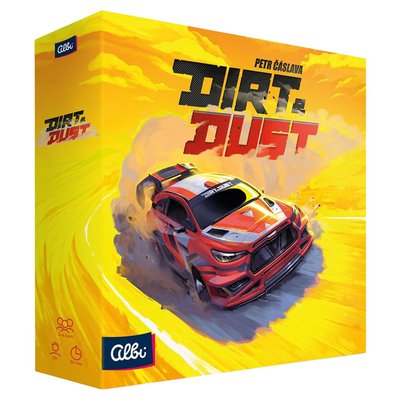
Ryan and I just played Dirt and Dust. This is a game that came out at Gen Con, and we actually talked about it in our Gen Con preview, not having full knowledge of the game at the time. I think for me anyway, there is quite a bit more deck building in this than I anticipated. Um, and while it is a racing game, it is not a traditional racing game.
It's not I I wouldn't even say it's a racing game. What What it is, it's
a game about racing.
It is a deck building game about racing. And I think if it's a cool theme for a deck building game, but it definitely, like David said, feels more like a deck building game than it does racing. If you're looking for some kind of head-to-head racing game where you're blocking your opponents,
they're moving cars on a track.
This is not that game. In fact, I'm going to say right off the bat, there is almost no player interaction in this game whatsoever. In fact, it's a simultaneous play deck building game. So already that's going to maybe push you in one direction or another as to whether this game is for you or not. But I like that style of gameplay.
Yeah. And I think also because of the fact that this is rally racing, it does lean into elements of that theme because you might be thinking like, well, there's no track, there's no interaction. Is this a racing game? Like we said, it's about racing. But the way they leaned into the theme there has a lot more to do with some of the behindthe-scenes things in rally racing, like planning for the race, which is a big part of it. In fact, you have kind of like a co-pilot navigator and they're going through a book and they you've studied the track and you're like they're telling you what to do. If you've ever played a video game that's rally racing, there's a voice saying like, "Oh, long easy left."
Uh that's evident here because that's effectively what you're doing in this is taking the stages of this track that you're on and being prepared for them. The things you do on your turn, among other things, is create traction. and you're going to spend that traction to sort of like, okay, I'm prepared for this coming up. It doesn't even need to be the next part of the course. It can be a later one, but you're prepared for it. And that's how you're going to score points.
Yeah, that primarily that's how you're going to score points. Every time you complete one of these stages, you're going to score points. And it works in an interesting way. You're kind of looking ahead at the track. And at the start of the game, it's going to be pretty full of cards. But every time you get to the end of a round, meaning everyone's done everything they're going to do, you'd look and see who has actually planned for that aspect of the course. Meaning, have you planned correctly for that turn? You have to spend that currency, but you're going to get points. Your points are going to be dependent on where your car is on this giant playerboard in front of you. Each section of this playerboard is kind of divided into different points. And as you play cards and as you kind of plan for these different track segments, you're going to be sliding all over. So, while that isn't maybe necessarily the same as moving your car on a track, it has that feeling of like peeling out and drifting over the turns and like some some of these corners are going to force you all the way to the end and then you got to find a way to resetting yourself.
So, a lot of what you're doing in the game is not only just preparing for these track segments, but also mitigating some of the things these track force you to do. Yeah, you're going to have to sort of adapt to what's happening. And like Ryan just alluded to, you don't necessarily want to stay the course and have a nice boring race because there's two points here. There's speed points, which are the points at the end of the game. But then there's also popularity. Popularity, you're going to get more of that if you push things to the edge. So if you're out here on the edges of your board, things like that, you're going to go up the popularity track. Why do you want to do that? Well, at the end of the game, whoever's highest on that is going to get some points. Second place gets a point. But throughout the game, whoever is leading that gets a bonus die to roll. And that brings me to what you do in this game every round. And every round is uh represented by each one of these stages. Players are going to roll their die. You're usually going to roll three of them. And then you're going to place them across the top of your board.
In this case, I have three sixes, but let's say I had two sixes and a three. Then all the players are going to have a hand of five cards. You'll have drip drawn up to five cards at the end of the prior round. And then when you take your turns, like Ryan said, you take these simultaneously. Now, when we've played the first game we played, we took our turns once and then we went simultaneous. But you really will really find that simultaneous play is the way to go because there's a puzzle to be solved here for sure. Every single turn you're doing, you're like, "Okay, how can I puzzle this out?" In fact, like more than any other racing game I've ever played, for sure. You're trying to solve a puzzle through playing cards, through activating those cards by using the dice that are above them. Again, there has to be dice above them to activate them. Uh by interacting with these stage cards by spending some of the traction that you've earned out there to use them. And when you place a traction token on here or one of these markers, you actually get to do the action of that card. And like we've already discussed, it preps you. So when that card does ultimately score, you will score it. So I could actually spend one out there knowing, okay, I'm not going to score that card for a while, but I really wanted to do this, which these things are going to manipulate your car around this playerboard here.
Not to mention give you some potential bonuses.
Yeah. And that puzzle you're trying to solve isn't just about generating the traction to move up this track. You're also wanting to generate wrenches, which can be used for a variety of things. Most of all, to buy new cards. Now, this is a game that uses a market. And there's actually for right now in the base game, two different markets you can choose from. So, two different sets of cards. I could see an expansion easily coming out that introduces more markets. But you're setting these up and these are all the cards that you're going to get to buy to add to your deck. So, this is in that way feels like a traditional deck building game, but in this way does not. So, cards that you buy go to your discard pile. And you might be familiar with discard or uh other deck building games where you play a card, you do its effect, and it goes straight to your discard pile waiting to be cycled back in. This game does not do that. You might notice that there's all these spaces with arrows. When you take a card and you play it, you're choosing where to play it, and it's going to stay there. The end of the round, it's going to move one space and then one space all the way until it's eventually discarded.
Now, that means that you can put cards that you don't love at the one spot, and that means they're only going to be around for one turn. But if there's a card that you really want to keep using, you can play it on that six, and every round when it slides down, you're going to get another chance to activate it, which is where these dice come into play.
Yeah, it is really interesting that dynamic that exists between the cards and the dice because you can activate them a lot of the actions on those cards with the dice. Some of the cards, like the Ryan, the one Ryan just played here, has this yellow background area. That one you don't even have to have a die above it. You can utilize that. It's called a passive effect. Now, he put a marker on that because all the passive effects when you use them, you put a marker on them. You can't use those for the rest of that round. Now, at the end of each round, those markers will come back off and he'll be able to use that again. But you don't need to die, which is interesting because like Ryan said, if you put it down here at the six, you don't have to worry about what you roll. You'll always be able to utilize that passive effect. And some of those can be very interesting. And in fact, we didn't mention this, but the game has four different racers. So that your starting cards are a mix of cards that everyone has and then like four or five cards that are unique to your driver that let you do incredibly different things and have a very different experience. I had a character that let me manage these collision die. These dice are things that are going to come into play. For instance, when you need two traction, you can just take one of these die. You get two traction, which is great. You need traction to get out here and mark these cards. But then you have to roll the dieice and take damage. The damage is going to move your damage marker. And every time the damage marker gets to the end of the track, you flip over the next damage token. And these damage tokens or effects effectively, make it trickier to play the rest of the game. The first one makes it so you slip and slide a little bit more than you might want to. The
next one makes it so the cards are a little bit more expensive. Up to including things like, oh, now you don't draw. You don't have a hand size of five, you have three hand size of three. That's not great in a deck building game.
Yeah, but these powers, these these player powers or these these certain drivers that you're playing all do want you to play a very specific way. My guy wanted me to call out cards and he generated or she generated a lot of wrenches which was by power. Whereas David, you were able to like just not even really worry about your collision dice because you could like ignore the collision dice. And then there's two other characters we haven't played with yet that have varying abilities as well. All of these abilities and all of these cards that you're going to buy and the starter cards all kind of form your deck as you're playing. But the real goal here is to play cards in specific ways to gain not only just these two currencies, but also manipulate where your car is on this track. You're seeing that there are these yellow and these red spots on the side. Anytime that you're in this yellow, you're going to unlock a lot of abilities on cards that require you to be in the yellow. And then if you're on this red, instead of getting points every round, you're getting popularity on this popularity track to eventually maybe get that other die. There's also ways to earn these red dice, which is something I did a lot with my my play that you can roll and then add out to the board as well to kind of extend your turn.
All of that is designed, all of this card play is designed to increase basically these two stats because really that's what you need in the game. you need to buy cards and you really need traction or else you can't complete some of these planning cards and you're leaving a lot of points on the table if you do that.
Yeah. I mean, that's probably the most basic and simplest way to explain it is get a lot of wrenches, get a lot of traction, those two currencies while at the same time not, you know, crashing. Basically, managing your car such that you're not wildly going potentially off the ends. We never did this in our game, but if you do go off the end, it forces you to take one of your collision dies, roll it up, and add it. I didn't mention this earlier, but when you take a collision die and roll it, you take the you suffer the damage, right? Then you might get some popularity because you're being a risky driver, but that die remains with you until you might do something to repair it. And there's not a lot of options to repair it, although you can repair them. What that means is at the beginning of every round, in addition to the normal dice that you roll, you have to roll all the collision dice you've taken. Now, like Ryan said, my character let me, it seemed like it was incentivizing me to be a little riskier. So, I right from the start, I took two of those things. I got my traction up. It allowed me to plan some of those cards early. So, then I didn't have to really worry about planning these stages as much for my next few turns. So, I kind of shifted towards trying to manage the collision die. And like you said, I had a card that allowed me if it were out and I had a card that allowed me to basically ignore these collision die or effectively make them blank so I didn't have to take any of the damage. So, it was a really interesting and exciting sort of take on a thinky game that's about racing.
Yeah, it's it is very thinky. I mean that like it's very thinky which is why we said you really do want to play this simultaneous because you can get into some some
maybe some AP situations because what you're doing on your turn you're doing it in any order. So like you can choose to play a card and then activate that card which might discard a card from your row which then lets you put a new card there which maybe then can be activated or you can spend these wrenches to change the die and go up one. And now maybe I want to use this one, which is going to move my car to another level. Now that my car is in the lower level, then I can start spinning traction to move it left and right. So there are a lot of different combos that you're going to kind of see here. And the characters themselves want you to play a specific way. Those specific cards for your driver are going to all kind of
be kind of based around one thing. And if you play them together, you're going to start to see how they synergize together. You're going to look at cards out here that synergize with what you're already doing. My character, like I said, could call cards out, but then my passive power, my main power, was that I could look through my stack of called out cards and pull any one of them back and just put it on my board. So, I had this insane amount of flexibility where my deck was really thin, but I had a reserve of like five or six cards at one point and I could always have, as long as that card was out on the table and I could activate it, I could always pull exactly what I needed and put it exactly where I needed it to go. And I tried to really lean into that power. And I felt like solving that puzzle or like feeling like, okay, I figured out how to get my traction and I figured out how to get back here and I figured out how to get up to the four, so I'm getting four points. It just leaves you feeling really good.
Yeah. And I think if you're sitting there thinking like, "Oh, that does sound thinky. It does sound like we mentioned AP." I do think it could lend itself to maybe some AP players really trying to think out every single detail. I mean, both of us did that at times, for sure. Sure. Um, so there is a solo game. I do think the game is designed, it feels a little bit more like a game that's that puzzle to solve like many solo games are. Um,
yeah,
I we haven't played it at more than two players, so I It went pretty quickly at two.
Yeah, it wouldn't go a ton longer with
I don't think it would go a ton longer as long as everyone was playing simultaneous and no one was getting too much AP. Now, the upside of that is that it lent itself to some incredibly big satisfying turns. But I'll caveat that by saying this game is a bit of a roller coaster because some of our turns were crazy. Like I had some like the one that Ryan was just describing was like, "Oh, I could do this and I can move my die." When you solve the puzzle by doing all those little minations, it is very satisfying. Now, on the flip side, there were some turns that were like, "Oh, I I I just can't do
I roll I roll three dice. I get six wrenches. That's my whole turn. Okay.
I can't solve the puzzle. So, I have a very sort of like maybe more mundane turn for sure." So, there's going to be some ups and some downs. And what we at least also found in our play here, uh, is
it didn't ramp and ramp and ramp and ramp. I actually went out fast quickly and then it was kind of all downhill from there. And by downhill I meant it became a little easier for me.
Coasting.
But yeah, literally by the end uh the last two rounds of the 10 rounds, I was right here in the center of my board where you're going to get maximum points. I'd placed all my markers on all the cards. So there it was I didn't have to manipulate this car back and forth because I'd had markers on all of these. And these are really some of the very few ways to manipulate your car. And if you're in the center, then that's good. Um, so I didn't find myself doing any uh things on the last two turns other than like, well, there's nothing to do with my car here. The only thing I could do is really like look for wrenches so I could buy a couple points out here, which also felt a little anticlimactic because those are cards in the last two rounds that I'm probably never even gonna see. I was literally just buying points.
Some of them have point. Yeah, the points are useful. But see, I was the opposite because I didn't have the ability to generate a ton of traction like you did. We actually both scored all 10 of the there's 10 in in the game that we played, which we should mention this too. We didn't mention this. There are multiple different track layouts. There's like five different track layouts and each layout is a deck of 10 cards and you're going to lay those out and then you're going to go through them in order. We both scored all 10.
For me, it was uh
it was a struggle to generate some of this traction. It was
like I was not you were at a point where you had like four of them done already. You were like I can just do nothing for the next four rounds. For me it was always a fight to get that like I placed the last one like everything I could do to generate just four traction that turn I did. And again I did feel really smart when I when I figured out how I could get to that like fourth traction.
Well I think also too and I don't know this to be the case. we've only played it once, but because the way you paced yourself may be reflected in our final score. Because while I sort of, like I said, went out strong and then kind of petered out towards the end, that might not be the best way to ultimately score points the whole time because I wasn't buying these cards as much as you were early on. And I'd gotten those out there. So, it kind of like brought an artificial end to my game, whereas you kind of like paced yourself the whole time. That was maybe a little more stressful.
It was It was pretty stressful. And I really relied on that power to like return cards from my call pile to like just barely get I like, you know, a lot of these cards, again, we didn't mention this part of the puzzle. A lot of these cards are going to do different effects if you're at the top or at the bottom. If you're accelerating or deacelerating, your cards might give you different things. So, it's becomes a puzzle of like, okay, well, if I can only find a way to get my car back, then I get two traction instead of one. Oh, I do have a card in my discard pile that I can then return or not my call pile, whatever, that I can then return to drop myself to de accelerate. Yeah, it felt good to to solve that. It felt good to find that little loop. But I can see this game there might be people that don't want to just sit here and puzzle over your board, right,
until you find that perfect solution. But that works for me.
Yeah, I think some people are the lack of player interaction in a racing game, which I don't have a problem with personally. In fact, if you look at a lot of racing games, there's not like a ton of player interaction.
Sure. I mean, like Formula D has pretty significant player action. Downforce has So, it just depends on on the game.
It depends on the game, but it's not like vicious, you know, there's not a lot of racing games out there where you're like trying to crash each other.
Thunder Road Vendetta, maybe. Maybe Thunder Road. There you go. Uh, but there's not a lot of that. And the fact that it's sort of a different thinking person's game about racing for sure
and but it's a cool thing. I I do want to that's the last thing I want to say. It is a cool theme for a deck building game. And if you like rally racing, there was a lot of love I think put into
this game. Even though it's not like necessarily a onetoone thematic, but all the cards are named after like parts of a rally car or different moves you might do. The idea of like how these tracks work and the guy talking in your ear telling you, "Oh, there's a, you know, hard turn coming up." Like you got to prepare for that hard turn. And it just feels like this this was made by fans of rally racing.
Yeah. And last thing I want to say too is you might look at the table here and see a ton of different icons and feel a little overwhelmed. Now I will tell you there are a lot of icons. I don't want this to scare you off because in our first play I mean we did have to reference this a couple times but it's not there wasn't anything in here that felt like incredibly obuse like well that doesn't make sense or like but
instead of going through all of those and explaining you to you what these do which would take forever. I just want to say this gives you a sense for all the different ways that you can kind of like find and solve those puzzles because some of these icons I never saw in my game, but Ryan did and vice versa. So, you're going to find your routes to victory or at least your routes to points in a few different ways. And I think we alluded to this earlier, but we were pretty close. I mean, Ryan ended up winning 38 to 33, but our games couldn't be more different from
and look at look how much damage you took over the course of the game. I tried to mitigate my damage. I only hit that damage marker one time where you've you were just like you said earlier, I think playing kind of fast and loose.
I was I was playing fast and loose. I had some cards there were some actions out here and I had some actions on the cards that let me repair these so I could ultimately put those dice back. And I did have all three of them back at the end of the game. Otherwise, each of those is worth negative one point. Um, but while I did so, I had to suffer these penalties. And these these did start to get a little rough. I think I would have preferred if I stopped shy of the three card one.
You probably could have bought a few more cards if you would had two extra cards every round, but
Exactly.
You know, the number of cards you have in your hand is is your flexibility. If you only have your three dice you're rolling, you're only activating three cards anyway. So, like it's not the end of the world necess and plus all the cards that stick. I I I think we didn't stress that enough. The fact that a lot of these cards stay out and just move down, meaning like you could activate them turn and turn and turn again, it makes this stand out versus most deck builders.
Yeah, it was really interesting. That was an interesting dynamic. And the fact of the matter is while we were playing, it wasn't until late in the game where I realized at a certain point I was like, because there's some cards that let you also when you activate them, wipe your row.
Oh, yeah.
And there was a couple times where I'm like, well, I have these three dice. I have this card here. I don't want to activate these two cards. Oh, you know what? I'll activate this card because one of the things I could do is wipe the row. We didn't mention this, but you don't have to do all of the actions on the cards. You can do some of them. If you do, you can't do part of an individual action, though. But one of the actions was let me Okay, I'll do this. I'll take all the good things from that card and then I'll get rid of the rest of the cards that open those spots up to maybe play a couple cards out of my hand that might have done me a little better.
That's interesting. That's again, that's a big part of the puzzle. It's just interesting. So many different solutions, so many different ways you can find to just get what you need to to get done.
Yeah, I'm interested to see how the other courses work. Like Ryan said, there are five main courses. I think there's a six which is sort of the trial course where you're you're only playing five rounds and it's like a little simpler experience. You actually don't use the the drivers, which
I would always use the drivers. Such a cool part of the game.
Ryan and I usually disagree on this. I usually say, "No, the first game you should probably do this." This one, if you're a gamer, if you're watching this channel, um, I think you could use one of the normal courses and you could also even use the player. In fact, I you definitely want to use the player powers.
I think if you didn't use the player powers, you might be walking away from this game going, "Okay, like I I don't see the hype."
It's definitely a much more
It's a different experience.
It's a much more special game using those driver powers, for sure. But if you have any questions about it at all, please make them in the comments below. We'll get down there and answer whatever we can. Until next time, make sure everyone has fun at the table and we'll see you then.