Fountains | How to Play | Learn to Play in 8 Minutes!
Games in This Video
1 game is featured in this video — it unlocks as you watch.
Transcript
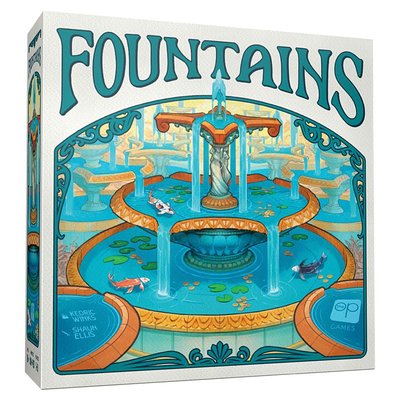
Hello everybody. My name is Elliot and my name is Tyler. Together with makeup coy, a couple that loves to play board games. And today we'll be teaching you how to play fountains. Fountains is designed by Kendrick Winks and it's published by the off games who help sponsor this video. Let's go to the table and let's learn how to play. As always, you'll begin by setting up. Each player will receive a starting fountain tile, a reference card, a wooden scoring mele, and three matching point tokens. You'll then place a base and board in the center of the table. You'll separate the fountain tiles by shape, shuffle them, and randomly draw a number of each according to your player count. You'll place each stack of tiles face up next to the basin board, matching the icons on the board. You'll then shuffle the bonus tokens face down and place five face up on the basin board, leaving the face down tiles nearby. You'll place the green, blue, and white basin ponds on the matching color spaces on the board and place the pond we tokens in the pile within reach of all players. You continue by placing the scoreboard next to the basin board and have each player place a scoring mele on the start space.
You'll keep your score tokens in your play area. Now, if you wish to play with advanced variant, you'll shuffle the 12 fountain design cards and draw three face up next to scoring board. The rest of the cards will not be used for the game. For your first game, we recommend you use these cards. Finally, you'll choose a starting player. You'll give them a swan token and you're now ready to play. Fountain is played in turns. Each turn, players will move upon and take a new tile to add to their fountain. You want to be strategic in your construction, ensuring water flows from jets across the many pools of your fountain. You'll aim to have many pools, fish, and lily pads in order to shine as the best fountainer. The game will end when one of the stacks of tiles runs out. You'll finish so each player has had equal turns, score, and the player with the best fountain wins. Now, let's go in depth through what a player's turn looks like. Each turn will consist of two actions, drafting and placing tiles.
When drafting, you'll choose one of the three basin pawns and advance the pawn clockwise one, two, or three spaces. You'll skip over any spaces with other pawns, which means you'll end your movement on an empty space. Now, where you land is which tile you will take, either the fountain tile or the bonus token if you end up in the bonus token space. Now, you're on to the second action of your turn, placing tiles. When adding fountain tiles, you need to follow three placement rules. Number one, a tile must lie beside another tile or completely on top of any number of tiles, but your newly placed tile must be fully supported by other tiles or simply be placed on the table. The second placement rule is at least two dark bricks on the new tile must touch two dark bricks on the existing tile in your fountain. And the third rule is once placed, the tile may not be moved.
Now, let's talk about some of the features and how they work. Jets are essential for your flow. They'll help you score and maintain a pristine fountain. Water will flow from the jet as long as there's a connection between the fountains. Water will continue to flow on the flat level, or it can flow down, but it may never flow up a tile. Now, pond weeds come into play when a portion of your fountain is not fed by a jet or if the water flow is cut off. Pond weeds are immediately placed on all pools affected by this when placing new fountain tiles. They may be removed as soon as the water flow is restored in a future turn. Pond weeds will restrict the specific fountain features from being scored until a token is cleared. We'll show you an example when we talk about the rewards. Speaking of rewards, let's dive into them. Let's speak about the other features as we discuss scoring points and obtaining the rewards.
Rewards are triggered when you place a fountain tile with coins or when any player ends the movement of a basin pond on its matching color space. Scoring always happens at the end of the player's turn after tile or token placement. Let's talk about the tiles with coins first. Immediately after placing a fountain tile with coins, you'll score five points as long as there is water flowing to the pool with the coins icon. The coins will only score once and only when placed. If restricted by a pondweed, the coins will not score, even if the pondweed is cleared at a later turn. Now, let's talk about the pawn placement rewards. Each color and symbol will score differently. This scoring again is triggered when one player places the pawn on its matching colored space. The scoring will apply to all players. Let's start off with the pools. When a blue pawn ends its movement on the blue space, players will score points for the pools in their fountain. Each player will count up the total number of pools in their fountain with water flow. Now, a pool is defined as any instance of water that is surrounded on all sides by bricks at any level as viewed from top down. Let's count the pools in this example. Now, once everyone's total their number of pools, you'll receive points based on your ranking compared to other players based on this chart. If there is a tie, all tied players will score the higher number. Non-tied players will receive the ward of their pool rank. Also, if playing with two players, the player with the most pools will score seven points, while the other player will score zero. Fish. When the white pawn
ends its movement on the white space, fish are scored. The player who triggered the scoring will declare the color of the fish that will receive points, red, white, or black. All players will count the total value of their fish and move the score marker accordingly. You'll also notice there are wild fish in the game. These count for each of the colors. Now fish are rewarded based on their level in the fountain. On the first level, the tiles on the table, each corresponding fish will score one point. Two points will be scored for fish on the second level, three on the third, and so on. Here is a scoring example. Lastly, we have lily pads. When the green pond ends its movement on the green space, players will score their lily pads. You'll identify the single largest group of lily pads in your fountain. A group here is all lily pads in a set of adjacent pools that are connected by water flow as viewed from above. Each lily in a group is worth points equal to the level it is on, similar to how fish are scored. Here's an example. Awards aside, let's end off by talking about the bonus tokens. When you move your pawn and claim a bonus token, you can either place it on an existing feature in your fountain or the darkened space present on any of the tiles. The bonus tokens will simply add more features for your accountants to help you score more points. If later you place a tile on top of a bonus token or tokens, they're removed from the game. Also, after taking a bonus token, you'll replenish the space with another one from the face down tokens. Now, you'll keep playing,
taking turns, building your fountains until any stack of fountain tiles or the supply of bonus tokens is depleted. Once this happens, you'll continue playing the current round so that all players have had the same number of turns. Now it's time to claim the final rewards. You'll first score your ponds, liies, and fish one last time. For fish, you can choose the fish color you want to score for your own player board. After this, if you're playing with the advanced variant, you'll score each of the cards. These grant you points for various conditions in your fountain as listed on the card. Each card is fairly self-explanatory, but if you need any support, feel free to leave a comment down below or reference the rule book as it does have a handy guide. Now, after all the scoring, you'll check the position of your scoring meeples. The player with the most points wins. If tied, the player with the least pondweed tokens wins. And if still tied, the player with the most bonus tokens wins.
And that's fountains. Oh, so much gorgeousness. Is that the sound they make? A fountain, maybe. Okay. Well, if you have any questions, leave them in the comments down below and we'll get back to you as soon as we possibly can. And if you found this video helpful, make sure you hit that thumbs up button, hit that subscribe button if you're new here, because we love talking and teaching board games to folks just like you. We sure do. Now, for our question of the day, if you were to design a fountain for the centerpiece of the town square, Mhm. what what would be the feature of your fountain? Would it be multiple spouts? Would there be a big figure head in the middle? What would it look like? Would the water be blue? Mine would have two otter resting at the very top just on their backs. Would they be holding a little pebble? Holding up holding shells probably. And one of them maybe is holding something up and then the water's coming out of it. There you go.
Done. That's incredible. Easy. Let us know in the comments down below and thank you so much for being here today. We'll see you in the next one. Bye. E.