Ra: The Dice Game & Rheinlander | Kickstarter Board Game Review
Games in This Video
2 games are featured in this video — they unlock as you watch.

Transcript
Thanks for joining us for another Tantrum House crowdfunding conipion. Today we're looking at two games coming to Kickstarter from 25th Century Games. Raw the Dice game and Rhinelander.
And as always, we want to make sure you're aware that our crowdfunded videos are sponsored in part by our own Kickstarter backers as well as by the creators of these games.
Hey gang, thanks for joining us at Tantram House Studio 3. I'm Will Meadows
and I'm Sarah Meadows and today we're looking at two games coming to Kickstarter on the same campaign from 25th Century Games. We have Raw the Dice game and Rhinelander. Both of these are designed by Dr. Riner Conitia and art is from Ian Oul.
Now we're going to give you a quick overview of both of these games. So, let's get started by taking a look at Raw, the dice game.
On your turn, you will roll five dice. If any raw symbols are rolled, they are added to the raw track immediately, while the other dice can be rolled up to two more times.
Players will use the symbols they roll to go up on the different tracks and mark areas that they have achieved.
A symbols are wild, but they must be used with other symbols. Just like in the original game, once RAW reaches the end of the track, the epoch ends and the board is scored.
Each time you score, the player who's highest on the Pharaoh track gains five points, but they'll move their marker back two spaces. The player with the least will lose two points, but they gain a space.
Players only score the Nile if they were able to flood it this epoch by rolling three rivers at once. They'll gain the points of their other marker on the track and then their flood token will be removed.
Players need at least three civilization dice rolled to mark a space here. Negative five is awarded for not having any civilization during scoring, but up to 15 can be gained for having all five spaces marked.
Monuments are not scored until the end of the game. Players may place a cube on an empty space matching the color of the dice rolled. If a player wants to play an additional monument that turn, it costs two more dice, and that cube must go in a column where they have no other cubes. Each column with your cubes will gain a point, and 10 points were awarded for having seven columns and 15 for all eight columns. Plus, each column that has at least three of your cubes will also score additional points. If a player manages to roll four or five raw dice, disaster strikes, meaning you get to determine the punishment for all the other players.
Yeah. So, when you roll four or five raw, they you can choose which section of the board, the pharaohs, the Nile, the civilizations, or the monuments that you will then cause all the other players to either remove cubes from the board or go down those tracks. So, it hopefully will give you a little bit of chance to catch up um because you didn't get to move anything on your turn.
So, in the over the course of the game, you're going to play three total rounds and then obviously you'll score again everything at the end of the game. Whoever scores the most points will win. All right, so let's go ahead and shift real quick. We'll start talking about Rhinelander.
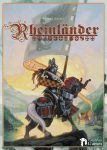
Rinlander is an area influence game for two to five players. Now, it's a redesign of the original game which was published by Hasbro way back in 1999. The new version of the game will feature a two-sided board to better balance your game based on your player count. It also now allows for only two players to play the game.
In the game, players will play a card from their hand and either place an influence token on that numbered space,
or they can play any card to bolster their area, adding a token beside one of their already placed tokens as long as it doesn't touch another token. Whenever a duche is created by two or more adjacent tokens, the player who has the majority will place a duke.
And anytime that power shifts in the game and a duke is replaced, the old duke will get to score his territory before being shoved out.
The score will be based solely on the city tokens, castles, which will be turned over to the new Duke, and churches, which will also ship.
Whichever player in the game controls the majority of churches will also gain the power of the bishop. This powerful token allows you to displace other tokens on the board if you play the matching card.
The game plays until one player has placed all of their influence tokens and then it ends immediately.
Players will tally up points for all of their cities, castles, and churches that they control. Each duke on the board will be worth five points and so will the bishop
and the player with the most points wins. This new version of the game also features a number of expansions, including a boat that will travel down the river, giving players additional options for placing their influence tokens.
It also features new goal cards that players can claim as soon as they've achieved the requirements
and new landmarks and power cards that replace the power of the bishop with unique abilities anytime you control the token on the board. Now, we've never had the opportunity, unfortunately, to play the original Rinlander. I've heard people talk about it and say things like it was one of Canitia's most elegant designs, uh, except for the fact that they didn't like it at certain player counts. And so, obviously, the new version is going to feature that double-sided board, which is going to fix things for your lower player counts, which I think is pretty clever. Uh, all the new art from Eno Tool really makes it a pretty beautiful package. Uh, and the gameplay experience, I'll be honest, was more it involved more things than I think you can anticipate just from the description of this game. So, one of the things that I didn't get when I just read the rules for the game was how much sandbagging was going to kind of happen with your cards. You've got those cards in your hand. You've placed your characters out on the board. You've got control over certain areas. And you don't want people to get the two numbers on the either side of your territory because you don't want them moving in on your space. The way the deck works in the game is that you'll play cards until you draw up to the joker and then you'll reshuffle the deck immediately. And so there's a lot of strategy just in holding on to cards so that other people can't get them. And there [clears throat] were lots of little strategies like that that I didn't see coming when I sat down to play the game.
Yeah. One thing we didn't mention about gameplay is every player will have three walls that you can put up. They can't go in the river uh but they can go on spaces to block territories or duchies from merging with others. So you can kind of block off your spaces. Um there's a lot of points to be had by gaining lots of little areas that you control and not necessarily one large one. So that may affect how you come come into playing the game.
We also didn't explain that during the setup you're putting out those tokens randomly on the board. So, it's going to really up your replayability because if two of the churches end up right next to each other and you can control them separately and suddenly you've got the bishop and you've got a lot of power to be able to stick to boost other people out of the game. Uh there are some interesting things that can happen just based on how the tokens lay out on the board.
Yeah. But then somebody can come on and merge territories together. So then you might end up losing control over certain things. Um, and control is going to shift uh and other areas of the board throughout the whole game. And you can gain lots of points by having your area taken over by other players.
Right? That is the main way to score points in the game. You kind of think, "Oh, I want to have control of this area and I want to keep it and have it the entire game. However, if you get it turned over at the right times, you're actually going to score a lot of points by other people taking your territory." And so if you can have that happen a couple times early in the game and then get a bunch of of your dukes out on the board late in the game. Uh lots and lots of different ways to score and win in this game. Really interesting stuff. If either of these two games sounds interesting to you, you've got to check them out on Kickstarter right now. Uh see all the stuff that's going on in the campaign, stretch goals, all that good stuff. Uh 21st Century does a really great job of putting together some really nice packaged games. You don't want to miss out. Check them out. Now, thank you guys so much for tuning in, liking all our videos, following along here at Tantrum