The ULTIMATE Board Game MAZE! - Scribbly Gum Review
Transcript
Are you looking for a game that draws you in? Maybe you're someone who enjoys connecting the dots. In this video, we look at an amazing game which has you acting like a moth larvae and scribbling on gum trees. One late Australian afternoon, the bush called out for me. Eucalyptus leaves crunched beneath my feet as I felt a line tug achingly at my heart. This call fluttered like a moth's wings deep within me. Tree sap coursed through my veins, taking control of my hand, leading me in. I looked for a path, or maybe even a sign that would point me in the right direction, but I could not understand the language.
Then, I discovered my objective. What sort of game was this? A euro of some sort? I laid it all out on the line. It unveiled a story of nature's true writing, a game to be deciphered with time. And that, I certainly had.
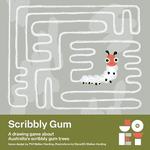
Scribbly Gum is a flip and write game that is going to be played across three rounds, and the aim of the game is to try and collect the best combination of food to score the most points possible. In the base game, players are going to start from one of the four dots in the center of their map. They're they then going to grab their eight direction tiles, shuffle them up, remove one, and then one at a time they're going to flip over a direction, and starting from any of those four dots, they're going to draw lines on their map and gather one of the three different types of food resources: blossoms, gum nuts, or leaves. If a player lands on a water drop, it acts as a wild resource and players can choose which one they want to eat. There are different types of pathways and networks that this game offers players. First of all, you've got these squiggly lines that allows players to go orthogonally, up, down, left, or right. And then you've got these dotted lines which are only able to be traveled when a dotted action tile is revealed. In that case, those dotted lines allows players to reach parts of the map a little bit more quickly and efficiently that they wouldn't be able to do so if they just followed the regular directional arrows.
So, what is the aim of the game? The aim of the game is to collect sets of three different types of food resources. By collecting every set of three resources, you get one meal, which is worth one point. Those meals are scored at the end of every round and are accumulative. So, the more sets of meals that you get across the game, the more points you'll be able to accumulate by the end. If you're playing with the advanced mode, you'll be using three of these objective or achievement tiles. Basically, these achievement tiles provide you with conditions that players are competing for. It might be getting at least 12 nuts on your meal tracker filled in first, or it might be filling up the end column of your map entirely. Whichever player completes the particular achievement first gets the points, and the second player to achieve it gets the points printed on the silver side, which are a little bit less than what the first player would get. Additionally, at the end of the game, if you manage to fill out an entire column of a particular resource, you'll get three bonus points added on, and you'll be able to fill out multiple columns if you plan your routes strategically and effectively. As players fill their meal tracker throughout the game, they'll be filling them from top to bottom.
Occasionally, players will reach a resource that is outlined by a black-bordered star. That star means that you can have one free orthogonal action once you fill that particular spot in. So, part of the beauty of this game is creating little chaining combo paths where you gather two gum nuts, which then allows you to reach the next black gum nut star, which then gives you a bonus movement point. And if you can accession that movement point to get you to another resource, which allows you to reach the next black outline resource star from another column, meaning that you can kind of steppy stone your way through the game, which will be able to maximize the amount of distance you can cover on your map and do so really quickly. Another interesting strategy that I discovered is that knowing the composition of the action tiles and how and when they occur will give you a big advantage in the game. Now, one of these action tiles is randomly removed each and every round, but when you've kind of revealed about three or four of these action tiles, you can pretty much predict which moves are coming next, and that can be utilized to create a cool strategy. That means if you've lined up your pathways to a certain point where you're waiting for a particular direction to give you those two leaves that you desperately need or that extra resource that will give you that extra move on the meal track, means that you can kind of formulate an advanced plan.
And having that advanced plan means that you can kind of predict where your network will reach and connect to next. Obviously, there's still that element of chance that that one tile that you think is in there may be that one tile that's been removed, but there is a lot of guarantee that you can have in the destiny that your little moth larvae can fulfill. Hey, wait, dude. I think there's something stuck at the bottom of my shoe. It could be gum.
So, what are my thoughts on Scribbly Gum? Well, Scribbly Gum is a game that definitely hits its target market, and that's families, new gamers, and people who want to play a very light flip and write game. And this game definitely scales very well from one player to as many players as you wish to play with. Now, I know there's a classroom version of this game, and as a school teacher, I really enjoy games like this. Ones I can play with big groups, but also invites uh discussions for game strategy involving maths as well as logistical planning and chance and data. All of these elements create for such a great discussion. The fact that it's married to this cool Australian biological theme is one that I also definitely connect with, too. I actually really enjoy this game at the solo and two-player count. Solo because the challenge is always often varied, and you're always trying to beat the score that you've got. And the games fly by very quickly. I'd say they take about 15 minutes all together.
But at the two-player mark, I really think this shines quite well because you've got this extra sense of competition. And at the two-player level, I definitely recommend using these gold achievement tiles because you're trying to fight for um those conditions and those points. And those points are really going to swing your game quite heavily. And I know that if one person manages to nab the yellow side, and the other person doesn't manage to nab the silver side, then the game can really shift in that person's favor. I really like this head-to-head competition element because not only are you trying to configure and work out the pathways on your board, you're also trying to look over at your partner and opponent and go, "Ooh, how have they been able to achieve those those goals using the same sort of directional movement patterns?" And I think that's where uh the game really shines is when you can kind of connect the pathways together, and it gives you that same satisfying feeling as if you were creating a dot-to-dot picture. It's got this mindfulness level to the game, and that's what the game is trying to do is to create this kind of cool, relaxing mindfulness experience, and I think it does that very well. So, there's one thing about Scribble Gum that I'm absolutely in love with and it's this kind of pathway connection system. The idea that you're trying to collect the three sets of resources, as well as that you're trying to reach these star-shaped resources that give you extra turns. And I think that combination of building the right pathway and navigating your way through the bark in the gum tree makes
for an interesting puzzle. In terms of developing a strategy, the set collecting element of the game is probably the part that I find most puzzling and enjoyable. The idea that you can't really heavily invest too much in one resource, but you've got to kind of diversify across the three resources to keep accumulating points cuz you score the number of meals across all three rounds means that you're going to have to keep in check with all of the three different things that you're collecting. If you're collecting way too many leaves, you might need to shift your strategy and collect more gum nuts or even blossoms just to balance things out. Where were you the night that the board game was stolen? You can't fool me. Look, I found your plans. What is this? An escape route?
Now, the game itself comes with two maps, the Kuringgai map and the Maroolah map. And I've noticed that there's a big clear difference between both maps. The Maroolah map really has uh players starting at the bottom of the map and there are lots of little dead ends that lead to a triple resource that are scattered across the actual game board. Whereas on the other side, the resources are distributed a little bit more evenly. We can get a triple or double resource if you head to the very corners of the map. Now, an interesting strategy that I've discovered in this game is that whilst you really want to get to the edge of your game board map, the edge of the map can actually restrict where you go further on. So, if you accelerate way too quickly to the side of the page, whenever you draw a move left tile, move right tile, that can really severely impact the freedom and flexibility of how you craft the next point in your path.
In terms of my thoughts on the limitations, I would say that the game may be too simplistic for people who are really into heavy Euro games or heavier strategy games. The theme is a little bit abstract, but it definitely works and marries well with what the game is trying to communicate. Um but, I think this game definitely has a sweet spot at the family level. What I really love about Australia is the fact that we have so many different Australian plant species, in particular different types of eucalyptus trees. And different eucalyptus trees actually shed their bark a little bit differently. Some of them have these strings that kind of come on. Some have this little patchwork look to them. And that's just basically the tree growing. It usually happens uh during summer. And what you'll see here behind me is that all of these eucalyptus trunks are actually quite white, and that's because they've already shed most of their bark for the season. We're kind of at the end of summer here at the time of filming of this video. I really love the little patchy patterns on this one. But, if you look over here, you can see that this one is completely all peeled off, and there's like a fresh layer underneath. And if you look carefully, there's still remnants of the old uh bark from last year still hanging around. They're actually all on the ground.
And considering my final score, if you're a family gamer or new to the board gaming hobby and want something casual, then this game it would be about a 7.5 out of 10 for me. If you're someone who's a little bit more experienced with gaming and you're looking for something heavier, this probably isn't the game for you. But, it definitely has that uh Phil Walker Harding touch to it. A lot of the wrinkles in the game feel nuanced, and a lot of the cool little micro decisions that you make uh definitely make this game stand out from the other flip and write. Now, if you really found this video helpful and you really like my content, please consider subscribing to my channel and liking this video and share it with your friends. Uh maybe one day we can have a cool conversation and if you really want to uh share your thoughts, please let me know by writing them in the comments section below.
Otherwise, you can head over to my Patreon page and support me there. This is Danny signing out. I hope your next board game is a cool, amazing, and fun experience cuz I look forward to seeing you again soon. Goodbye.