Tokaido - Review
Games in This Video
1 game is featured in this video — it unlocks as you watch.
Transcript
Welcome to Allies Are Enemies. I'm Jess and I am Sean. And today we are talking about Tokaido and specifically the new edition of Tokaido. And our copy was provided for review, but the thoughts in this video are all our own. And Tekkaido is a one to five player game designed by Antoine Baoza. And you are travelers going from Kyoto to Ido. Let's take a look at how it plays. You start the game with a traveler, a few coins in the long road to Edido, waiting ahead. On your turn, you can move as many spaces as you want as long as you stop at the next inn. And then you take the action of whatever space you stopped on. These include the shop, which lets you buy items that you want to collect into sets. The farm, which gives you three coins, the temple, which lets you donate coins for immediate and endgame points, the hot springs, which gives you either two or three points, panoramas, which let you add to one of three different vistas. Encounters, which provide a random effect based on the other locations, and finally, ins, which work like checkpoints. and let you buy food for points. After a player takes a turn, whoever's the farthest behind will go next. And this will continue until everyone stops at the last inn in Edido, at which point you score for the temple and for final
achievement cards for most shop items, most hot springs, most souvenirs, and the most expensive meal. And then the greatest traveler is named. So that was the overview of how to play. And the core part of the game is really the movement system and choosing how far you want to go on your turn because you can go like way ahead. You only have to stop at the end. So you're choosing like, do I just go to the next available space or do I want to jump ahead? Yeah. And in our first games, we really thought, well, let's just go to the next available space. And I bet a lot of people do that, too, cuz you think, I'm just going to take as many turns as I possibly can. And that kind of works at first, I guess, if like everyone does that. But pretty soon, you realize like within a few games really, that there's a lot more to it than that is sometimes it really is smart to jump ahead and to like focus on places or to take places away from other people and that pace becomes a bit more interesting. Yeah, there will definitely be some spaces that you want to make sure you land on.
Like one of the spaces might be the space where you get three coins because money can be really tight and at the end of each round you stop at the inn and you're really going to want to make sure you can afford the food there because that's worth six points which is a decent amount of points. Oh yeah, six points is a huge chunk. really need to get the meals at each one. And it's tricky because if you get to that in last, you have last choice of the food. And the food ranges from$1 to $3, which is a huge range in this cuz usually I've got like $2 to $4 in my bank at any one time. So, it can be a thought of do I jump ahead to that end to get cheap food or more often, do I jump ahead to those money spaces? And Jess often will try and block those money spaces. But what can happen is one person's blocking the money spaces, then the other person's blocking the buying stuff spaces and just like fine, have all that money, but you can't do anything with it. And so I like that part of this game, too, that there are these really different routes.
Yeah. And I think it took us a few games before we really realized that there were a few different routes. And sometimes it's even just doing a little bit of certain things. I will say that if you are collecting panoramas, you want to try and finish at least one of them because the last panorama card is worth the most points. And if you can finish first, it's worth even more. So, you'll certainly, if you got a choice of a couple panorama spaces, be going for the one that may finish it up. Yeah. Yeah. The the big one, the sky one, or the sea one. The sea is the last card really is worth eight points. So, that's a ton of points. but also like the item sets are worth quite a bit and it's worth sometimes just getting the uh the spa cards which are just that's just free points. So, you don't need to spend any money. It's no like building up to anything. It's the same thing too with the gifts which just kind of give you they give you something from one of the other things. You're not sure what it is, but again, it's just a free bonus.
And both the spa and the they're not souvenirs. Those are both worth three points at the end of the game for whoever has the most. So, you do want to be looking at what other people have all of the time. Yeah, you're very much evaluating that to see if maybe you can beat them to the panorama card or have the most of something in comparison or just block the space that they desperately want. And it is tricky though because if you really want to block a space, you may jump too far ahead and then the other player may get to take like multiple turns before it's your turn again. Yeah. And I think one of the things to talk about here and let's just jump into player count. Um but I think for player count, one of the the key things is just how much that dynamic changes. Because if you're playing this at three to five players, you're going to have a whole bunch of people on that road and there's going to be more people to possibly push or you're just going to be like you're going to sometimes be forced to jump ahead a bit. Although at four and five that extra space opens up. So there kind of is a bit more space. But at three I find I think that's really where like it feels really tight in there and you really do need to jump ahead to make sure you get the stuff you want to get.
Yeah, it's I think you're right. I think three is the tightest because you don't have that second option that presents itself for some of the spaces, but it does feel different at all the various player counts in particular at two players, which is the player count we've played the most because there is a two-player variant. And how that works is there's another pawn of a different color and whoever's furthest ahead on the track gets to then place that pawn, which is really interesting at a two-player game because you will often use that pawn to block a space that your opponent might want. You'll exclusively use that pawn to block. The pawn just becomes a jerk. They're like the jerkiest possible player. They don't get any points. All they're doing is blocking each other. And it does make it a little bit more worthwhile of pushing the pace a bit because then you take over that pawn and you can stop the other player from stopping at each one of those spaces. And so I do like that the two-player game almost feels like the meanest version of this game because you get to move that that third kind of bot player. Yeah, you are very much paying attention to what your opponent has and specifically trying to stop them. Whereas at more players, you're not going to be paying as close attention necessarily to what everybody has and what everyone's doing. So, the solo mode is the main addition to the Stonemer version of this
game and that's made by Atoma Factory and it's run by a deck of cards and it's fairly simple. You're playing against two bots. Every time it's one of their turns, you're going to flip a card. That card's going to dictate how far they can move. Then where they stop is decided by how many cards they have in each one of their rows. So as they go, they're going to make these columns and whichever column they have the most cards in, that's going to be their preference because they're going to score for how tall that column is. So if they put their fifth card, they get five points. It's pretty simple, but it means that you can kind of see what they're aiming at like you would with a human player. You would see, oh, they're going to focus on getting the the different goods or items, whatever the black cards are. So you can see that that's what they're doing. And so you can kind of think about where they might go. But sometimes they're a little bit tricky, too, and they move to the money spaces or the temple spaces or they even rush ahead to the inn. And so I think they're very very lowmaintenance, but it does kind of play like a game. And we found that it's interesting as well to use it to players. So I like I like this very simple version where you use that bot to just move back or not bot, but use that kind of dummy player. But this makes it really feel like kind of a four-player game. Yeah, it is interesting playing with them in a two-player game and making it feel like a four-player game.
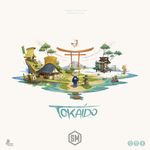
They are a bit more upkeep, but not too much more. And I think one of the key interesting parts is the temple because I do think the temple at two players isn't that interesting because you can pretty easily get first or second. Yeah. and they one of them whooped us that they had so many on on that temple. But um they're actually pretty competitive too. I found this in both the solo and the two-player. The solo I think I just barely beat it. The two-player one of them Taiu for second place overall, but they were pushing pretty well. And there is also a deck that changes their difficulty as well that just kind of it's really simple. It just gives them an extra one of the cards in each one of those columns. And you can add them to like each column if you want. You can randomize that as well. They've got extra cards that do that. So, you can raise that difficulty. But even at like the lowest difficulty, they were they were definitely a challenge. So, let's move on to components. And there are a few differences with this version, but if you're not familiar with Takaido, it is the same art, and that is a selling point. It all looks lovely. The board is really nice and clean, but has really good visuals. The cards all look like really pretty. And it is part of the journey is you're collecting these like memories of Japan. So, it is really nice that the cards look so lovely. Yeah, I
think that's always been such a selling point of Tokaido is the the look of Tokaido has been such a big reason why it's sold so many copies. And this version does have a few little tweaks. So, I think one of the fair and I I have not played the original version, so I just I've read this on the internet, but I know one of the complaints from the earlier ones are that the panorama cards were a little bit lower quality, I believe. And I they may have been a different shape. I'm not positive, but those now have been kind of knocked up a a level. All of the card quality here, it's really nice. Um, really there's not a big problem with any of the components. There's also a little bit more clarity. Whereas it used to just be the icons, now there is some writing on some of those cards that just need a little bit more to it. So, there's some stuff for the endgame goals, also for the different characters on the back of all of those. It explains what it does on the front. Yeah. Although I will say the I really appreciate the simplicity of the board, but we found that where you're supposed to actually stop is a little bit confusing and so we prefer to stop a little bit above the space and it's so minor but it like for something that should be really intuitive, we definitely got that wrong our first few plays. Yeah, if you look at if you've seen the photos that this whole time we're always standing right on the icon cuz that just made sense to me.
Apparently, you're supposed to stand on the little dots that are in between. We never did that. And it feels it feels a bit too jumbled when you do that. There is like there's a dot for the four and five players there. You can have two people on the road and then there's a dot that's a little bit lower down. But I just I I like to stand on the icon. You know what? I'm just going to keep on doing that. But I think in general, it's fairly easy to see everything. There is also a little bit sometimes between the panoramas, especially the um the one with the snow and the one with the ocean or the mountains in the ocean. Those two icons I really have to like take a close look at and the hot tub gets a bit mixed in with those. I think you get used to it, but your first few games I do think you're going to have to like really take a close look at the board. And I also really like that the character cards have a hole in them that lets you put your player color in.
And speaking of those characters, it's interesting. It gives each player a like asymmetric power and that's going to make the game feel different every time you play for every character you are. Yeah. No, there's a lot of replayability just because of that because those powers are fairly strong and often I think we feel like I think this one's broken. But I don't think we I I would be interested to see kind of what people think is that tier list of those different characters. But it is interesting cuz some of them give you like the food cheaper or they make the the souvenirs feel a lot better or all the different aspects of the game. Yeah. And some of them very much tie to a specific place as well. And the tricky thing with those ones is other players may block you out from going to those spaces at all. So that can feel pretty tough though if you're somebody that get your specific thing is you get a bonus every time you get to choose souvenirs and if everybody else is making sure you don't ever get to visit the souvenir place that can feel tough. Yeah. And Jess brings this up because this is what I did to our last game. I was just like you know what you're not going to do that. Um I but that is just part of the game and that is also part of that strategy and that is kind of when it started to feel more interesting to us as well is that like realization of I can block someone from this and then they've got to change the thing that they're doing. But also in blocking them I'm now not doing the thing I'm supposed to do. So I'm kind of shooting myself in the foot because you did win that game
even though I I my plan was to be such a jerk. it ended up backfiring against me. Yeah, that that is true. And it isn't always to your advantage to block the other player. And the different characters also come with different amounts of starting money. And usually if your power maybe doesn't feel as strong, you typically start with more money, which is a pretty big advantage as well. And so it is interesting because it does, I feel like, drive you to try different things every time you play because you'll want to play into your character power. So for final thoughts really this is a gateway game. This is very much for people who are relatively new to board games. It has a lot of things that gateway games have. It has like very quick rules to explain. It has it looks very nice on the table like the white board and the clean icons I think invite a lot of people in. Yeah, I think people are definitely going to come in because of the look of this game, because of the theme of this game, and just how it's it's kind of a simple introduction to worker placement. There is there is like a bit more in there, and I think for even for board gamers who have played a lot more games, it is still just kind of like a nice casual kind of chill game. I don't think anyone's going to get too intense in this. There is interaction, but none of it is particularly mean, except maybe sometimes going somewhere where someone specifically wants to go, but that's a big part of the game. And because that's happening almost every turn, you're not going to get too hurt
about that as well. Yeah. So, if you're more experienced, I could see it being more of like a filler game, something you might play before a heavier game. For sure. And and I don't know if this is the the first one to introduce kind of the the moving down a path system, but it is, I think, one of the most popular ones. Yeah, I think this system had definitely happened before. I think Kais maybe does a similar thing and then it's happened since as well. Stuff like Parks and First Rat, but this one is one of the more famous versions of that. And I think this is really one of those um it came out in like 2010 or 2012 or something. And I think this has been a bit established as one of those core gateway games a little bit like like Ticket to Ride, like Stone Age, like um Lords of Water Deep or uh Carcasson, it kind of falls within that category.
Yeah, I agree. And just to add in terms of the Stonemer version, if you already have the older version of Tekkaido, really the key difference is those Autotoma cards that let you play solo or add in bots for two players. And I think those are even produced separately. So you could just get it as a separate pack. But I think if you do own the other one, this doesn't add that much to make it a different game. Yeah. But I think if you don't have Takaido at all, this is definitely the version to pick up because the components just a little bit nicer. It's a little bit more accessible. And accessibility really is kind of the thing with this game. I think this game is going to be the best fit for newer players, for families. It just it does a great job of bringing people in with that theme, with the aesthetic of everything and just how easy it is to pick up. But if you are a more experienced gamer and you're playing with those newer gamers, I think you'll still get something out of it.
And that is it. That is Tokaido. Have you played the new version of Takaido? Have you played the old version of Takaido? Have you played Tekkaido with solo or two-player with the bots like us? Please let us know in the comments. Thank you so much for watching and as usual, please like, subscribe, and hopefully we'll see you next time for another game.