Xenology Review - With Graeme
Games in This Video
1 game is featured in this video — it unlocks as you watch.
Transcript
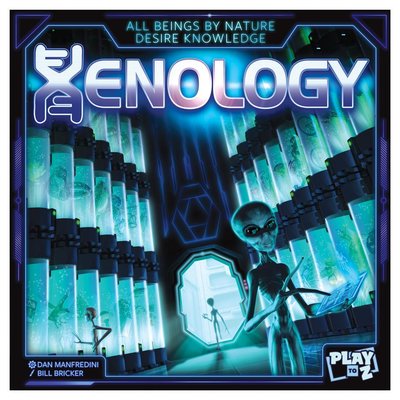
Hello everybody. This is Graham and today I'm going to be looking at a game called Xenology. Now in this game you are aliens who have discovered a brand new planet. Your mission is to explore and gather as much intelligence about the planet as possible to appease the elders back on your home planet. You're going to board your landers, explore the world, and bring back specimens for research and longer details into the galactic database. Now the game mechanisms kind of revolve around moving one of your aliens to an adjacent section of the mothership and taking the action from that spot. From jumping into the starship to launching them to exploring the world. At first glance, it may not look like it but this is actually a tight economic game and the economy in this one are your cubes. You only start with three but just about everything you need to do to kind of advance your strategy is using a cube. So getting that right balance is critical to the game. Now I was intrigued by the theme in this one and I almost always enjoy games where planning several moves ahead goes hand in hand with rationing your precious resources. So will this game be like a fantastic newly discovered planet or should it just be passed over while you look on for a new one? Let's get it to the table, see how it's played and we'll come back for my final thoughts on Xenology. Here is Xenology set up. There are five areas to the main board each associated with a different action you'll be taking during the game.
All the areas will have the respective components including random bonus tiles added. The planet board is randomly seeded with its tiles making sure to place a low and a medium population tile which are designated by the number of circles on them and flip them over to the revealed side. Spaceships are placed in order one through four, cards shuffled, and five drawn and based on the top card drawn a matching database tile is placed in that area. Each player takes their components and places three of their aliens in the mission control and the other three in the stasis chambers. You start with two research, one rank token, continent markers on the left side, and three cubes in your personal supply. All other cubes go into the general supply. Each player starts the game with three random cards off the top of the deck. Now, the planet board is split into three continents: polar, dry, and tropical.
Your player board tracks your rank, what continents you've explored, spaces for your containers, your research track, spaces for your devices you'll unlock during the game, base for your active research cards, available research cubes, and completed research cards. The mothership board is split into five sections. Mission control, where you'll direct your aliens on the planet to do something, the elder council, where you'll propose research to the elders and move up their tracks, database, where you drop off your completed research and move cubes or more tiles into the database, the bridge is where you coordinate the launching of the landing craft, and finally, the specimen storage, where you can claim, take out, or return specimen containers. The game is played until one player has taken their last research cube from the general supply. This will trigger the final rounds of the game.
On a player's turn, they must move one of their aliens across a single blue line or from anywhere in the mothership to one of the empty landing crafts. After moving, you'll perform the action of that area. If you place your alien in a landing craft, you'll perform one or both of the actions. Take a card from the display or top of the deck, wipe the cards from the display, redraw them, and either take one from the display or top of the deck, or clean up. Clean up means picking a single continent on the planet and returning all the cubes to their respective owners and receiving a bonus. Now, each cube you return is worth one, each other player's is worth two. Add up that total and get a bonus. Gain a cube from the general supply and impress an elder, which basically means move up a single track and gain the benefit, or impress an elder and gain a cleanup bonus tile, and place it on your board. Now, if you already have a device on your board and it's used, instead of taking a new one, you can just recharge the existing one.
At the specimen storage, you're either going to get access to a new locker and/or move a container either in or out. To claim a locker, you place a cube from your supply next to it. The associated containers are now yours. You can only own a number of lockers equal to your rank. If you take a container, it goes onto your player board. At the start, a player board can only hold one container. When the container is filled through another process, which we'll talk about later, it can be moved back into the storage to get the appropriate bonus. An animal unlocks one of your aliens from storage. A mineral allows you to get a device or recharge a device you already used. A plant can add a cube from the personal supply to the research track, and an artifact gives you any of the other bonuses. Now, going to the elder council allows you to play cards to the research bay and go up the matching elder tracks. The value, that is the number of symbols along the left of all cards, including the ones already on your board, plus the new ones you want to play, must be equal to or less than your current research level.
For each card played, move up the appropriate track. If the card played has a single research symbol on it, you get one of the two rewards. If it has two research symbols, you get both of the rewards on the space you move to. Now, I'm not going to go through all the rewards here, just highlight a few. First is replicate. Take a matching replica token and place it under one of your filled specimen containers. This will matter for end of game scoring. You can also increase your research by placing a cube on your research track or gain insight. This allows you to place a cube on any valid spot in the database section, and we'll talk more about the database section in a bit. At the bridge, you launch all the landing craft. Starting with the landing craft number one, the owner of the alien in that craft will place it on the planet. It has to go on a revealed tile with no other aliens and no evidence cubes on it. Depending on the number of crafts launched, you're going to get a reward.
Cube, impress an elder, or impress an elder and gain a bonus device or recharge an existing one. In the mission control, this is where you can direct your aliens on the planet to either explore or extract. To explore, your alien can move to any face up tile that it can trace a path of revealed empty tiles to. An alien can also, or instead, reveal a tile that's adjacent to them. If they just revealed tiles in a continent that they have not previously explored, move the appropriate marker over. If all three are now moved over, gain an explore bonus and reset your markers. Now, instead of exploring, you can extract. Return the alien to mission control. You then have the option to place a number of cubes from your supply as evidence on the space your alien was on. The number you have to leave is the population of that tile. If you do, you have collected a sample of that type. You can then place a cube on each of your cards covering that symbol matching that tile.
For example, this card here requires you to extract a tree and from a population size three site. They don't have to be done in the same tile, but it is more efficient that way. You can also flip your specimen tile over if it matches the terrain as it shows in the top left of that specimen container. The last action is the database space. Here is where you can add more general knowledge to the database and or move cubes from your completed research cards into the database tiles. To add a tile, discard a card from your hand and take the tile that matches the card type. Again, it's in the top left-hand corner of the card. Then, place the tile next to any existing tile so it has at least one square adjacent to an existing square. And here, a square is either a blank white space or a white space with a symbol on it. The other thing to do here is to assign your specific knowledge. That is, cubes from your completed cards. If your cards have all of their research filled, you can move those cubes to the database.
They must be placed next to the symbols matching the card type. So, these cubes here can go here. Once the cubes have been moved, move the card to your completed pile. The end of the game is triggered when someone takes their final cube from their general supply. Once it has been triggered, when it's a player's turn, they can flip over one of their rank tokens to the inactive side and take an additional turn. If they have no more active rank tokens, their game is over. Once all players are done, we go to final scoring. Each cube you have in the database is worth two points, and a pair of directly adjacent cubes that you own is also a point. Each field specimen container in storage is worth points equal to the number of stars matching the types on the completed research cards. So, if I have two of these containers filled in storage, each one is worth three points because of my completed research cards.
You'll lose a point for each piece of evidence or alien left on the planet, and then the player with the most points is the winner. Let's get back to see what I thought about Xenology. So, let's start with theme and components. I absolutely love the theme in this one. The fact that you play as aliens exploring a new planet, they don't explicitly say it's Earth, but I've always thought of it as Earth, and you're abducting people and animals while leaving some evidence behind. The theme also works when teaching. It just kind of makes sense. You hop onto the ship, explore the planet, bring back samples, and store the information in a large database. So, for Eurogame, I found the theme well done and actually kind of well integrated into the mechanisms. For the components, they are okay. The board and art are well functional. I guess we have been spoiled with truly spectacular-looking board games in the last several years, and in comparison, this one looks fine. I do like the alien meeples, and I finally iconography can be a little hard to decipher, especially on those device tiles. The rule book does a good job of explaining the rules as it should. So, overall, the components are, again, functional.
For the gameplay, this game revolves, around, much to my surprise, your cubes. These are the most precious resource in the game, and knowing when to use them and when to save them is kind of critical to how well you do. You can get into situations where you need to do an action that needs cube or cubes, and you don't have any. So, you might have a wasted turn, and not getting yourselves into these situations is kind of the key to the game. Getting cubes is not easy. So, when you see a chance to get them, you should take it. For me, that's something I always enjoy, but I did play with some people who maybe weren't as enthusiastic about it as I was. The game also has a good balance of how powerful an action is when you take it, specifically when launching and cleaning up. Of course, waiting until you get the highest bonus makes sense, right? Well, not always. Impressing an elder elder or even getting a device can be useful, but then you miss out on the cube that you get from maybe doing a minimum cleaner launch. And because cubes are so valuable, that's actually not a bad trade-off.
In terms of longer-term strategy, I know what I want to do. And again, with the theme in this one, it makes sense in the progression of the steps I need to take. But that also may make the first several rounds of each game feel the same. You need a locker and a specimen container. You need to play research cards by going to the elders. Then you hop on a ship, then land, and take actions on the surface. Because the database action really only comes into play later on in the game. All players are going to be doing variations of this during the first turns cuz it just kind of makes sense. But I kind of wish there was a quick start to this game where maybe your lockers, specimen tank, cards, and aliens on the planet were maybe drafted before the start of the game just to kind of get rid of that sameness. For the devices, you can acquire them doing certain actions, but I didn't find them overly powerful since they were mostly a one-time use of thing unless you got them recharged. So, I never found that I was pushing too much to get them. And in several games, I received them just never to use them during the entire game because I was never in that kind of exact situation where I needed them.
Getting cubes and impressing an elder is, to me, much more of a useful bonus. I did find the game can be a little luck dependent. Ideally, you want to be most efficient. You want cards in your hand that match the space your alien is on on the planet that matches the container you have. And it's good to have maybe two of the same type of card in your hand, so one can be used for the research and one can be discarded in the database section to make sure you can move cubes from your completed research card to the database. And hopefully, all these things luckily fell into place for you. If not, you can still do them, but it's going to take more actions to fulfill it. And it feels annoying when someone just kind of happens to flip over a planet on the tile that perfectly fits their container and the cards that they're trying to research. And I also found that at two players the game was not nearly as good as it is with three and four players. I found at two players it was good, but definitely compared to the higher player counts, it just felt like it was missing something.
I don't think I'd play this again too many more times at two, but I would definitely play it at the higher player counts, you know, that's my choice. So, would I recommend this game? I would for sure, assuming you're going to be playing at the higher player accounts. I love the theme and how well it's integrated with the mechanisms. The game is kind of a relatively game in its actions, but does have a fair bit of depth to it, which I really enjoyed. I enjoyed the level of player interaction here. I can't stop you from doing anything. But there is competition to be first in some areas to get what you want, which may diminish the action when you take it. I enjoyed the puzzle of trying to be as efficient as possible, getting the right cards with the right container, with being in the right spot on the planet board. The game also lasts a good amount of time, and near the end of the game there's definite tension as you are looking at all the other players' cubes to see how many they have left, to see if you have enough time to fill that last container and get it back to the mothership.
On the downside, I did find the randomness to be a little frustrating. Having to go to the landing craft just to flush the cards to hopefully get a card you really need feels like a wasted action. And the first couple of rounds of the game feel the same from game to game. I also felt that the game really doesn't shine at two. It works and is enjoyable, but it doesn't feel as satisfying as the three and four. Some people I played with felt the economy of the cubes was a little a little too restrictive for their enjoyment. I also wish the game just kind of looks snazzier on the table. Overall though, I'm going to give Xenology an eight out of 10 and the Dice Tower Seal of Approval. This one actually surprised me, and I fear it's going to be overlooked. But if you're looking for a good, solid, thematic Euro game, you should definitely check this one out. But that's it for the moment. Until next time, thanks for watching.
Hey folks, I'm Tom Vasel. Thanks for watching this video. Check out our channel. We have a lot of videos on our channel. We have live videos that go up each week from live Q&A's to videos where we take a look at the newest stuff on Kickstarter, crowd surfing, to top 10 lists and more. There's lots of stuff on this channel. We encourage you to explore it. You can find out more at our website dicetower.com. I'm Tom Vasel. Thanks for watching another video on the Dice Tower.