I finally finished Pandemic Legacy: Season 1 (No Spoilers!)
Games in This Video
1 game is featured in this video — it unlocks as you watch.
Transcript
Seven years ago, before the real pandemic, four board gamers set out to finish this extremely highly rated cooperative legacy game. And now only two remain for its completion.
We're bad.
Struggle continues.
We're bad.
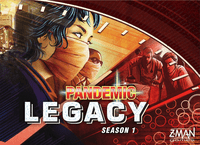
But we did it. From players switching out and dropping out, we finally finished it. Pandemic Legacy Season 1, our very first legacy game ever. And since it was our first ever, this video is not going to be a review. Rather, it's going to be more of a casual thoughts video because I want to make a video reviewing every single Pandemic Legacy at one point because I'm crazy like that. But for this video, yeah, I'll be going over what I liked and what I didn't like, roughly, very roughly. And then also, we'll have a spoiler section. There will be no scoring in this video. This is not a review, okay? Not a review. Pandemic Legacy Season 1 is a legacy treatment of Pandemic where you and a group of buddies save the world from four diseases by discarding five cards of the same color while at a research center in your city. But it's not easy because these cards will be spread all throughout different players hands and you generally have to be in that city to hand the matching card over. There's also treating disease to keep the disease from getting too dangerous because each city maxes out at three cubes. If it goes over, it'll be an outbreak which spreads diseases to all the surrounding cities. It also pushes the outbreak marker, which is one of the ways to lose the game or if you just run out of cubes. The last loss condition is by running out of time when the player deck you draw from every turn depletes. However, with the legacy version, the map will evolve over the course of 12 missions, and the mechanics will change over time. Okay, now to just start talking about the experience. It was very novel doing all the legacy stuff of opening boxes and then you have these different components and pieces and stickers, putting stickers onto the board or even rule book.
Rule book. There's going to be a lot of stickers in the rule book as you get mechanics. That was cool. It's novel the presentation with these dossiers and you know taking stuff out. Nice. Although these stickers are a little bit small and it is kind of fiddly to put them on at at times. But yeah, it is the feeling of your board game physically evolving cuz legacy, right? Like destroying cards, which is the board game sin. Uh yeah, doing that intentionally was a trick.
I'm supposed to just Yeah,
that feels morally incorrect.
I know, right?
Moral is the point.
I don't like that. No,
I just can't help myself from trying to destroy them nicely while playing and keeping them around, though. I don't really like throwing away cards. It's just it's just me. I was actually impressed by the card quality though, cuz they simultaneously feel sturdy, but then they're also pretty easy and clean to rip. Having to write inside your character sheet, like on the cards themselves, gave us a nice sense of ownership, and it made the game feel less dry. It's like you have a connection with this character. And then you see all the empty slots, so that gives them more gravitas over just the base game having a single card. And without spoiling the unlockable characters, they're mostly pretty cool. From the start, you have your original ones, but now you have stuff like the generalist and then the buffed building dude, which we called OSHA man. He can build not just research centers, he can build structures anywhere. Some characters can also take from the discard. Some have global effects and some are better at self-travel.
Characters are even divided into two categories at some point, which makes a lot of sense. Now, the most critical mechanic from the get-go is how cities can degenerate. They can rise and then they eventually fall. This had our group really curious to say the least. The game owner was freaking out over cities falling because he was saying, "Oh my god, like these places like Mexico City is getting destroyed." And I personally thought it was really cool that the cities were transforming as the world transformed. And I actually wanted them to fall more if possible so I could see how that interacts with the mechanics. Uh yeah, this would end up biting us in the butt later though cuz uh when a city completely falls, you just can't ever do normal travel in or out. rather you have to discard two cards to move in or out. This is insanely expensive. Also, tier four is expensive as well. Like you can imagine entire opening hands just getting depleted by moving and then also you probably need those colors for the area you're moving in. Or you can just pray you get this event card, but it's only once per game. It really did feel like that city fell and was like some sort of deserted wasteland. From the get-go, we immediately noticed that Legacy does a good job of preventing that pandemic moment where you just sit around in a space and do nothing like you have wasted actions because you're waiting for someone else to hand a car to you because now, well, there's a whole bunch of spoiler mechanics which I won't mention now, but there's a lot of them. Okay, but you can use character special abilities because there's more of those. Or actually, we can mention quarantining since that's available from early on. So, that's cool because you can always quarantine any city even if
it doesn't have cubes on it. So, that's always nice as a fallback. A neat slight spoiler that we maybe didn't do enough is scarring your character to avoid the infection step. You know, when cards flip over to spread disease. This sometimes, I mean sometimes, made for cool last stand moments for reasons I'll say later. But when it did feel cool, it did feel cool and was a really nice climactic sendoff for that character because sometimes you got to do it so Shanghai doesn't fall. The fact that characters can die and then they get replaced by new characters you unlock or even old characters you just had sitting around. This all makes the party feel more dynamic. Like it's far from base pandemic where you just kind of go to your set roles. You love these roles and you just know how to win with by using their abilities together. Like now you look at the objectives and go, "Oh wait, we should probably use this new character or my old character is literally dead so they cannot be used."
And with more objectives to do on each session, like you'll have to cure the main diseases plus do some other stuff. You need to team comp accordingly. Later on in the campaign, we were really utilizing the fact that you get to pick who gets what character after you set up the entire map. Like as in you set up all the diseases, then look at the objectives. At some point in early campaignish, there will be a twist in the story and it changes a mechanic that will really make you reframe how you draw player cards. So that's novel. Although it just made drawing player cards strictly worse to compensate for us getting stronger. So h but it's novel. We saw that the more complex mechanics here vastly improve the quarterbacking tendency of base. Like you can't really order someone to kill off their own character because that would be messed up. And also the characters are more interconnected with the rivals or family members to increase the number of teamwork moments both players have to agree on when to exploit. Like oh snap, we're family, right? So we should actually go to the same city together and we should hang out together. we should try to get more actions. And then with cities just degrading and as they degrade they get more complicated to interact with that just makes the map more complicated. But actually a big reason why our group fell apart during our second run of this by the way we had to run this with three different groups in three different years to eventually finish it with two players. So the reason why for a lot of this is because well the game just wasn't that interesting after a while.
And although it had less quarterbacking tendencies, it also didn't feel like there was a big reason to round up four players to see it through. So yeah, despite all the cool seeming flavor and the new mechanics and the unlockables and the presentation, right? Ooh, top secret. Yeah, the objectives can change, the cities fall apart, but actually the game still ended up feeling fairly dry to us. Without spoiling too much, there are some turns in the story. They do mechanically change some things, but in terms of flavor, they're really, really quickly explained, if at all. And then they also happen no matter what you do. Like, there's not really decisions to make for the story. So, the game changes, but fundamentally not due to your decisions. Although, the game can definitely get easier or harder based off of how well your party is doing. As a side note, I find it extremely odd that a certain region of the board can actually get filled with diseases, but then not every outbreak, so it's dangerous and then at the start of the next month, you just carry on like all that disease is gone.
Like maybe Africa is the issue now, not China. But diseases don't just disappear like that, right? Uh yeah, I don't know. It just makes actually more sense in Pandemic Normal. As you can imagine, you're playing alternate universes, but in this legacy game, what whatever. Let me give an example of some dryness with a core mechanic that sounds good. Scarring. This is supposed to be this heroic self-sacrifice to get this permanent downgrade, right? Oh, snap. You scar. Oh, what a heroic thing. However, the fact that you can choose your scar and some of the scars don't really hurt that much, especially on certain characters. This makes it not really feel heroic. Like, this feels gamey. Like, you can just choose a downgrade that does not matter at all for your specific character. Let's say a character that never cures diseases because they're too busy doing other stuff now has a harder time curing diseases. Okay, I'm not opposed at all to there being nonharmful scars and diversity is good for flavor and character development without actively hurting them too much. But choosing it is just too much. Like if it was random and you got one that didn't feel that bad, yeah, that's that's cool, right?
But at least there's a tension of maybe you'll get a bad one cuz it's like getting hurt in general, right? You can't really choose how you get hurt. Another weirdness is how it doesn't matter at all to the story whether or not you win or lose a month. Like sure, losing probably meant that some places on the board got a little bit more wrecked than others, so that's going to hurt you in the long run, but the flavor text doesn't adjust or anything, and you can only do each scenario twice. So, it's not like you can ever win a scenario even if you keep doing it. And and that also makes sense, although it's gamey because they had to account for people not doing like July like 15 times cuz that would just fill the board with stickers. Uh yeah, but when you lose a scenario, you get more funding from the government. So you get two more event cards. So that feels nice initially to plan around, but if you win, you also get rewarded with these unlockables. So you get rewarded either way. If you lose a lot, you get rewarded extra hard, which we got. so things won't spiral out of control. The campaign balance is actually in an interesting spot. As we played more and we realized we made some really crucial mistakes early game, partially due to me just being curious, but we made some mistakes early game. I thought we were in a downward death spiral come like twothirds through the campaign. Oh, we also got kind of unlucky early on. Like getting Mexico City to break early is bad because Mexico City has a lot of connections.
But actually, by getting more event cards as you lose, the game actually really self-balances pretty well because getting more event cards means that the player deck is thicker. So, you have more time and there's also more time between each epidemic card, which is killer for pandemic. But then by losing a lot, the board is already getting wrecked. So, your early games just become way harder if cities are already weakened. Like, travel in general just gets so much harder. So then this made pandemic feel even more gamey because there were times where we looked at the board in our current state and we went, "Yeah, we're going to lose." But we can't just like surrender. We have to play it out. So in playing it out, we wanted to accelerate the game end by having disease be in a way where it was all over the board, but we didn't want cities to ever outbreak even though disease was all over the board. And you know how we talked about bad luck, like we had some bad luck? Well, yeah, because Pandemic Legacy still has the core Pandemic problem of the Epidemic card being massively punishing. In fact, it's even more punishing in later scenarios once a certain mechanic is introduced. But yeah, it's just terrible to flip this over and when you flip it turn one, you get wrecked. There's nothing you can do to react. It's probably an immediate outbreak. In an ongoing campaign of 12 plus sessions, it feels even worse to get epidemic early on because it usually causes an outbreak and outbreaks are irreversible damage to cities. So, you just have to stay with that. You have to live with that.
Remember, there's no flavor to epidemics either. They just randomly happen. In fact, there's actually more variance in opening games here compared to normal pandemic. As you might know, if you played enough pandemic that sometimes normal pandemic just becomes too easy. But in Pandemic Legacy, we finish some scenarios in like maybe what, like 20 minutes, just cuz like once you start getting disease upgrades and then you have the right cards and disease is not in a certain part of the board, you can just cure something quick. Like if you eradicated Z's on turn two, that means every time you flip over that disease from this deck, nothing happens. Which is insane value. It's really weird feeling to start this game and be like, "Oh yeah, um yeah, this this month is going to be pretty much impossible. I think we just lose and just try to write out trying not to lose too hard." And then other times we go, "Oh, hey, look at my hand. Cool. You have that in your hand. Let's trade trade." And then cure cure eradicated. Cool. Easy. Let's just wrap up the the objectives. Oh, lastly, before I go all out into spoiler territory, we wish this game had some better plastic bags and organization for when you start opening things. It gets to be a lot to manage at some point, and some of the cardboard quality on some of the emergent mechanics are not good to touch. And the scratchoffs are novel, but become kind of a pain. And it just gets everywhere. It's like sand. H, it's just everywhere. It's wow. I'm still I still see bits of it on my table now.
Okay, now to start complaining, but not reviewing spoiler stuff. Just just talking about it. But seriously, click off now if you think you're gonna run through this campaign at all at some point. Okay, guys. The campaign pacing is quite poor. I thought it was just me at first being too picky and being too impatient with Pademic, but no. I talked to Alex who didn't get through this campaign, and by looking through many BG written reviews, yeah, they actually ran into the same problem. So, there is a twist early on, which is fine, I suppose. It definitely makes it feel much different than normal pandemic, but then after that, there's a huge lull in the game. Like, not really much happens flavor-wise and mechanically. Like, you really just got to trudge it out into late game. Okay. Then the campaign just ends super suddenly with low flavor. Like, there's not even a win or loss condition because you just have to calculate your score. Oh, okay. Yeah, that's pretty anticlimactic because you have to add up so many numbers, then you just read two sentences on what happened to the world. And it's so simplistic.
Like even if a ton of places are fallen, the world recovers back to normal in a year. Huh? Like what? How? How? What about the twist again endgame? Like how is the government reacting to that? How are the other governments reacting to that? Actually, yeah. When playing the campaign, it does get thematically inongruent in a lot of places. Why is it that when you find someone, they come to you after the next session? Huh? disease. Teleporting to other parts of the world during the same month if you redo it makes no sense. Why is it that even when we find out military bases are bad, we can sabotage them, but then use them to travel and we can make new ones? Huh? Why do all the NPCs show up for a bit, say something, and then we never hear from them again, even endgame? Why does the military do nothing about all the disaster around the world even though there's a military presence in the story and bases on the map? Why are there no villains? When I was talking about this with Alex, he said that Pandemic Legacy season 1 has really jumped the shark, a term he heard about when talking to some of his other friends about Pandemic Legacy. So, I haven't heard the term in a while. So, I wanted to look it up, and this is a 1985 term, and I totally agree. It's to describe how a creative work or entity has evolved and reached a point in which it has exhausted its core intent and is introducing new ideas that are a caricature of its original theme or purpose. My friend who I finished this campaign with, who is a Pandemic Legacy faithful from the start, he said, "This game should be awesome, right?" He was just super soured on the search mechanic. This is a really gamey idea
around Pandemic that is really pushing away from the ideas of disease. And I'll have to think more about this for a future video, but yeah, it just doesn't really sit right. And then also, it's repeated again and again and again in the middle of the campaign. To explain, you have to go to certain area or city and spend cards to move up a tracker. And if you hit the right prerex, you can move it up more. If an epidemic happens, you move the goalpost back. This is acceptable at first cuz it's novel. And there's even a character that can abuse its progression as he can take cards from the discard. But you basically do the same thing next month and then the month after and even endame. Yes, they brought back the search for endgame, which is not only surprising, but anticlimatic and not pandemic feeling. Suddenly at the end of the game, you're focused on finding pairs of player cards to discard to move up a tracker. Like you're not focusing on positioning to cure diseases or worrying about diseases breaking out as much because you're probably taking care of that. Maybe you're strong enough because of all the upgrades. Instead, we're just sitting in one place just hoping we top deck the right cards. And if we get the right colors, then we can discard them. We move up the track. Wait, but don't you have that character, the the the soldier? He can make search easy. And you should have figured out how to master the search mechanic by now, right? Well, the endgame twist is that your best character, who is probably the soldier, betrays your party and leaves, so you can't use him. So, this felt really bad for us. But also, it makes sense to not use him to not make endgame a breeze. I really don't know what the solution is for this. Again, these are my initial thoughts for now um before I make the massive review. But yeah, I
don't know. Maybe someone below can jog my my ideas. I feel like it's really easy to complain when our group was quite disjointed and mostly irritated at the mechanics. Like I'm honestly thinking what else could this system do, right? Because at this legacy's core, it still wants to feel like pandemic of trading cards and curing diseases. And then when you branch out from that too hard, it feels a lot different. Again, it's why I want to play season 2 and season zero before giving any sort of score.
Do you remember how to play Pandemic?
Do I know how to pandemic? Oh, I know how to play Pandemic. Personally, personally, I think that the general dryness and epidemic mechanic make this game a far cry from a masterclass of design. Like, those are just like pretty jarring things. Like, let's compare this to Brass Birmingham, which is very close on the BG track. Like, this is a pretty jarring mechanical difference. Even presentation wise, Brass Birmingham looks better. While I can see a lot of non-board gamers like a Pandemic Legacy, especially if they don't play campaign games, the Midame feels like such a slog. And so many 10 out of 10 are fascinating to me. Again, it's why I need to do more research.
What?
There's only one color.
They all just go here.
There's only one color.
Oh, wait. This is This is way different than Epidemic.
No, no, no, no, no. The card screwed us last campaign. Okay. Right. Okay. All right. Okay. Watch this. Epidemic. Oh,
no. It can't be Epidemic again.
Oh, Never mind. Yeah. What? Look at this.
Well,
wait. We lose in hell.
Wait, did we lose?
Yeah, we don't lose.
So, yeah. Part of my hunch is that I guess if you don't mind 12 scenarios where I think it really should have been like eight and then really like pandemic and have a group that really really likes pandemic too, then yeah, I guess you will get rewarded here. like the things are changing and then also yeah people aren't really playing Pandemic for the theme anyways but they kind of are but also it's dry. It's so odd because recently I was looking on Reddit and BG and some people still glaze this game like they're saying it it's one of the best gaming experiences ever but then when you start delving into long form BG reviews you'll quickly find a lot of people who are more critical about this game and I tend to agree with their thoughts. Although some of the writing is a lot more passionate about being glad to throw away the game forever. I'm not really angry at it, just more disappointed. I'm withholding my personal score until the actual review because yeah, I'm still not sure how to feel about this. Like, at times I thought it was a three or four. Other times I thought it was like a five or six. And there were times I I genuinely was entertained. Like it was a seven at multiple hours. Sure, like the game ended around like a five or six, but I didn't feel like I was wasting my time playing it. It was still fine. Yeah, like the game is mega dry, but I'm surprised how there's many interesting puzzling things going on. Like the board keeps evolving, so there's a lot more to Grock. As we compare our two-player versus four player experience, yeah, two characters control really helped alleviate boredom as some parts with the minimal flavor text and the okay story elements. I was actually convinced I was saving the world kind of. I mean, yeah,
the game is epic by scale and when it's interesting, it can have that momentum behind it. Surprisingly, I actually enjoyed seeing all the new events and seeing all the ways we could use them and seeing all the ways we could lose because the board evolving is cool as an idea. These places shall burn in hell. They shall rot.
It's over.
It's all over.
The US is burning.
Can't win. Can't win anymore. Can't win with these citizens.
We cannot win. I actually feel like the pandemic maybe is not really for me because to this day I still feel a sick thrill of uh the outbreak happening and getting to place more cubes. Placing more cubes is fun. And of course that gets bad with certain diseases with the twist and uh yeah, I don't know. I just like seeing things multiply. It's like a combo. And you can tell this game owner was not entirely as hyped as he thought he would be.
It's painful Mr. Man.
It's painful Mr. Man,
what the
But then he said he would still recommend this to people that are casually into board games, like our friends that like Slay the Spire and play some Frost Haven but don't really own collections or play regularly or even complete that many campaigns. Huh. I wonder if my enjoyment would have been higher if this game wasn't so hyped online. Maybe. Maybe. Anyways, I can't wait to see what happens after season two and then um season season zero because I heard this one does some really interesting stuff. It's like the Cold War or something. Huh? Like surely they've gotten better, right? Like surely they they've learned some stuff from here and they've they've made it better. So yeah, I don't know. Thanks for watching and uh we have a lot more actual reviews in the works, in-depth reviews, and I'll cut to some gameplay footage now. Bye-bye.
What's the problem with that?
Unfortunate. It's riding.
Yeah, I mean it was always riding basically.
I had a grenade belt. Okay, so that's my turn. What does it do again? Cruise faded.
It's this and this.
This first. This first then that.
Okay,
you flip them. Remote treatment. Oh, yellow. Wait, can uh oh,
it's okay.
Oh, remote treatment. That's pretty good.