Positano - How to Play. Complete, Clear, Concise Board Game Tutorial
Games in This Video
1 game is featured in this video — it unlocks as you watch.
Transcript
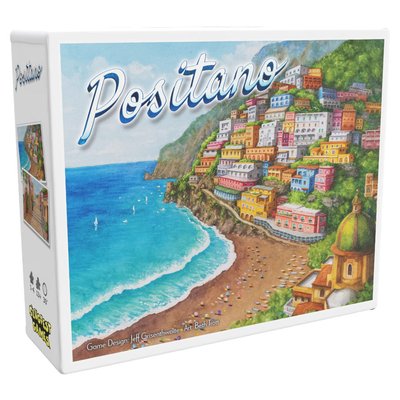
Build your luxury homes on a cliffside paradise while blocking someone else's view in Positano. And today we'll be teaching you how to play Positano game designed by Jeff Gryenthroit and published by Slugfest Games. And hi everyone, it's Stella and Tarant. Welcome to Megan University. And hey, if you enjoy this video after watching, like, subscribe, comments, you know what to do. All right, now let's get to the classroom. The Amalfi Coast village of Positano is known for its luxury villas which stand up high on the cliff face offering wonderful Mediterranean views. In the game, players will compete to have the best property portfolio in Positano. Round by round, players will make bids in an auction to try to get the chance to claim the best lots, the best building materials, and the best chances to build. But be careful as you build up your structures. There's always someone ready to block your picture perfect view.
When the cliff face is complete, whoever scores the most points by having the greatest views, meeting objectives, and to enjoy their seaside stay has eaten the most gelato, will win the game. To set up, assemble the cliff structure. Choose a player color. Take the 13 bid cards of that color into hand and take one of your colored blocks, moving the other 15 to the general supply. To be clear, your color of blocks does exclusively belong to you. However, you have to gain them from this general supply before you can use them. Also, add the roofs to the supply. the bronze cheap roofs, the silver standard roofs, and the gold luxury roofs.
Set up the market of tiles, the lots, blocks, and builds. At four, players use all the tiles. Deal out four random lots and the grayboarded starter tiles for both the blocks and builds, shuffling the rest. At three players, remove one lot tile from the game. You'll deal out three lots and use the two and three player starting tiles for the builds and blocks, shuffling the respective four player starters into their corresponding decks. In the two-player game, remove four lots. Deal out only two of each type and shuffle the three and four player starters into their decks.
In both cases, flip the removed lots face up. These are the lots which aren't going to be built during the game and by seeing them, players can plan around this. Randomly choose three of the double-sided goal cards with which you'll play. These can change from game to game and offer various different objectives for scoring. You're now ready to play. Positano plays in rounds and each round plays in four phases. bid, pick lot, obtain blocks, and build. In bid, players will simultaneously pick cards from their hands to determine the turn order for the other three phases. In pick lot, each player will choose one of the lot tiles, and this will determine where they build this round.
In obtain blocks, players will choose blocks tiles to determine how many of their colored blocks they gain to their supply for future building. And in build, players choose a build tile, which gives them one of the colored roofs. And we'll use that roof, their blocks, and their lot to construct their building for the round. Once everyone has built, you'll reset the board with one tile of each type per player and proceed to the next round. The game ends at the end of the round in which the lots deck is empty, which will be the fourth round at four players, the fifth round at three players, or the sixth round at two players. At that point, count up your scores, and the player with the highest score will win.
So now, let's look at each phase in detail. First is bid. And here you'll be using the cards in your hand to bid for turn order on the three subsequent phases. You begin the game with 13 cards in your hand. Seven, which look like this, are called base bid cards, and they show a number between 10 and 70 for each of the three other phases. Pick lot, obtain blocks, and build. The other six, which look like this, have a single number, 5, 6, 13, 14, 21, or 22. During the bid phase, players simultaneously and secretly look through their own hands and choose two cards to play. One must be a base bid and one must be a booster.
Play those face down on the table. Once all players have locked in their bids, reveal. And for each of the three subsequent phases, determine the turn order by adding up your base and booster bid and ranking them from highest to lowest. So in this case, for picking lots, green will go first with 71, then yellow with 56, blue with 43, and red with 15. For obtaining blocks, blue will go first with 83, then red with 65, green with 31, and yellow with 16. And for building, it will be green 81, yellow 66, red 55, and blue 33.
In a case where two players pick exactly the same pair of cards, ties are broken by the number of stars in that row. So with five stars to three, blue proceeds green on picking lots. With two stars to zero, blue would obtain blocks first. But with six stars to two, green would build first. The cards you play in this phase will not be returned to your hand, meaning each of them is single use throughout the game. Phase two is pick lots. In picking lots turn order, choose one of the remaining lot tiles from the board, adding it to your personal area. This is a very quick phase with nothing else happening at this point.
The third phase is obtain blocks. In the blocks turn order, choose one tile from those available in the blocks row and take that number of your colored blocks from the general supply, adding both them and the blocks tile to your play area. Most of these simply grant you a fixed number of blocks, while this one lets you double your current block inventory or gain two blocks. And this one lets you triple your block inventory or gain three. If the supply ever runs out of your color of blocks, gain only what you can. The final phase is build. In the build turn order, take a build tile that's available on the board and take a roof whose color matches the top of the tile.
You must now build a building. That building must go in the lot you took. this round. It must be capped with the roof you just gained. It must be a minimum height of one block and a maximum height based on what's printed on the lot tile. This will always be height one for a level one lot, height two for a level two lot, three for a level three lot, or four for a level four lot. Again, you must build at least height one unless you're holding no blocks, but can otherwise choose any height that is not above the regulation height. Here, let's say I build a level four luxury building, placing it in lot 4D. It would be built like so.
There are several special build tiles. One showing this icon can be built taller than regulation height. In this case, it's one step taller. So, I could build a twostory building here on lot 1A. If it were this tile, I could build three stories on level one. A tile like this would let me do a standard build with a silver roof and then also upgrade one of my previously placed bronze roofs to a silver one. So, for example, build three floors on 3B and changing out this previously placed roof. There's also one which upgrades silver to gold. Finally, a tile with this icon lets you extend a previously placed building in addition to the standard build. Here, I could build my twostory luxury building on 1A, as well as increase the height of this previously placed building as long as its final height does not exceed the normal regulation height for a building in that lot, plus any bonus from the tile you just used to extend it. Through all of this, the layers that you're placing must come from the supplier blocks that you gained. And if you run out of blocks while building, this simply limits you to building less than the maximum height.
On the other hand, if you have blocks left over at the end of a round, you keep them. They will carry over to be available in future rounds. Once everyone has finished building, you'll refresh for the next round. The cards that you played and the tiles that you drafted should be collected face down. This is because any of these gelato icons on them will score for you at the end of the game. However, as your bid cards end up in this scoring pile, the size of your hand for future rounds bids will dwindle. Now, refill the market board so there's one tile per player in each row. At the end of the round, when there are no more lot tiles in the deck, the game is over and proceed to final scoring.
Each house scores its owner points equal to the number of its floors whose frontal ocean view has not been blocked multiplied by the quality of its roof. So one point for a bronze roof, two points for a silver roof, or three points for a gold roof. So, for example, red has only these four floors, all with bronze roofs visible. One point each for a total of four. Blue scores all of these floors, one bronze, two silver, and two gold. So, 11 points. Yellow scores two gold and six silver for 18 points. And green scores two silver and four bronze for eight points.
Next, score the three goal cards. Some of these will give you a certain number of points for each of your buildings which meets an objective. Here, for example, two points for each building which matches the regulation height. Some give you a flat rate of points if you meet the objective. So, here five points if you have at least one building of each of the roof types. And some objectives are competitive. Here, for example, it would be six points for the single player with the most buildings in levels four and three, and three points for whoever has second most. In this type of objective, the tiebreaker is whoever has the most blocks in those relevant buildings, whether those have a seafront view or not. If it's still tied, add up the tide points and divide them rounded down. And you must have at least one of the relevant building type to score one of these objectives at all.
Finally, go through all the bid cards you played and the tiles you collected and gain one point for each gelato. The player with the highest score wins. And if tied, victory is shared. Thanks for watching and if you like this video, maybe you'd like to watch this next one. Have a great day. Bye.