










Positano Deep Dive
What the Community Thinks About Positano
Reviewers who spend time with Positano tend to come away enthusiastic. TheGameBoyGeek placed it at the top of a year-end family games list, calling it a game they love with a ton of interaction. Chairman of the Board devoted a full episode to it, describing a design that left them very impressed and calling it one of the surprises of the year. On The Dice Tower, the panel ranked it among their favorite games discussed that episode and landed on a simple verdict: it is an excellent game. The hosts of a top-50 list video were just as positive about the experience itself, calling it a great family auction building game and noting how impressive the building aspect looks on the table.
The praise is not uniform in every detail. Chairman of the Board is upfront that although the box lists one to four players, they stick to three or four players because of how interactive the game is, and admit to no real interest in trying it at one or two. Those hosts love the game but are lukewarm on its cover art, saying they are not very enthusiastic about it even while recommending the game itself. That same pair also flags a mismatch between the game's physical presence and its digital life on Board Game Arena, arguing the experience is built around handling large plastic pieces rather than clicking through an online interface.
Core Mechanics That Define Positano
Simultaneous Bidding for Turn Order
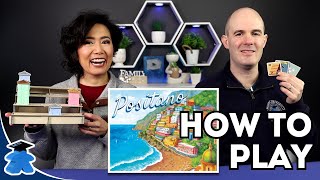
Chairman of the Board explains that players hold a hand of bidding cards, each with three numbers tied to the plot they will build on, how many blocks they gain, and how tall and with which roof they can build. Each round, players commit two cards at once, one relating to their overall priority and a separate booster card that pushes their total higher, and once a card is played it is gone for the rest of the game. TheGameBoyGeek describes the same system from the other side of the table, calling it a very clever simultaneous secret auction mechanism where the tiles coming available will let players build in certain spots, build to certain heights, or otherwise shape their turn. Both reviewers frame the tension the same way: cards are usually strong at one thing and weak at the others, so committing a card to chase one prize can leave a player short elsewhere.
Building for a View, and Blocking Everyone Else's
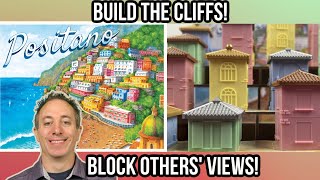
Once turn order is set, players draft plots, building materials, and roofs, then construct upward on a shared cliffside rock face. Chairman of the Board notes the objective is clean: players want their buildings visible from the front view, and taller buildings block whatever sits behind them. Roof quality multiplies the payoff, with bronze worth one point per level, silver worth two, and gold worth three, so a tall building with a good roof and a clear sightline to the sea is the ideal outcome. The top-50 list hosts frame the same system in blunter terms, noting that only what is visible actually scores, so continuing to build in front of other players is how a player keeps their opponents' totals down.
The Positano Experience
A Full Game in Half an Hour
Chairman of the Board is struck by how much game fits into a short runtime, saying a thirty minute time frame for a design like this is impressive and that it still feels like playing a full game rather than a quick filler. They add that the tile order changes every session, so a weaker bid can still land a useful lot depending on what happens to be available that round. That pacing lets several short rounds carry real decisions without dragging, which the same reviewer credits for making Positano one of their favorite discoveries of the year.
Friendly Meanness
Blocking a neighbor's view is central to Positano, and reviewers agree it produces a game with bite that never turns sour. The Dice Tower's panel calls it the meanest game on their list but excuses that because it is a short game, and they describe the blocking as something players chuckle about rather than resent. TheGameBoyGeek pitches it directly at players who like sort of meanness blocking paired with a secret auction. Chairman of the Board describes the same dynamic as an almost barrage-like feel of building higher to cut off a rival's points, while stressing it comes across as helping yourself rather than a reckless, purely spiteful style of play.
What Makes Positano Stand Out
Table Presence and Physical Building
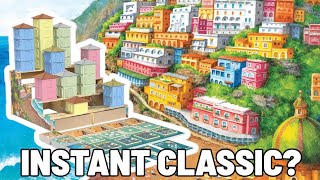
Multiple reviewers single out how the game looks once it is set up. Chairman of the Board calls the production and table presence fantastic, and the top-50 list hosts describe the piece count as quite big pieces of plastic and call the whole building aspect impressive, comparing the physical feel directly to Cities. That same reviewer also points out the box is not as expensive as its imposing size would suggest, calling it reasonably priced for what players get.
An Expansion That Opens Up Player Counts
Both TheGameBoyGeek and Chairman of the Board bring up the expansion unprompted. TheGameBoyGeek recommends it specifically for reaching up to six players and for unlocking a longer four player game similar to what is normally only available at two players, calling the base experience fantastic and the expansion worth adding if a group plays with four regularly. Chairman of the Board is intrigued by the same expansion for adding more players, though they note their own group is not quite large enough to make use of it.
Potential Drawbacks
Best Reserved for a Full Table
Despite being boxed for one to four players, Chairman of the Board treats the lower end of that range as an asterisk rather than a real recommendation. They explain that the interactive, blocking-driven nature of the design is what makes it work, and admit they have not played it at one or two players and have no real interest in doing so, which suggests the experience is built around a fuller table rather than solo or head-to-head play.
A Physical Game That Loses Something Online
Those same list hosts note that Positano is available on Board Game Arena but argue the game is not really meant to be played there. Their reasoning ties back to what makes it appealing on a table: the towers of chunky plastic pieces and the shared cliffside board are part of the appeal, and translating that to a screen strips away much of what makes the physical version streamlined and satisfying to build.
If You Enjoy Positano
The top-50 list hosts draw a direct line from Positano to Cities, saying it is really similar to Cities in how physical the building aspect feels, with the caveat that Cities is a drafting game while Positano runs on bidding. They point out that anyone who already likes Cities should look into Positano for that same tower-building, tactile appeal in a quicker, meaner package.
What Reviewers Are Saying
"I think it's a wonderful design. Again, if you like those old school clean rules style games, I think you're going to get a lot from this one. And I think even non-gamers or gateway gamers are going to get a lot from it as well because it looks so cool and that rule set is so approachable."
— Chairman of the Board
"This game is a very clever sort of simultaneous secret auction mechanism where things are going to be coming available, the types of tiles, and they're going to do different things. They're going to allow you to build in certain spots. They're going to allow you to build certain heights."
— TheGameBoyGeek
"My number seven is probably the meanest game on the list, but it's okay to be mean because it is a short game. It is Positano. Positano is really fun, but mean."
— The Dice Tower