How to play Lord of the Rings: Duel for Middle-earth (& Allies Expansion)
Games in This Video
2 games are featured in this video — they unlock as you watch.

Transcript
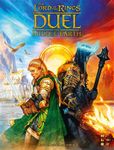
Hey, I'm Ralph from justtheroad.com. I'm going to show you how to play The Lord of the Rings: Journeys in Middle-earth as well as the Allies expansion. This is a game for two players, plays in about 30 minutes. It's designed by Antoine Bauza and Bruno Cathala and is published by Repos Production. One player plays as the Fellowship, drafting cards for skills and gold trying to get Frodo to Mount Doom. And the other player is Sauron, also drafting cards trying to get the Nazgûl to catch Frodo before he can get there. Both players also use skills and gold to try and gather support of the races and also try and conquer Middle-earth. The player that beats one of these three victory conditions first is the winner. As you move your pointer down the screen, you shall not pass the subscribe button for more how to play videos like this one. I can't click it for you, but I can carry on telling you where it is.
On to setup. Place the central board between both players. Put all the coins within reach of both players as a shared reserve. Shuffle the landmark tiles and place three face up on the table, return the rest to the box. Decide or randomly choose who's going to play the Fellowship and who is going to play Sauron. Each player takes their 15 unit pawns and seven fortress pawns of their faction color, yellow for the Fellowship and gray for Sauron. The Fellowship player places two units in Arnor on the central board and takes three coins from the reserve. The Sauron player places two units on Mordor on the central board and takes two coins from the reserve. Assemble the Quest of the Ring track and place it below the central board. Position the plastic overlay so the One Ring sits over the left most space on the track. Place the Nazgûl piece on the left space of the plastic overlay. Sort the alliance tokens by race into separate stacks. Shuffle each stack individually and place them face down on the central board of their space. Sort the chapter cards by the rune on the back and the three separate decks and shuffle each one. Refer to page three of the rulebook for the outline diagram showing how cards are arranged at the start of each chapter. It shows which cards are face down and face up. The The player always starts the game. If playing with the Allies expansion, at the start of each chapter, place two power tokens on the cards indicated by the setup diagram on page six of the Allies rulebook. Sort the Allies cards by faction, then each player shuffles their seven Ally cards, draw three, and return the rest to the box. Each player also takes one power token during setup.
Players take turns doing one of two things: taking a chapter card from the central area, or playing a landmark tile. When taking a chapter card, the chapter card is available if it isn't partially covered by any other card. Once you've taken a card, you either play it or discard it. To play the card, pay the cost, put it in your play area, and resolve it. The cost is shown in the middle of the card. To meet the skill requirement, you need the matching symbol on the card already in your play area. For example, this card needs one knowledge, and this skill provides that knowledge. Remember, you don't spend the skill symbols. The skill symbols will stay on the cards in your play area. You just need to have enough of the skill symbols to play the card you want. But, if you are short of skill symbols, you can pay one coin to the reserve for each symbol you're missing. Let's look at the different kind of cards. Grey cards give you skill symbols. Each symbol can only be used once per turn. For example, this one gives you two courage. If a card shows skill symbols separated by a slash, pick one to use each turn. For example, this card gives you a ruse, strength, or courage to use. Yellow cards give you coins immediately. Take the amount shown from the reserve. Blue cards advance you along the Quest of the Ring track, one space per ring symbol shown. When the Fellowship player advances, slide the plastic overlay one space towards Mount Doom. When the Sauron player advances, move the Nazgûl one space closer to Frodo and Sam. If your movement lands on or passes a bonus space, you immediately collect its reward. For example, when you move onto this space, you gain one coin from the supply. Green cards carry race symbols for the races of Middle-earth: Elves,
Ents, Hobbits, Humans, Dwarves, and Wizards. As soon as you have two matching race symbols in your play area, take the top two alliance tokens of that race and reveal them to both players. Choose one token to keep in front of you and return the other face down to the top of the stack. These alliance tokens give you abilities. For example, this one says that for the rest of the game, whenever you play a yellow card, you take an extra turn. This one lets you move two spaces on the quest of the ring track as a one-off bonus. Once per game, when you have three different race symbols, take the top token from each of those three race stacks and reveal them. Keep one and put the others back on the stacks where they came from face down. Remember, if you get three different race symbols, this will only trigger for each player once per game, even if you get more symbols later. Red cards let you place units on the board. Choose one of the two regions shown on the card.
Whenever a unit is in a region containing an enemy unit, a conflict starts immediately. Both players remove a unit from that region one at a time until only one faction remains. Purple cards are only available in chapter three and let you perform military maneuvers. Arrow, move one of your units along a connection to a neighboring region. Units can only move along connections between regions. If a purple card gives you multiple movements, you can spread them across different units or use them all on the same one. A coin with an X causes your opponent to lose that number of coins, return them to the supply. A unit with an X, remove the number of enemy units shown from anywhere on the board. Starting in chapter two, if a card has a chaining symbol in its top right corner that matches a card already in your play area, you can play it for free without needing any skills. The matching chaining symbol must already be on the card in front of you. For example, this card requires two strength and one courage skill, but as you have this symbol on the card in your play area, you could play it for free. Instead of playing the card you took at all, you can instead discard it. You get one coin in chapter one, two coins in chapter two, and three coins in chapter three.
After taking your card, flip face up any cards that are now fully uncovered. If playing with allies expansion, when the newly revealed card has a power token on it, you take the token and flip the card face up as you normally would. Instead of taking a card, you could pick any face-up landmark tile. Pay its cost using coins to place any missing skill symbols as normal, and add it to your play area. The tile's fortress icon means the coin cost equal to the fortresses you have already on the board. So, your first tile is free. Now, resolve the effect on the tile. For example, this tile lets you place a fortress and one unit in Gondor, then make two movements on the quest of the ring track. A fortress moving into a region with enemy units does not start a conflict. You can have units in the region with an opponent's fortress. Taking a landmark tile, just like taking a card, ends your turn. For allies, you may call upon one ally per turn at any point, even after you reveal the cards at the end of your turn. Calling an ally doesn't replace your action for the turn. You can still claim a chapter card or a landmark tile. To bring an ally in, spend one power token, reveal one of your ally cards, and fully resolve its enter effect on the left. For example, the cave troll allows you to discard one gray card from your opponent's play area. You must be able to complete the whole thing. For example, Boromir allows you to remove one of your opponent's units from any region, but can't be played if your opponent doesn't have any units on the board. On a future turn, you can spend two power to activate the ally already in front of you using its exit effect. The card is then removed from the game. For example, the Witch-king allows you to move the Nazgûl one space on the quest for the ring track, and place one unit on any region
on the board. As soon as the last card of a chapter leaves the central play area, immediately set up the next chapter. Whichever player took the final chapter card from the display, will go second in the next chapter. The exception is if you gained an extra turn when taking the last card, you will then use that extra turn to go first in the next chapter. At the start of each new chapter, if playing with the allies expansion, remember to place power tokens on the card as indicated by the setup diagram. There are several ways to win the game. If the Fellowship player advances Frodo and Sam all the way to Mount Doom on the quest of the ring track, they immediately win. If the Nazgûl catch up to Frodo and Sam on the track, Sauron wins immediately. If a player collects six different race symbols across their green cards, they win immediately. If a player has at least one fortress or unit in every region on the central board, they win immediately. If all three chapters are complete without anyone getting an immediate victory, you go to a tiebreaker. Count how many different regions each player is present in. The player in the most regions wins. If both players are present in the same number of regions, the victory is shared and that's how you play The Lord of the Rings: Duel for Middle-earth with the Allies expansion. Thanks for watching.
Remember to like, share, and subscribe and hit the notification bell so you know when a new video goes live. You can follow on Insta and YouTube at Just the Rogue and find the blog at justtherogue.com. I've been Rob AKA Just the Rogue and I'll see you soon.