Umbra Via Board Game Review & Runthrough | Top Abstract Game
Games in This Video
1 game is featured in this video — it unlocks as you watch.
Transcript
Hey dude. I think we're totally lost. Not to mention I'm covered in these creepy vines. Are you sure that this rare board game exists? Trust me, man. The flowers definitely know the way. Ah. Daylight. You were right. I mean, look at this amazing board game species. It's definitely one of a kind.
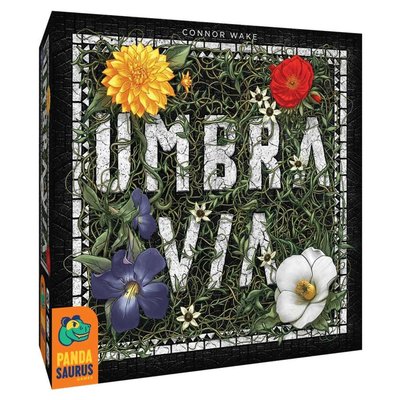
Have you ever wandered through your garden at night and watched the moon as it drifts across the sky? Umbravia is an auction tile placement board game where players are trying to bid for different tiles as they try to create the longest meandering path with the most energy flowers on them to acquire soul flowers in their own collection. The player who retrieves all of their soul flowers first will win the game. Gardens are such fascinating places. We all imagine having a green thumb, growing our very own plants, herbs, vegetables, meeples, wooden flowers, and board games. Umbravia is an abstract board game that reminds you that the world of floral competition is both thorny and pretty at the same time.
Across a round of Umbravia, players will reveal four tiles from this stack and secretly bid on which tiles they want by drawing three wooden flower tokens from their player bags and placing them on their bidding board located behind their player screens. Across each auction, players will be bidding by using these darker colored energy flowers, which are worth one or these lighter colored soul flowers which are worth two. Players can bid on multiple tiles or one if they wish. Once the bids have been placed, the screens are revealed and the flowers transport Pocahontas style towards their respective tiles for all players to see. In most board games that feature an auctioning mechanism, players will usually pick an item or location to bid on and place their coinage or resources on that item. And the player who commits the most resources to it will usually acquire that item or location. Under Vera Twists, the knot on this very little auctioning mechanism by introducing the idea of a double auction. Excuse me, could you stop creeping around? I'm trying to film a review here.
This means that the auction actually happens twice in a row. The first auction allows players to see what the other players might be vying for and the second auction allows players to finalize the tiles that they really want. After the final review, the tiles are numbered in order starting with the tile with the fewest number of flowers in total. Any ties in the auction are decided by this flower track and any player who wins a tie immediately moves their flower down. The winner of the tile, i.e. the player with the most number of bidding points on the particular tile, removes all of the light colored soul flowers from it and then places the tile onto the main garden board connecting it to a previously placed tile. Tiles are then placed in the order that they came in in the auction from fewest flowers to most flowers.
On the main board, players are attempting to create completely closed pathways using the tiles that they acquired from the auction. A closed pathway is one that has no side openings. Completing or closing a pathway means that the path can now be scored based on who has the majority of energy flowers on the entire path. The garden board now becomes a botanical battlefield of tactical tile placement, floral arrays, and an all-out plant war.
Scoring a tile simply involves counting up the number of each player's energy flowers on the completed path and ranking them. Whoever has the most energy flowers in the path gains a soul flower from their soul flower stash for each tile in the completed path. Each other player gains soul flowers equal to half of the previous player's scatter's amount, rounded down. Plays continue down this path until one player has claimed all of the soul flowers from their tile and built their final path, which is going to be at least two tiles long, to claim their soul tile and therefore become the winner of the game. What I really love about Umbra Via is how the game incorporates a double auctioning mechanic to help decide which players are going to place out certain tiles throughout the round. Splitting the auction into two stages allows players to observe what tiles the other players may potentially be competing for. Players in this step can bid strategically by spreading their bid across multiple tiles or placing them on one significant tile that they really want to outbid and prevent other players from acquiring it. The auctioning stage also provides room for bluffing, where players can trick each other into thinking that they're going for one tile, but actually they're going for another. And acquiring in this method means that they're playing at a strategic level.
As the game progresses during the auctioning stage, as players draw from their mystery bag, there's an element of uncertainty of what each player is going to draw from it. Players could draw three energy flowers or three soul flowers or combination of both. As players complete more and more paths, they're going to acquire more and more light-colored soul flowers, which will go in the bag, meaning that on future rounds they're going to have greater and more powerful bidding power to acquire the tiles that they want. This keeps the game exciting and slightly unpredictable. So, the Soul Flower token is ultimately like a double-edged sword, where on one hand they help you to bid big and claim those tiles that you want, whereas on the other hand they serve very little value or purpose when it comes to scoring energy flower pathways on the game board map.
The tile placement aspect of Umbravia is incredibly intriguing, as it taps into players' ability to think spatially, as well as forcing players to decide whether they're going to stop or close off a path, or extend an existing one. Forward planning is essential when it comes to placing each and every tile, as players are going to be doing it collegially and collectively and competitively as well. I mean, do players place the tile down so that they can close off a path so that they can earn points, or do they extend a longer path hoping that in the future they might be able to close it off and combo out? This element of interaction is what makes Umbravia truly blossom. There are three special tiles that can appear on the altar track. The four-point tile allows players to move all energy counters on it to an adjacent tile of their choice. This can be used by a player to strengthen the number of flowers that they have on a particular pathway.
If players bid on the void tile, the winner can place all the flowers on an empty untiled space on the game board. This is useful for setting up dominance in future turns. The block tile simply restricts the number of tiles that will be bidded on for that round.
Throughout the game, the players who nab the winning tiles often interrupt the plans that you try to make, forcing you to adapt to the changing nature of the pathways that the players have created on the main game board. The gameplay often has players feeling like they're a garden of flowers trying to outgrow and outcompete each other. The tile placement order mechanic is something in this game that I actually really think is beautifully crafted and designed. At the end of the auctioning and bidding phase, players are going to essentially count up the number of flowers on each of the tiles that were bid it on. They're going to discard any tile that wasn't bid it on. They're going to order the tiles from fewest flowers to most flowers with the tile with the fewest flowers being placed out onto the game board first, meaning that the most popular tile with the most sold flowers on it is going to be placed onto the game board last. And this element is huge. I've played a few games where players have purposefully put flowers onto certain tiles to try and affect the turn order and how and who gets to complete certain parts that are already in progress on the main game board. And the strategy that can go into which tiles you bid for and influencing which order the tiles are going to be placed out is massive and it's probably one of my most favorite elements and aspects of this game because there's a huge social impact that this mechanic has on how the game plays out.
From a game design perspective, Umbravia has a lot of nuances in its micro mechanics that makes the game feel organic and flow. Each rule seems quietly crafted so everything seems to have a purpose so the game doesn't feel overbearing. The theming of the game in Umbra Via isn't something that is very strong. The game is quite mathematical, calculated, and economic at the same time, especially when it comes to the decisions that players are going to make, which are very weighty. The game components are beautiful, but a few times when I tried to move a tile with flowers on it, they often slid off too easily. Also, I thought some of these tiles probably could have done with a little bit more greenery on the edge just to give the look of the game board a bit more of a table presence.
Umbra Via has a really good two-player option that is well-developed and thought out. At the two-player level, a neutral third color is introduced and placed into each player's bags, so that when they're randomly drawn out, they influence the dominance on the tiles as well as the ranking order of who claims them. The cool twist here is that the neutral flowers can win completed pods, and thus, in a way, can act like a third player. The neutral colors can also provide players with neutral soul flowers, and if the neutral colors soul flower tile is depleted, the tile flips over and it doubles the value of the tile pathways in the game. So, in considering my final verdict, Umbra Via is a deceptively intuitive game, where each mechanism just swivels correctly and purposefully so that each and every micro decision that you make impacts on your future success in the game.
It is an abstract board game that definitely grows on you. Ah, I see what you did. I see how you planted that joke right in the review. I guess when you find a really good auction bidding game, you definitely root for the winner, right? What a way to finish the review. Thank you once again for joining me for another Board Game Sanctuary video. If you really like this video, don't forget to like, subscribe, and share this video with all of your friends and family. Also, if you really want to support and help Board Game Sanctuary grow, don't forget to check out my Patreon page, link in the description box below. Now, it's time to plant some tokens and gain some soul flowers. See you guys soon. Bye.