
Just beyond the towering vines lies an ancient pathway into the unknown. Push back the thorn-riddled stocks to discover a clandestine garden, blooming with mysterious vigor. Vivid colors mark the way to intricate tiles zigging and zagging through the green. Within the flowers lies the key to greater meaning. An explanation for all things unknown...
In Umbra Via, players compete to control and complete the most cunning paths. Reach into your bag to select wooden flowers, then place them on your secret board in the order of the paths you want most. But when players reveal their choices, things get delightfully tricky. Experience the magic of Umbra Via and find out why this award-winning design belongs on any table.
In more detail, at the start of each round four tiles are revealed from the deck, with each tile showing part of a path, e.g., a straight line, a curve, or a T. Players secretly draw three cubes from their bag and place them on spaces on their personal board corresponding to these tiles. They all reveal their choices, move their cubes to the chosen tiles, then secretly place three more cubes, then move those cubes to the tiles. Whichever tile ends up with the fewest cubes on it is placed in the 4x4 grid first, maintaining the same orientation, by the player who bid the most cubes on that tile. (Some cubes in your bag are worth two cubes during the bidding phase, but are then removed from the tile and returned to your bag prior to placement.) Then the next tile is placed on the grid, and so on.
When you place a tile, if all the "open" ends of that path are cut off — whether by the edge of the board or other tiles — you count how many cubes each player has on the path. The player with the most placed cubes retrieves "double-bidding" cubes from the reserve equal to the number of tiles in the path, adding these cubes and all other cubes to their bag. The player with the secondmost cubes on the path retrieves half this many "double-bidding" cubes, and so on. After removing and returning all the cubes on this path, remove the tiles from the grid, placing them in a discard pile.
As soon as a player has retrieved all of their "double-bidding" cubes from the reserve, they win!


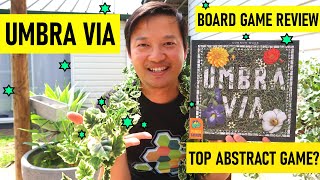
- Incorporates a double auctioning mechanic.
- Auctioning stage provides room for bluffing.
- Drawing from the mystery bag adds uncertainty and keeps the game exciting.
- Tile placement requires spatial thinking and strategic decisions about closing or extending paths.
- Tile placement order mechanic is beautifully crafted and designed, with a huge social impact.
- Nuances in micro mechanics make the game feel organic and flow.
- Rules are quietly crafted with purpose.
- Good two-player option.
- Theming is not very strong.
- Game can feel mathematical, calculated, and economic.
- Components: tiles with flowers on them can slide off too easily.
- Some tiles could have used more greenery for better table presence.
- Floral competition
Mechanics (from transcript analysis)
- Auction — Players bid for different tiles using energy flowers and soul flowers. The game features a double auction mechanism where the auction happens twice in a row.
- Bag Building — Players draw wooden flower tokens from their player bags to bid. As players acquire soul flowers, they are added to their bag, increasing their bidding power in future rounds.
- route/network building — Players try to create the longest meandering path with the most energy flowers on them.
- Set Collection — Players acquire soul flowers by completing pathways. The player who retrieves all of their soul flowers first wins the game.
- Tile Placement — Players acquire tiles from the auction and place them onto the main garden board, connecting them to previously placed tiles to create closed pathways.
Video topics + discussion points
Quotes (from this video)
- Umbravia is an abstract board game that reminds you that the world of floral competition is both thorny and pretty at the same time.
- The garden board now becomes a botanical battlefield of tactical tile placement, floral arrays, and an all-out plant war.
- The tile placement order mechanic is something in this game that I actually really think is beautifully crafted and designed.
- Umbravia is a deceptively intuitive game, where each mechanism just swivels correctly and purposefully so that each and every micro decision that you make impacts on your future success in the game.
- It is an abstract board game that definitely grows on you.
References (from this video)

Mechanics (from transcript analysis)
Video topics + discussion points
Quotes (from this video)
- I appreciate the enormous outpouring of support that came through
- the light at the end of the tunnel being so big of playing board games with people in person
References (from this video)
Mechanics (from transcript analysis)
Video topics + discussion points
Quotes (from this video)
- easy to learn hard to master
- it's essentially a sort of a spatial beating and area control area majority influence sort of game
- it's pretty simple rules
- I found that whole element of it very interesting
- the bidding economy is pretty clear
- not exciting but I definitely found it interesting
References (from this video)
- Easy to learn rules with depth in strategy
- Clear and interesting bidding mechanism
- Time-efficient pacing with two bidding opportunities per round
- Focus on star efficiency and minimizing wasted points
- Engaging tension around closing paths and attaining majorities
- Randomness in star drawing can overturn planned strategy
- Not described as exciting by one speaker, though still interesting
- Mastery requires careful balance and experience, which may be challenging
- majorities on road segments through star bidding and placement
- abstract spatial area control with roads
Mechanics (from transcript analysis)
- Auction / Bidding — Each round has two bidding steps; players draw three stars (a mix of light and dark) from their bag and bid on tiles behind screens.
- Catch-Up — There are two rounds per cycle, giving players a chance to respond after seeing early actions.
- Compound Scoring — Paths are scored by majority of stars on a path, with points equal to the path's length.
- order of placement and rotation rules — The player with the fewest total stars places first, the first tile must go in the middle, and tiles cannot be rotated.
- path closure and scoring — As paths are closed, lines are removed and scoring is resolved for the affected paths.
- path/majority scoring — Paths are scored by majority of stars on a path, with points equal to the path's length.
- random element in bidding — The stars drawn for bidding include random light/dark stars, which can overturn strategies.
- round end final tile — The final tile of the round determines the round winner and grants additional points.
- secret bidding with star tokens — Each round has two bidding steps; players draw three stars (a mix of light and dark) from their bag and bid on tiles behind screens.
- star placement behind screens and reveal — After bidding, players reveal and place stars onto roads on the board, aiming for majority control.
- star values — Light stars are worth two points; darkest stars are worth one point.
- two-round cycle with catch-up — There are two rounds per cycle, giving players a chance to respond after seeing early actions.
Video topics + discussion points
Quotes (from this video)
- easy to learn hard to master
- it's essentially a sort of a spatial beating and area control area majority influence sort of game
- it's pretty simple rules
- I found that whole element of it very interesting
- the bidding economy is pretty clear
- not exciting but I definitely found it interesting
References (from this video)

Mechanics (from transcript analysis)
Video topics + discussion points
Quotes (from this video)
- all of the games we played were really close there's not a game where anybody
- umbravia is published by pandasaurus games
- it's very suspenseful
References (from this video)
- suspenseful bidding with meaningful player interaction
- close, tense games across multiple plays
- beautiful visuals and vibrant components
- effective blend of bidding, route building, and area control
- abstract thematic connection may not appeal to those seeking a strongly narrative experience
- secret bidding can lead to coordination feelings that some players might find uncomfortable
- recovering/putting your soul back together
- Whitson Wagers
Mechanics (from transcript analysis)
- Area Control — scoring goes to the player who controls a pathway based on the distribution of energy flowers on tiles
- Blind bidding — players draw three flowers and place bidding tokens face-down, with a two-phase bidding process and reveal
- end condition based on soul tile — game ends when a player removes their soul tile by meeting specific path and soul flower requirements
- Network/Route Building — players place tiles to create and extend paths on the main board and attempt to close pathways
- path closure and tile discarding — once a pathway is completed, the path tiles are scored and soul tiles are discarded from the game
- path scoring and tie-breaks — paths are scored by energy flowers on them; ties are resolved by a defined tie-break order
- Route Building — players place tiles to create and extend paths on the main board and attempt to close pathways
- soul flowers and soul tile scoring — flowers collected contribute points; the soul tile is worth two soul flowers and is central to endgame goals
- Tile Placement — tiles are placed on the altar board in a setup, and bidding tokens map to those tiles
- tile placement on the altar board — tiles are placed on the altar board in a setup, and bidding tokens map to those tiles
Video topics + discussion points
Quotes (from this video)
- all of the games we played were really close there's not a game where anybody
- umbravia is published by pandasaurus games
- it's very suspenseful
References (from this video)

- Interesting two-step bidding
- Strategic path manipulation
- Complicated gameplay
- Soul Flowers
- Ancient pathway
Mechanics (from transcript analysis)
- Auction / Bidding — Players secretly place flowers on tiles
- Path building — Creating and completing paths with tiles
- secret bidding — Players secretly place flowers on tiles
Video topics + discussion points
Quotes (from this video)
- maybe there is a new game for you to discover
References (from this video)

Mechanics (from transcript analysis)
Video topics + discussion points
Quotes (from this video)
- it's a race to do that
- this is a clever design
- it's a puzzle
- bidding for me is such a difficult thing
- double bidding