Mistborn Board Game Review
Games in This Video
1 game is featured in this video — it unlocks as you watch.
Transcript
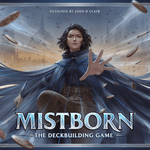
Enter the world of coinshots, tan eyes, and soothers in Misborn the deck building game. Thank you for joining us at Tantrum House Studio D. I'm Melissa. I'm Kevin Dup. Misttor, the deck building game is a competitive deck building game for one to four players. It takes about an hour to play. It's based on the book series by Brandon Sanderson and designed by John Declair. It's published by Brotherwise Games. And the publisher sent us this review copy. So, in this video, we're going to give a quick overview of the game and then discuss our opinions. In Misborn, the deck building game, you take on the role of a powerful alommancer who can burn metals to trigger special powers. You can win the game in one of three ways. Eliminate the other players, reach the top of all three mission tracks, or power a specific card with four ATM. On your turn, you advance your training track by one. This track determines how many medals you can burn and which character abilities you can activate. Then you can play the cards in your hand. They can be action, ally, or funding cards. Funding cards let you buy more cards. Action cards require you to burn a specific metal to grant you some benefit. You can
use the matching token or another card with the correct medal. Allies are played in front of you and stay out until they are defeated. They can have ongoing abilities or special abilities that trigger when you burn a specific metal. Some of the benefits you can gain from cards are money, which you can use to buy more cards from the market, mission points, which let you move up the mission tracks, combat points, which let you attack other players, and health to restore yourself. You're trying to gain the best combination of cars to advance your goals and hinder the other players. The first player to achieve one of the win conditions wins the game. Yep. So, we're separating the section into four C's. Our thoughts about components, our critiques, our commendations, and finally at the end is the conclusions.
Okay, let's start at components. So, first of all, there is a storage solution. It's a plastic insert into the bot bottom of the box. It it all fits well in here. Um, you have a spot for the cards and the tokens and, you know, your player tracks and stuff like that. But I will say the medals are all in one spot here. It would be nice if there were some sort of way to have player pieces all together so you can hand them out easier. I was thinking maybe even like little cardboard boxes that you can have like, oh, here's your player. Here's your player. Here's your player. And you just pass them out. I've seen that in other games. I think that would just be a little bit easier, right? Yeah. I would love to just be like, here's your bag of stuff, right? Deal with it. Um the so as far as components go, the player boards are inset. So that is nice. There's a place to move your training tracker also to hold the different metal tokens because you're moving them and flipping them and that sort of thing. So there is a spot for them on the player board. So that's nice. Uh you also have player dials. I don't remember. Did we have to put these together or I think they were already together. I don't remember. Don't remember. But they work fine. They are functional. Y they go up to 49.
Yep. And you read your health up and down. Yeah. Usually down, but yes, player dials for each player and they are good. We're fine. They work fine. Uh there there is a little bit of artwork not a lot but there is artwork on the cards which I think works well in the universe the misborn universe. I think it evokes what you're you know what you're reading in the books if you've read the Misborn books I will say so you have 1 2 3 4 5 6 7 eight different metals. Mhm. Now they all sort of have different designs on them, but interesting thing is there's one, two, three, four sort of pairs and they each have a a similar color. So you have, for instance, red is pewtor and tin, but they have like the pewtor has a gray background and the tin has a red background. On the card, it's I think actually a little a little clearer on the card. The tin has a darker gray here. And actually I would get confus not my not my eyes are confusing but I think my brain would automatically switch and I would be playing a Peter card for 10 when I was you know playing a you trying to burn a special metal but that's you can't do that right so it's not the fault of the game it's the fault of me maybe it's a fault of maybe the iconography could be similarly matched cuz it seemed like the tin here gray is just a little lighter and I think my My
eyes saw the light gray and the and the red color and automatically went to the pewtor. Even though it's a different opposite, I know, but I know it's opposite, but I don't know why my brain did that. It's just very interesting that that's what how it did. And I did it multiple times and I had to catch myself. So, it wasn't like, oh, it happened once. It happened multiple times and in different games. So, maybe it's just me. So, Kevin Kevin has trouble distinguishing some of the Yeah. different medals. So, anyway. Yeah, I it is important. Um the pairings work together, but you still have to use the specific token for the specific type of card. All right, we're ready to move on to our critiques. All right, so this is a deck building game. Y. So, it's going to have deck building features, which I I don't think there's a way to get around this in a deck building game, but you do start off pretty weak with not very interesting turns until you can actually build up your deck and get those synergies going. So, the game is a little slow to begin with until you kind of hit that momentum.
And with it being a deck building game, you have the randomness of the shuffle. Mhm. So, it can sometimes be a little frustrating if you're pulling your weak cards or cards that don't go together and then other players are hitting those combos and having those big turns. It's just something that is inherent I think with deck building games and it's part of this one as well that you'll have some really interesting impactful turns and then you'll have some turns that you're like I bought something or I I had one time when we were playing I flipped the token. I had one where I didn't have any like the way it turned out is like I couldn't even get a token cuz I needed you need $2 in order to get a token and and that's just even a bad turn in of itself. So I was like I guess I'm really not doing anything this turn.
So like most deck builders this game has those aspects. So it's less of a maybe critique of Misborn the deck building game but just if you're going into a deck building game just know that these sort of things happen. Um, I already mentioned a small critique about the art in uh during the component section. Another critique I have is there's different game modes. You have the main game mode which is competitive play where you are trying to basically defeat the other players and and try to win for yourself. There is a variant or solo variant. We haven't played the solo. There's also a co-op variant. I thought going into this game I was like, "Oh, you're burning medals. you're trying to like, you know, build yourself up. And in this co-op mode, you're trying to defeat the game. In this game, it's the Lord Ruler, which is in the book. I was like, "Oh, that'd be that just sounded cool in my mind." I'm like, "We as a team can band together and we can defeat the Lord Ruler." I'm like, I'm excited. Yep. But that didn't happen. I was like, I don't know if who designed the co-op variant, but it it is extremely difficult. Now, I think we should let viewers know that we played co-op first. We did. So, we didn't have a lot of the, hey, I've really learned how to play this game through the
competitive. I've gotten all those synergies together. So, I would say don't try co-op first. The Lord Ruler will decimate you. But we played it multiple times, multiple times before we would decide to go with the competitive play. I don't know. I just even knowing now the competitive play, which we'll get to in a second. But I'm thinking like in most co-op games, I want it to be like a 60% fail rate and a 40% win rate. I don't know. This is like a 90% fail rate and a 10 there. The Lord Ruler is hard. I know that's sort of like thematic with the book. If you want to speak to that a little bit, you can. Yeah, the the Lord Ruler, he he's pretty powerful. It it takes some stuff to bring him down. But I mean, in a co-op game, you want I I think you won a 60/40, not a 9010.
Yeah. And I know we're getting ready to talk about the competitive game. Yeah. I would say in the cooperative game it feels like you are getting targeted and beaten down pummeled pummeled more often. Yeah. Than in the competitive game. So it it feels more everyone is getting pummeled in the co-op game. And I feel like man I wish there was a way where it was it wasn't hitting everyone cuz I it's like oh are you going to take damage? No. We're all taking damage. We're down to 10. Can we even survive to even cuz in the co-op game you have to sort of make it to the top of the mission tracks and then you can start actually getting killing the Lord killing the Lord Ruler. You can't really do any damage to the Lord Ruler until you get to the top of the mission tracks and it can take you a long time to get to the top of some of those mission tracks if you're not planning well. So there's a lot of planning and a lot of losing.
But I was surprised by the competitive play. So, let's move on to our commendations. So, let's talk about the competitive play. I was surprised on how much I actually enjoyed the competitive play compared to the co-op. So, and I'm specifically going to say three or four players for the competitive play. And the best way I can help you understand how the competitive play works is if you've played King of Tokyo. King of Tokyo is like exactly what sort of the competitive game feels like, but in a deck building sort of game. Whereas you as a player, if you have the target card, you are target um token token, you are going to be getting all the damage. So it's like you're in Tokyo. You're in Tokyo. But if you have the target and it's your turn, all your damage affects everybody around the table equally. So, if I'm going to deal 10 damage, everybody's getting 10 damage, which I find very satisfying in uh this kind of game where you could, you know, feel like I'm going to maybe not have the target or maybe I want to pass the target off. And there's ways to do that in the game. Yeah. So basically, if you have the target and you get damaged, you have the option to keep the target or give it to another player. So you have a little bit of agency of who do I think
needs to get beaten down or who do I not want to have the power to do a bunch of damage back to me? That's true. So, it adds a little bit of strategy into a game which could just have been, "Oh, that's the weakest player. Let's knock them till they die." And now it's a little more difficult to do that because you have the target that's moving around when you have three or four players. Yeah, I like that a lot. Um, also, one of the things I enjoy about this game are the mission cards. And you're going to have three in a given game. And there's multiple cards to choose from. I I mean, you could do it randomly or you could be like, "We want to play with these three mission cards." And you're going up basically tracks and you're getting benefits along the way, whether it's whether it's health or maybe it's moving up your training track a little bit faster. That's fun. So, I I appreciate um the mission cards. Yeah.
And there's a little bit of a race element, too, because the first person who gets to certain levels gets an extra benefit. Kevin did beat me to a couple. Like, I was one step away and then he Yes, cuz you some of the cards you can purchase can help you go up those mission tracks even faster. Mhm. Now, there are a few that can um slow people's ascent and bring them down as well. So, uh that's sort of dovtales into one of my commendations. One of the things that I like about this game is the thematic elements. So, I've read the Misborn series. Kevin has as well. Oh, where'd my There there's I have a little VIN pin. Little VIN pin of uh one of the main characters from Misborn. Yep. But the medals that you're using in the game, the actions and what they allow you to do are thematic to the types of things that would happen in the books.
Mhm. Cuz each metal gives sort of a different power. So you have the iron and the steel which are pushing and pulling and that's letting you pull cards out of your discard back into your deck or push cards out of the market so you can refill it to have more options. You have pewtor which gives people a lot of strength and that's going to give you a lot of combat points or defense points and those sort of things. So each of the the metals and the types of benefits you're going to find on the cards is thematic to the books and I enjoyed that. Uh thinking through those things you thought about a lot more than I did. I mean I do agree it's thematic but I I like oh yeah it's it's there and you and you're pulling things well because I'm so familiar with it and I've read the rule book. Um I can look and see oh that's a copper card. I know it's gonna do these sorts of things before I even pick it up to read the exact power. I kind of have an idea of what those cards are going to be doing. Cool. Uh another thing I enjoy in the in this game are the training tracks. You're moving up and as you move that training up, you're getting better. Um you're able to burn more medals cuz at the beginning you're only be able to burn one. Now, I will say the game does have a mechanic that lets you activate cards even if you aren't able to burn more than one metal.
And that's you can flare a metal, which basically is spending it, you know, so that you can kind of like exhausting it, exhausting it. And there's there are ways to get that, you know, unflare getting it back. And then you can also um get cards that can actually um activate the powers as well. So if you if you want to activate a pewtor card, you could get a pewtor another puter or tin. Um is it tin anyway? Peter and tin and tin go together. So like that when I talked about those pairs, they are important because then they can help you activate other cards even if you aren't able to burn those medals. Now you are spending that card instead of using it for the power. So you have to weigh the, you know, what's better for you, what what card you want to play. But I appreciate that there's other ways of playing cards than just having the to burn medals. Yeah, I really enjoyed that strategy aspect of the game. And sometimes those cards have little benefits if you use it as a payment.
Yes. If you're using it to activate another card, it may have an additional little benefit. Mhm. Uh so the last thing that I wanted to bring up in the commendations, the things that we like is that the game does have some asymmetry. Asymmetry. um heard it both ways. The player decks are slightly different for each player. They're going to have affinities for different metals in their deck cuz I think it's about four actual action cards in your deck that is specific to a character and then you get the money cards, some funding cards. So, you start out with a little bit of a different specialty than other players, and then each player has three abilities slashbonuses. One of those is unique to each player. The other two, I believe, are the same for um each player. So you have some of that uh divergence at the beginning of the game and things that you're going in and kind of make you lean towards different metals maybe if you're trying to synergize them. So I like it's it's not a ton of asymmetry but a little bit. Yeah, it's helpful.
All right, let's end with our conclusions. So I want to start the end with some comparisons. Sure. Uh Kevin already mentioned the comparison to King of Tokyo with the target that is moving around to different players. There was another game that an aspect of this reminded me of as well and that is Star Realms which is another deck building game. It has the I think the base cards that go out in front of you and stay there until they get defeated. Well, Misborn has ally cards, and those go out in front of you until another player defeats them, and some of them even are defenders. So, you can't attack the player until you've taken out their defender ally. So, that was just a a little uh comparison. And I'm not saying it's exactly the same, but to try to think about what this game is like, that was something similar that I noticed for me. I thought going into this game I was going to enjoy the co-op game better than the competitive, but in the end, I enjoy I think what this game was made for was the competitive version, and I really like that. I like deck building games. This game does very well with that. I think John Declair was able to incorporate the Misttor universe, the theme, we sort of mentioned that even like the medals and the players and the
allies and all of that together has works really well. Keeping the Misborn theme at the forefront and not just a side effect to what you're actually doing in the game. So, personally, I normally don't like head-to-head, attack other players, try to eliminate them types of games, but I appreciated that this one does have multiple ways to win. It's not only or just about eliminating other players. You can try to get up those tracks or get the card and try to get the ATM. And I think I did almost at one time. I think I had like three ATM and I had the card. M it's almost like a you win card if you can pull it off. Uh so I appreciate that this game has those elements to it. I have enjoyed playing it.
I enjoyed the source material, the Misborn novels, and I'm a fan of a lot of the designers games, John Declar's games. So, I was so happy that it all came together in a great game, a fun game, a strategic game, something that is interesting to try to create those synergies and figure out how to make the cards work for you and to use your medals and not um you know, flare them all so you don't have them. So, I was very impressed with Misborn, the deck building game, for the type of game it is. I would enjoy it and play it. Good. Well, we would love for you to check out Miss Born the Debbing game from Brother Wise Games. Be sure to check it out on their website or at your friendly local game store. And as always, please like and subscribe. We'll see you on the next video and let us know, are you a fan of Brandon Sanderson? What what are your favorite novels that he's done in the comments?