Defenders of the Wild 2nd Edition & Critter Moon - TCbH Review
Games in This Video
1 game is featured in this video — it unlocks as you watch.
Transcript
But the point that I'm getting at is that pretty much all the actions in the game, both of the actions you take and on the part of the automated machine, are So, in preparation for this review of Defenders of the Wild second edition, I thought it would be important for me to go back and watch the original video to really see how things shook out last time. And aside from looking at it and going, "Man, that guy without a beard still looks pretty good." I was surprised by how much still held true. Now, part of that may just be my general review style where usually I'm less interested in getting to a granular level with particulars where most of the changes in the second edition reside.
But it's also just my overall assessment of the game. Defenders of the Wild is a solid, if a little straightforward, cooperative game that tells a bold story of collaborative resistance against impending industrial machinations via bold woodland creatures v. machines. That was true a couple years ago, and it's still true now. But second edition feels a little bit more realized, a little bit more defined, polished. It's paying more attention to the adjectives, you know? Where something might have been described as rudimentary in the past, with just a couple tweaks, it's now coming across as more efficient. Where something was more limited, well, it's looking for every opportunity to jam things in just in the right way so you could describe it as dynamic. It's definitely the same game, but tip-to-tail, it's just a much more organized woodland rage against the machine. Okay, I'm not going to spell out the entirety of the game here. And if you want to go back, you can watch the original review, which has a gameplay overview that's still 90% accurate. So, just know in broad strokes, each player has a faction represented on the board by a leader.
You play one card per turn which sets your action point and usually gives you some immediate or ongoing bonus. Then you take actions to interfere with machines by breaching walls, clearing pollution, re-wilding constructed factories, or destroying max. All of which increases support which lets you put out new resistance outposts at increasing support costs. Then concluding each turn by revealing a machine card, performing its operations to create that which you're pushing up against, pollution, walls, factories, and max, and play continues. Hey, quick editor's note here. You'll notice that the machine engines are dictated by their little gear eyeballs with two on one side and one on the other except in a lot of the B-roll, you'll notice that I used this one or these two which have two and two. This was a mistake on the part of the production, but it was caught early enough that the publisher was able to send me replacements and also address the issue on the publishing end so all backers get the corrected versions and all the future copies will have the correct components and you won't have to worry about this issue. Instead of it being a criticism of the game at this point, it's now a compliment to the publisher for getting it resolved so quick. Now back to the video. Important to note though, as you take actions, if you're at a space or adjacent to a space with a mech including the central core, you roll for damage before resolving the action outcomes if you're actually on a space with one or more max. Once all
players put out their outposts and make a final movement into the machine core, they win the game, but fail to do that before taking so much damage that you lose too many valuable team member cards from your deck or run out of any of the machine related components and you lose. Okay, like I said, all of that is still true, but it's in the details where you start to notice the biggest differences. The first change that came to my attention, and a very welcome change, was in how items are used. Little expendable tokens that can be used for free actions and have a huge amount of utility, but used to be defined and exclusive to whatever factions are currently in your session. If someone is playing the plum-colored sect faction, who thematically are a little bit more comfortable with the machines than the other factions, all players could have access to the rockets, but in that first edition, if you didn't play with the sect, then no rockets got used by anyone. Second edition maintains a general faction alignment, but within each faction deck are opportunities to get any of the four items, granting more strategic possibilities, thereby making more interesting turns, and as a product, resulting in more fun. And the faction decks in general have been focused a bit, leaning into what works, but juicing up the things that didn't, so it doesn't feel like there's any duds in the deck. At the same time, the rules in general are just more straightforward. Operation of the mix,
more straightforward. How cards are played, more straightforward. Though, one of my criticisms of the original was that there wasn't really a different identity, a different scheme that you could give to the overall machines to make each session feel like you're you're playing against a different big bad, and that's not fully addressed here, but there is some effort in giving each of the factories, once constructed, these huge totemic towers that have their own flavor of card, giving a unique form of bad stuff happening, and moving the furnace, the new source through which pollution is distributed, overall relying on the predictable systems to create slightly different variations via the cards. The game doesn't seem any less dynamic, just more confident, which is kind of fascinating, especially with the introduction of the Critter Moon expansion, which in addition to giving each player color two new faction leaders, making it kind of a no-brainer, it also gives you these big, bold insect shields for each faction that you can activate every new outpost you create. Then, like an item, you can spend it as a free action. It's a tiny addition, augmenting the existing asymmetry created by a combination of default and leaders personal faction cards, but furthers the distinction of each faction with virtually no additional rules overhead. Honestly, it's a slight criticism, but I get it.
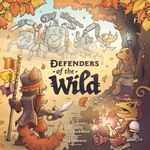
It's the biz of producing games, but I honestly think everything that's in Critter Moon could have just been included in the second edition box, and it would have been no worse for wear. While less important, I don't want to undersell how much better the second edition looks. Bearing in mind that even first edition was no slouch. Some of it looks the same, sure, but the resistance leaders are resplendent with a glossy finish, and the machines are much more menacing than ever with the ultra-chunky core hex, smartly sporting a dual-layer inlay for engine direction toggle. Pair that with some new artwork thanks to the expansion and a massively thick border, and probably my favorite new addition, the wall breaches that now straddle over walls for a really cool effect and just better functionality.
The game overall feels nicer without betraying its humble artwork through outright ostentation. The things it hasn't changed, though, are, for better or worse, the fundamentals. Defenders of the Wild is still pretty narrow in scope and follows the flow of the most well-tread format of cooperative board games. Move your pawn, take some actions, take care of short- and long-term bad stuff. Bad stuff happens, try to not let immediate bad stuff grow out of control while working toward long-term goals. Next player's turn. There's a fine line between stale and classic game design it's treading, and while the polish, especially in the second edition, puts it solidly in the latter camp for me, your own mileage may vary. When the original came out, I was very excited by Defenders. I love co-op games. I love pawn claw fantasy. I love resistance stories. And I was really interested in the union of Outlandish Games who had done Block by Block, as well as the designer Henry Audubon who had designed Parks. I mean, that's a really potent union. And the game was pretty good, but far from a favorite. Interesting, but it hadn't quite found its footing. Second edition genuinely changed that for me. It found its voice leaning into what it was trying to be and cut away the fat. I mean, hell, part of the marketing for the second edition was now a fewer rules, which is awesome and hilarious, but also I think pretty astute. The self-recognition that having a more
complicated game often just complicates the game itself without making it any more complex or rich. And so, instead, just trying to lean into how to have the best experience with the rule set that it has and finding its niche. As it stands, the second edition is now definitely a keeper for me. Having a lot of meat on its bones, but having a smaller box and play time than a lot of its contemporaries. If you played Defenders first edition and hated it, I don't think this is going to redeem it. But, if you found it pretty good, if not quite there yet, or you're new to the game, but you're interested in a more classic style co-op with some rich, but easy to understand, navigate, and carry out systems with some novel ideas on strategy, as well as the procedural development to the mounting bad stuff, and a tidy solo mode to boot.
Defenders of the Wild second edition did it for me. And that's our review. But, let me know, what is your favorite second edition of game that took some rough ideas, fleshed them out, and polished it and presented it in a bold way moving forward. Put it in the comments below, and as always, thanks for watching, thanks for supporting, thanks for doing all this stuff that helped this channel grow. Your likes, subscribes, comments, checking out the Patreon, and sharing these videos out on the webs do a tremendous amount to help us. But, above all else, thanks for being such a great community. You know that I've been Jack for The Cardboard Herald.