Land vs. Sea (board game review)
Games in This Video
1 game is featured in this video — it unlocks as you watch.
Transcript
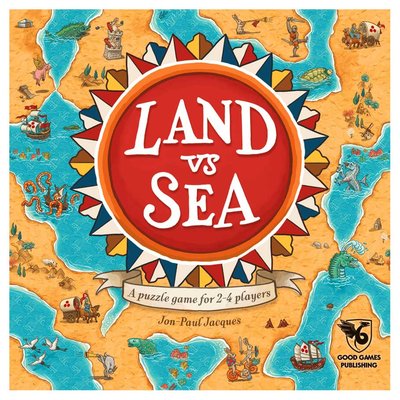
this episode of brains on games is about a puzzly tile laying game that's about making maps welcome to brains on games i'm dr brian mcdonald in this episode we are going to talk about a puzzle-laying map making kind of a game that was sent to me not too long ago by the folks over at good games publishing now i've been doing this show for over a year and i maybe i was sort of feeling like i couldn't be surprised anymore like i knew what kinds of games were coming before they they were out in in retail and i was up on the news about new games but this one hit me completely by surprise it's a little game called land versus c now this is a game for between two and four players it works with kids age 14 and up honestly it's very modular so younger kids could definitely figure this game out but 14 and up is what it says on the box you can play a game in about 40 minutes let's take a look at land versus c i've learned over the year of doing this show that one thing that i love is a game that is very strategic and offers you lots of interesting decisions but that's quick to learn and quick to set up and land versus c has this in spades first of all you get this box that has some hints on the side about scoring it's got some artwork on the other side but the box is also your victory point
tracker so you're going to put some counters on here to keep track of your points this is where all the tiles go and when i open up the box there they all were all lined up and there's a little spot at the end for the counters so this is a game that literally takes probably less than 30 seconds to get set up you open up the box you make two stacks of these tiles that have islands and things on them and and oceans well there's land and there's c right you'll have your victory point counter from the box right there somewhere within reach of both players or all of the players you'll have two stacks of of tiles like this the only other things really that you have to do is pull a land and a c counter out of the bag now if you're playing three players there's also a navigator and things score a little bit differently but at our place we played mostly two players and that's mostly what i'll be talking to you about today there are two special tiles that you also have to pull out of the stack so when i'm putting the game away i always grab these tiles and make sure they're at the top so that they're easy to find again i like a game that sets up very quickly and this definitely does that you play the starting tile right in the middle of the table this is where you're going to be building your map from that point it's got that big marker on it and it's half land and half c the other special tile has a whirlpool on one side and a volcano on the other and this is a special tile that get that gets played once you've surrounded a hex with other
tiles you would drop in either the the whirlpool if it's a c that's surrounding the middle or you would drop in the volcano and that is a tile that will give the player who completes that that c or that land lots of bonus points we'll talk about how the game is scored as we go forward you'll grab a couple of tokens like i said a a lan token and a c token those will go at zero on your victory point tracker there are some extra tokens in the box and those are meant to set waypoints that will give you bonus points if you manage to score the tile that you've placed them on once you've got your center tile picked out in your whirlpool slash volcano tile pulled out of the stack you've got your two stacks you've got your victory point counters each player is going to start with two of these tiles they're all double-sided on the stack but really you're only allowed to see one side until you choose it so i can't peek at the other side of these tiles before i pick one i'm only allowed to see one side and then each player is just going to take turns laying tiles in the hope that they're going to be able to earn some points what how do you lay those tiles well you have to just make sure that you're you're lining up all of the land areas or the c areas so here this would be a valid placement i could place this tile this way as well i could place it over here like this but i
couldn't place it this way because you can see that there's land on this side and see and they don't line up properly you're trying to make these islands you're you're you're creating this this medieval map uh as you play the game uh and what you're trying to do to earn points is to close off if i were land i want to close off islands i'm going to earn points once i've closed an island up so that there's c all around it whereas the c player is trying to close in lakes or seas so i've played my tile here like this i don't earn any points for that because nothing's closed off i have one tile left and at the end of my turn i draw up so that i've got two and then the next player goes in a clockwise fashion if you're playing a four player game it's two teams one team is land and one team is c and a three player game like i said will use this navigator tile and they score things a little bit differently uh the scoring is super easy you've got cheat sheets here that tell you for three player or two to four player games uh what is it that you're going to be doing but all you're doing like i said is laying those tiles and trying to close in islands or close in seas once the game gets going you're going to see your map start to build up something like this there's little sea creatures and there's a mermaid and a sea monster here there's a ship there's some soldiers over on the side uh but this is your medieval map that you're building and i've got one island in the middle
that's completed so that means that land can score because i've completed this construction the scoring in the basic game is just based on the number of islands the number of tiles in your islands construction or the number of tiles in your lake but in this case i'm counting the land tiles and there are one two three four five here so i will move my land token over here to five points and and that's just about it for the basic game there are some additional things i'll tell you about for the more advanced versions but it's very modular so i've just explained to you how to play this game super easy two extra things though on these tiles sometimes you have little crosses you can see there's some white ones here in the sea and a black one maybe over here and one up here if you manage to close an island that has those x's on them or the crosses on them you get an extra bonus point for each one on that island if you're closing in a c you get the bonus points for that so if i closed in as the land player if i closed in this c i don't know if i can do it well i really had to build up this map in order to close off that c and it took me a minute to figure out where all the openings were so this is where you you've kind of got to think about what it is that you're doing and really examine the board to make sure that you've got things closed off and maybe that's where the 14 year olds are going to be better at doing that than the nine-year-olds but i've got
this great big c that's f that's the name of a band i've got a great big c that's closed off here in the middle this is these are going to generate huge points for the c player so once this is closed off and say as the land player and the one maybe i accidentally close it off or i want to steal some of the bonus points if i play this as the final tile here to close it up the the c player will get the points for each tile in that lake but the player who's who is the one who closed that construction that the c or the land depending on what you're doing in this case it's the c so since i'm the one as the land player who closed up the c i get these one two three four bonus points so the c player is going to get all of the the main points here for this huge ocean in the middle of the map but as the land player because i closed it up i get the bonus points so you are doing a back and forth tug of war trying to close in your areas and maybe create more open spaces for the other player to make it harder for them to close in theirs and you're earning some bonus points based on those number of x's on the tile so you definitely want to think about how you lay things out and when you're going to close things up and you as i showed you at the beginning you've got the whirlpool here that has six bonus points there's six bonus points for the volcano so if i were somehow able to create a big open area in the
middle i could drop this in and whichever player is the one who closes that space is going to get those six bonus points obviously each player well if if it's the whirlpool this is what happened in our game my son managed to play the whirlpool but he had this big c construction that he was trying to finish and i he was trying to close it up and i was trying to stop him from closing it but since he was working so hard to close it i might have been and he eventually did it but i might have been better off closing it myself to block him from getting too many points from the big lake and then i would have gotten these six bonus points plus whatever bonus points were also available on the board two other things in the base game that comes up on the tiles that you would do before you replenish your hand is the some of the tiles have symbols on them that allow you to take actions for example this symbol right here i'll show it under the camera you can see there's a couple of them on the map this symbol right here means play again so i would get to lay two tiles if i put this one on the board and then i replenish my both of my tiles at the end of my turn the second special symbol special action that you can do is a steel action so you've got a picture of these two swords i'll show it on the other camera here it's two swords in the middle of the tile and if i've got two tiles in my hand and i play that one let's see if i can make it fit here so if i've played this that means i get to steal a tile from one of my opponents
and if i steal that tile now i've replenished up to two i don't get to draw a third tile at the end of my turn because i've got a full hand of tiles with only two of them but because you replenish at the end of your turn the player who i've stolen that tile from is only going to start with one so immediately i've cut their options in half in terms of what they can do on their turn there's not a thing that they can do about that because they can only draw up to their full hand at the end once you've played your tile and taken whatever your special action is you do draw up if you're down to one if you've already got two you don't get to if maybe you've if you've played a play again you've played both of your taws you get to draw two to make sure that you're filled up all the way to two tiles uh and then the next player gets to go it is fairly quick into because you're limited in terms of what you're doing you're taking only one action out of a possible four because you've got two double-sided tiles as the map gets bigger you really do have to analyze things a bit more and see where where the closures are and where the areas are that you have to fill in in order to earn those points and that is just in the base game what the other things are that you can add are waypoints that give you extra bonus points if i've got a waypoint on here and i finish that island i'm going to get an extra bonus point for that we didn't play with all the extra bells and whistles honestly because i wanted to get as many games in as i could so i could get used to it
the other things that you can do is track corals some of the tiles in the ocean have coral reefs some of the tiles on land have mountains and you can earn extra points by creating mountain ranges or creating long coral reefs as you're laying those tiles so suddenly you're thinking about the rotation here not just closing things up but what's going to be in the middle how are you going to get some bonus points for that it just gets more and more complicated there are caravans where you get bonus points for linking up tiles that have ships or have trade caravans on them if you were talking about the land tiles i mean it's just it it ramps up quickly in terms of the difficulty when you add all of those extra things i think that increases the playability it certainly makes you think more and more about where you're going to set those tiles down and which of these tiles do you want to choose but even the basic game was we had a great time playing it i immediately wanted to play again and again and again to sort of get the hang of this the pieces are beautiful the components are great the box is excellent it how long did it take me i'm a slow talker and a repetitive talker and how long did it take me to explain this game to you you've got you've you've got a tile delay an action to take you replenish your hand that's it you get points for closing things in whether you're land or c obviously this is a game that we really loved what would i change about it i mean the only thing i can think of is maybe having more time in my life so that i could
play it more or making the pieces heavier and waterproof so i could bring them outside and i wouldn't have to worry about them getting wrecked it'd be nice in the summertime to play this game outdoors and have this beautiful map on your table but what skills are you working when you're playing it it's a huge visual spatial game because you are thinking about the various permutations and rotations of these pieces that you're putting on the board and how are you going to close up those areas that you need to close you're also exercising working memory working memory is the white board in your mind where you keep information so that you can do something with it you're juggling a lot of numbers here and a lot of information and each module that you add whether it's the caravans or the mountains and coral reefs that's adding more complexity the waypoints even it's adding more information that you have to keep track of and juggle when you're doing the calculation of how am i going to maximize the number of points that i'm getting if i put this tile down here at the bottom i could close up that island but maybe i don't want to close it up yet maybe i want to make that island a little bit bigger and i'll close up this part of that island because this could be huge points for me at the end if i close it up so i'm taking this piece and i'm rotating it around and thinking of where can i put it and if i put it here i'm going to get only three points but if i put it down here then on the next turn i might be able to x y or z so there's lots of calculations that you're doing and the calculations get more
complicated with each new rule that you add to the game we finished just the basic game i think our first one our scores were like 86 to 57 or something like that and you have to look on i think i posted it on instagram or facebook and i i won our first game the first time we played it so i was very pleased with that usually if it's a spatial game my son who's in engineering he's an engineering student right now he'll he'll beat the pants off me but i it certainly was a route last time we played so if any of my family members are watching i defeated riley uh the first time we played this game we will talk about later games but you're exercising visual spatial thinking visual spatial planning mental rotation skills those all fit under the visual spatial umbrella puzzle assembly and visual analysis those are all under the visual spatial section if we're doing an iq test and that working memory which is one of the executive functions those skills that you need to be able to work towards a goal and that in a nutshell is land versus c a super fun puzzly game we played it usually as just a duel between two players but it's quick it's fun it's strategic super easy to set up super easy to explain if you have any questions or comments about this video you can leave them in the comments section below or you can email me at brian brainsongames.ca brainsongames.ca is the website that's where future episodes will go and the previous ones are up there already brainzone games is the
twitter handle on the facebook page in the instagram feed so we're all over the place and if you enjoyed this video and you want to be notified of future ones you can head on over to youtube and click that subscribe button thanks for joining me hopefully i'll see you next time you