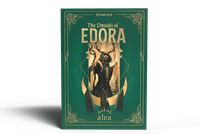
The Druids of Edora Review: It's Not Easy Bein' Green
Games in This Video
1 game is featured in this video — it unlocks as you watch.
Transcript
Hey everybody, I'm Tom Vasel.
I'm Chris Yee. And I'm Wendy Yee. And today we're taking a look at the Druids of Adora. Uh very unassuming name. There's a lot of games with Druids in them these days. This came out last year to almost nothing. I heard nothing about it and it slowly grew in buzz at Dice Tower West. People were talking about it.
Or did it not? It didn't. Okay. In fact, it still [clears throat] hasn't.
Yeah. Pretty much yeah, it's an Essen release and I had some buzz there. Uh designer Stefan Feld, obviously he drives some buzz and some excitement and to see him paired again with Alea, you know, I mean that pair made a lot of classic games. Yeah, in this game you are doing something druidy. I honestly don't really
You want druid prestige. You are erecting rune stones and standing stones and collecting mistletoe for your magic potions.
It's a Feld, baby.
Druid prestige.
Wendy's going to show us how to play it and we'll be back. In the Druids of Adora, players are playing as druids who are going around visiting shrines on the board, making magical potions, collecting gems, and doing various and sundry other things to be able to become the most prestigious druid out there. Uh this is the victory point track, also known as the prestige track. And during the game, players are going to be taking one turn at a time until someone has used up all of their dice. Now, the way a turn works is this, player eight over here. So, first someone is going to move their die and they're going to pay provisions based on whether they move through black area, whether they move to a new shrine, all of that. So, they'll pay provisions for moving, then they will place out a and they will pay provisions based on the die value that they've placed.
They will then compare dice with anybody else that is in that shrine, and whoever's the winner's going to receive two points. Right now, this is purple, so they would get two prestige points immediately. Then, they would take the action of the space, and depending on which space you actually place your die will determine what action that you take. Um and then, you'll look around to see if your dice have completely surrounded any of these campfires that are on the board, and those just give you little bonuses. Then, you'll check to see if your dice have connected any two dolmens of the same color. So, right now, purple is getting really close to connecting the pink ones. And then finally, you'll look to see if you have unlocked any of these special flower herbs over here. Now, these flower herbs are ways to get little special player powers and bonuses. You usually pick one and then turn over the other. All right, now that I talked about general turn structure, let's talk about the actions. Now, the first action I want to talk about is actually gaining mistletoe and brewing potions. So, throughout the game, you're going to be gaining these little mistletoe tokens over here. And then, when you gain the option to actually brew a potion, you can choose one of these tiles based on the amount of mistletoe that they require. Next on my list is the knowledge track. Now, this knowledge tracker is going to be end-game multipliers at the end of the game for kind of an area majority thing that you're going to move along this, as well as the tiebreaker for the game. And you can just move up on that track with anything that has this knowledge symbol.
All right, so I seem to be moving down components-wise here's for the action. So, let's go ahead and do these gemstone tokens over here. Uh you get these on these gemstone spots, and there's different levels of gemstones. You can place them based on the levels over here for end-game scoring, as well as you'll get a multiplier for whatever the bonus is on the gemstones themselves. Next on my components is dice, and on the action space, you can either choose to get dice, or you can choose to get provisions. These are super required to take a turn because you always have to play provisions to move and place out the dice, and you need the dice physically in front of you, so you need them unlocked to be able to take the actions on your turn. All right, moving from these components to the right, this is the Oracle area over here. I mean, you take an action space that kind of matches this back over here, so it's the symbol with the swirlies.
And this Oracle area, you're just going to take one of these Oracle stones, and these are kind of end game objectives you're trying to meet, and then you'll take these little bonuses that are on the side of it. It just replaces, and that's the whole action right there. All right, next let's move to our player board over here. So, we have square spaced rune stones and then circle spaced uh standing stones, and you can see them over here on the board. I'm trying to find two together. Here we go. So, we have the rune stones, which is kind of square based, and then the standing stones, which is kind of circle based. So, for the rune stones, you're going to take these off, you're going to place them wherever you're at, where you took that action, and they're just going to stay there, and they're going to be like an end game multiplier thing for whoever has majority on this space. And then, the action that you take is going to be based on your die value. So, you're going to get some sort of bonus based on that. Whereas, the standing stones will also come out wherever your die is, and I know that's not technically that action. Um but, they'll stay there.
They'll also be part of that end game multiplier. However, these give you the benefit of whatever you chose uh to pull it from, plus any other ones you've placed out. So, if let's say I've placed out a couple um in the game, let me put these where they actually both belong. Uh then, when I place out a new one, I would get all the benefits that are uncovered from left to right. Now, last but not least is the sickle action, so that's this little thing over here. This allows you to move, and like I mentioned before, you get to place these out, and these unlock special bonuses. Oops, I put that in the wrong spot. Uh they go where they match and that is some sort of ongoing special ability that you get throughout the game. All right, like I mentioned before, you're going to play until someone's dice have all been played and then you're going to count up score at the end. So, you're going to get points for stuff that's left over like provisions and mistletoe and dice. Uh any of these little stones that you've completed over here are going to be worth 10 points each as well as this sickle track if you've moved up, you can get points from this. Uh the gemstones, if you complete rows or you complete this first column, you can get points from that as well.
And then finally, we're going to score the shrines over here. Now, this is going to be very full by the end of the game. This is not that set up. But what you're going to be doing is you're going to be removing all dice except the highest level die on each shrine. Uh so, let's pretend that this is the end game scenario after we've pulled off all the dice and this is what is left. All right, the way that this scores is you're going to count up all of the dice that you have left on the board after the this low ones have been removed. All the rune stones and standing stones on the locations where you are at and then you're going to multiply it by whatever multiplier you've received over here on the knowledge track. All right, so after you've scored up all the points that happened during the game as well as all those end game points we talked about, uh then the person or the druid with the most prestige is the coolest and you know what? They deserve high fives. All right, let's go ahead and go back to the studio and we'll share our thoughts.
Okay, unfortunately, the first thing we need to talk about here is components because I think that is a big issue with the game. Although, oddly enough, I personally really like the vibrant colors of the players. I think the colors of the dice and the pieces, I think they look fantastic. That being said, I I know I'm sounding like a broken record, but in a game where you need to know all the symbology to not have enough player aids for everybody, as in none, is is insane. We printed out player aids for this game because I don't know how you could do it otherwise. You have to have player aids for everybody.
hand around the rule book a bajillion times. The other issue that I have with production is being able to see the tiny tiny print of how many victory points are on those bonfires, are on the little gem pieces. Like, if you have any sort of visual issues or struggles, like Like wearing glasses or something.
yeah. Oh, no, it's I was
hard to see. It's not just that. The symbology in general, I would get the points mixed up with the tie breaker thing, whatever that's called. Um the the seeing the dark green or forgetting it's there, just moving around. It's the game is a little smaller than it feels it could be, but the symbols and everything, the flowers, again, you could be like, "Well, once you know how to play the game." You will never probably know the game good enough to know what every flower does. I cannot see that. You have to look that up all the time. Oh, [clears throat] no. And And without a player aid, the symbology I I it's unbelievable that this is not a a Friedemann Friese Spiele game with how much green is on that board. Every icon, every symbol, every action is explained in green with a green representation.
It's so bizarre of a choice. No, I So, I agree. I I don't like the choice, but I think the choice they made is because druid's green forest. No, I get that, too, but I'm It's It's definitely a detriment to playing. Um Alea usually does pretty good quality, and I'm It's It's weird because I'm not even necessarily sure that I would argue about the quality. It's just hard to see everything. Yes.
Um and this and the symbols aren't helping in the lack of player aids. That's going to just be a barrier to most people. But game itself Mhm. So the game itself has a really funky dice mechanism cuz it's hard whenever you do a dice placement game high dice are good, low dice bad or you you know and this game does a pretty good way of handling that. The low dice are not as good although sometimes they are. I mean it's usually better to have low dice than not. There's only a few spots where the higher dice matter. Usually you're putting a dice somewhere activates a spot. Yeah, there's plenty of There's plenty of actions that the die number doesn't matter and that's when I feel like a low die is fine because then it costs less provisions. Yeah, what I want is of my 12 it's 12 dice I think. I want there to be eight ones and four sixes.
I I really think that that's the best roll. Really? Because I want high dice if I'm going to be doing a lot on that uh tiebreaker tracker for the end game multipliers because then you have more area control at the end of the game. Sure, that's why I want some high dice. Yeah. But and you want it to be sixes preferably cuz having a bunch of fours you're like, I don't think you're going to win the majority of very many spots. It is a weird system. It's kind of self-balancing. But it's also one of those situations where you look at someone else's die roll and go, that feels better but mathematically and objectively it might not. So just be aware that you're going to have that weird feeling of like being rubbed a little raw where you're like, oh man, he has some sixes I wish I had those. Oh, he has some ones I wish I had those. Sure. I think that it also leads to some rather boring turns because the way that they balance it out is the provisions and getting provisions for a turn you're just like, okay, I did that.
Yeah, provisions is the one um attribute attribute that doesn't This is This is a Feld game. You sneeze you're going to get victory points. You know, whatever you might do, you're going to get victory points and you're going to have to out which of these little things get you more victory points than other.
To the point where one of the flower upgrades is every time you get exactly three victory points, it's actually five victory points. And that sounds laughable, except for the number of ways you can earn exactly three victory points in this game.
Yeah, so that's that's kind of a funky thing, but it's also I find myself enjoying that more nowadays. I kind of like, "Oh, I did that. I got victory points." Finding what's the best strategy is, I couldn't tell you. You know, connecting lines is awesome. I mean, there's I haven't yet seen the little round towers pay off. I don't know what those are called. Well, because when you put one out, you get a little bit, then you put it out, and it's like that sounds amazing, but you're putting all your eggs in that one basket.
that it's very strong if you have a path that you know you're going to take that has multiple of those.
And no one else is doing it.
And you're it's a higher player count game, no one else is doing it, and you have high dice so that you can place your high dice on those spots so that you know you're going to get that for an end game multiplayer. Speaking of player count. Yes. Okay. Oh, I really quickly get to player I think I interrupted your thought
[clears throat]
with the 3.5 point thing. Uh I think you were saying something along the lines of the number the amount of upkeep you have to do for those provisions though. Like you were taking multiple turns just earning provisions
Well, I I was going to get to that later. It might be negative. Okay. Yeah, I got you. I got you. I want to make sure not to skip that thought. Let's talk about player count. I think this game is incredibly weaker at two players. I and and I I would not have suspected that from the get-go. Many Euro games are like, "I don't necessarily want to play it at the highest player count." Many of them work just fine with two players. I found I did not terribly like the game at two, and I found it profoundly more interesting and with many more options at four players. I agree, and I think that the reason for that is you reduce the spaces down on each one of the shrines. I think that's what they're called. Um
[clears throat]
and so at a two-player game, instead of at the beginning of the game when all the shrines around you are open, you go to a shrine and you're like, there's two spots to pick from, not four. And as you progress along and some of those get taken, sure in a higher player count game, it gets tighter and there's just fewer spaces you can go. But in a two-player game, there's just fewer of whatever strategies you're trying to pick. And so if you're trying to do something that nobody else is doing, you're like, okay, well, all those spaces are taken. Yeah, and you just have more interesting opportunities in a higher player count game because you can choose to divert directions where other people are fighting for area control points over here. And so I'll go this way and maybe I'll take the actions I want and I can get a a shrine majority scoring at the end with a one because I see you trying to connect those pink uh domain stones and so you're not going to come this way with the limited turns of the game. There's just so many more interesting paths of strategy in a higher player count game than in the lower.
There are some things I really like about the game. I like the speed of the game. A four-player game of this is 70 minutes once you know what you're doing. It really is unless someone has strong anal assist paralysis. Um and I really like the herbs a lot. I like having a special ability. They do a good job. You get two and you can't have one. And you get the other one. That's a good rule.
Oh, those those flowers you get
Yeah, I think they're called herbs or maybe I don't remember what they're called. I still don't I didn't know mistletoe was using so many potions as an aside. Um I thought it was just for Christmas.
Yeah, I go go figure, but but I like that rule a lot. I like special powers in general, but I like how you don't the order's going to be different and but you have two. So you're like, "Mhm, that one's not very useful for me. It would be useful at the beginning, but not useful at the end, but this one is good and I'll take it." So that's fun, but again, that the the the time length of the game I think is a big a big turn on for me. Well, and what's neat too about those those flowers or herbs as you can progress that along that track, you have kind of this predictable pattern of when you'll get upgrades. You know what to kind of focus on, which will be good earlier or later. But then there's also a couple of those potions that you pay the mistletoe for that you then get to sometimes grab one of those flower upgrades at the end of the track or wherever you want on there. And so you say, "Well, I wasn't going to be able to get that but I do have a way to actually get that upgrade that would take me half the game to get there. I'll get it really early on and I'll have that power and I'll just keep rocking it. Three points? How about five? I love that there's some clever workarounds with that.
What I do not like, and we mentioned this earlier, is the provisions. It's a feed your people mechanism, but it feels a little ham-fisted. And what I don't like about the game is that you essentially have 12 turns uh in this game. We have 12 dice and it feels awful to have to take a turn to take a die and or provisions. As what's that? The Druid in Distress. That's what it's called. I do like the name of that. Um but that feels awful and you may or may not do it. In fact, the last time we played you took that action and won still, right?
Yeah. But you have to get provisions. And there are different ways to get them but I'm spending turns so I can take other turns and I don't find that to be that interesting. I you have to do it. You know, and when you get provisions, you're going to be pay a minimum of two to get 12. That's And you're very likely you know, you might not have rolled many ones. You might be paying four provisions to get 12. And the the upkeep and the manipulation of that doesn't feel great. It feels old school in a lot of ways and I think that this game kind of does have some older school sensibilities about it. And I think because the dice are split up from the provisions, like you can get them on the same space, but I believe you only have you have to pick one or the other, right? So,
you're like, "Okay, I spent all this effort to get 12 provisions. Cool, I have no dice now." Yeah, and it's It's balancing out both is is frustrating. Or, I grab I'm like, "Okay, I get to grab three dice. I've got a high and a low." And then I realize that I don't have provisions to pay for that high one. I should have just taken all low dice at that time.
It's a little weird because you are doing a lot of math to play. Not math to win, but I'm doing some math so that in three turns I can keep playing. Yes. So, I have to sit there and go, "Okay, if I take 12 provisions, the next turn I spend three, and then do this." Of course, with the other players, they might accidentally block me or on purp- probably not on purpose. You they're not really doing that in this game. You're You're fighting for area control and to create lines, but you're not blocking people normally. It would take a lot of foresight both of your own mathematical train there and someone else's to really But, some some high player high-level player is doing it, of course. Not I.
and I think that's the thing is that this game it has so much variable set up at the beginning, right? The way that that map is laid out, the dolmens, the everything, the connections, all of that. And so, at the beginning of the game, if I really wanted to play this competitively, which I don't, I would have to do so much math at the beginning of the game. I'd have to plan out my routes. And then on top of that, I'd have to tactively tactically decide, do I want you know, do I think someone's going to come in and mess up my grand scheme and plan? And I think that that's a lot up front uh that some people will absolutely love, and then some people will absolutely hate. There's a lot I like about the game. I like the speed of the game. I like the wide array of options. They're just fun. Getting herbs, putting up the standing stone, and multiplying by the die, or putting up the other standing stone. I forgot which one's which. And then getting the other ones, surrounding campfires, and you you have like amazing turns. But for every amazing turn there's also very boring turns and I don't love that aspect. There's you can move anywhere on the board but you almost never can because it's really expensive. And That should get that upgrade which is awesome. It's my favorite upgrade.
yeah, it is but you might not even have the choice to get that. It might be the last upgrade. So that combined with the visual problems, I can't recommend the game. I'm giving it a six. It is there's a lot of things I like. I don't dislike playing it but those things rankle on me. I'm having a hard time figuring out how to play the game with all the the not have how to play it but what does this do? What does that do? What does this do? And then on top of that I'm I'm I'm starting to lose favor of games that have a boring turn and this has you will take at least of your 12 turns probably three of them are boring. And I don't know if I want that to be the case. I I am coming in higher score-wise. Not a ton, I'm coming in at a seven. I would recommend it unfortunately with a few caveats but I do like the game so much, right?
One of the caveats being your box that you buy this might have a bad rulebook. It has been updated and it's available online and even that one had to get re-updated and stuff. Uh the the lack of player aids really rankles me. But I did find the game playable even with those issues. And now that it's been kind of fixed and stuff and like I said that this is actually before a true US release. So all of those things might be non-issues by the time it actually is on store shelves here. But I agree that the the iconography, the issues, the visual issues of it uh are are bothersome but I find the game really fun and I find it refreshing that this is a little bit of an old school game that is restrictive, is kind of punishing and I think that as you play it more, you're going to take two or maybe one of those very boring turns because there are also other ways that you can take interesting actions that will give you the provisions you need or the dice income, finding a way to make the round pillars work, finding a way to make that campfire work, uh those those campfire runestones. It almost feels like there's too many mechanisms stapled together that your first time or two times playing, you're going to say, "I'm not sitting near the camp near the runestones. I will ignore that." But It's happened to every player I've taught this to.
But as you let yourself get familiarized with the game, you start to see how all those things interact nicely together. So I like it. I wish it didn't have as many issues as it has. That's why I feel comfortable giving it a seven recommendation. Okay, I'm also coming in at a seven, and I was really sitting here teetering between am I going to recommend this for all the very reasons that Kristy said. Um so for the positive reasons of why I am recommending this is I really enjoy every single one of those action possibilities other than taking provisions and dice.
That I agree 100%.
I find a lot of enjoyment in like I've played games where my focus is connecting those dolmens and getting there quickly and getting those points and getting the bonuses. Um and I've had other games where I'm you know putting up all the different structure what are they called like the towers
Standing stones, runestones.
uh which also don't stay standing up on the player board. I always knock them over.
But like I've spent focusing on doing that in the area control and building up my multiplier for the end game and having like an amazing experience at the end. And um you know being able to do those potions and saving up for those potions to get those really expensive ones. They are so much more powerful than the cheap ones. So there's so many cool things that I really enjoy going on in this game. And so I do have to set all of those negatives aside of the you know my initial experience with a bad rulebook and you know having to look up questions online and then not being able to read things on the board and not having like all those things are negatives but at the end of the day I do enjoy the game and now that I understand more of the iconography I have to look up less.
Yeah, it just it comes with such an asterisk by my seven. Well, there you go. Six and some some some some sevens.
Qualified statements.
Yeah, some qualified statements but
Yes.
it's a fun game. I think you you do agree with that still, right?
Yeah, it's a very interesting game. So it's it's almost a return to form for him in a in a sense and with a lot of the things in it.
Yeah. So that's the Druids of Idadora. I'm Tom. I'm Chris. And I'm Wendy. And we're all druids.
Hey everybody, thanks for watching this video. If you like this review or whatever you just watched, wasn't it amazing? Uh check out our channel, Dice Tower. We have all kinds of things we review games, we do top tens, we play games live. It's all about board games but especially the people who play them. Check out Dice Tower YouTube channel.