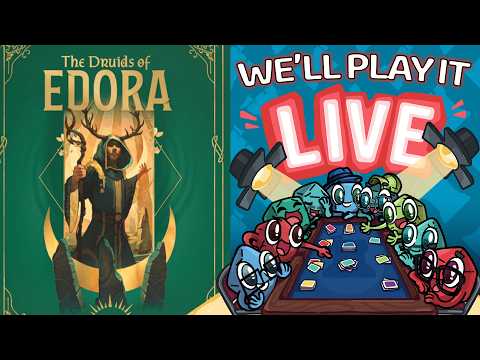













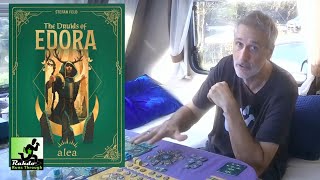
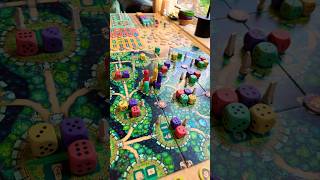



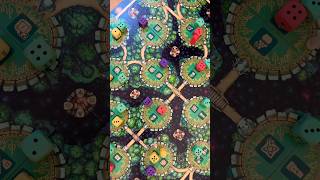




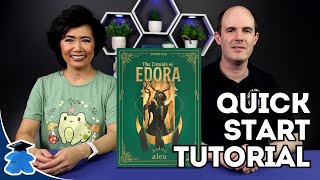



The Druids of Edora box art

The Druids of Edora

Game ID: GID0327864
Game Info
Year
2025
Players
2-4
Age
12+
Playtime
90 min
Collection
Rating
Mechanic profile
Not enough video data yet
Vibe profile
Not enough video data yet
Description

The Druids of Edora is a game of strategic dice placement and building menhirs and stelae with the help of healing herbs and mysterious stones.

Description

The Druids of Edora is a game of strategic dice placement and building menhirs and stelae with the help of healing herbs and mysterious stones.

Ask a Rules Question
All mentions
Browse transcript mentions, sentiments, pros/cons, mechanics, topics, quotes, and references.
Total mentions: 10
This page: 10
Sentiment: pos 6 · mix 4 · neu 0 · neg 0
Mentions per page
Showing 1–10 of 10
Video SL7129FYW7k Rules Teach at 0:03 sentiment: positive
video_pk 67665 · mention_pk 163843
The Druids of Edora video thumbnail
Click to watch at 0:03 · YouTube ↗
Overall sentiment (raw)
positive
Pros
  • Elegant mechanisms that lend themselves to deep puzzle-solving.
  • Strategic depth with clear ideas but challenging execution.
  • High replayability due to varied objectives and board layout.
  • Interactive gameplay where players are interested in what others are doing.
  • The fundamental pressure comes from player decisions regarding resource management.
  • The game sings and purrs, offering a great experience.
Cons
  • In a two-player game, high-value dice are less impactful for area majority and can feel like a disadvantage if not managed with other mechanics.
  • The board can feel very large, potentially leading to players spending the game on opposite sides.
Thematic elements
  • druids and their legacy
  • magical mystical forest
Comparison games
  • Castles of Burgundy
Mechanics (from transcript analysis)
  • action selection — On a turn, players move through a sequence of seven steps, including moving, deploying dice, performing actions, and checking for certain scoring conditions.
  • area majority — If players have dice in the same zone, the player with the highest value die gets victory points.
  • Dice rolling — Dice are used for determining starting player, and players deploy dice to zones on the board, with higher values costing more provisions.
  • drafting — Players draft dice from a common pool or from their own rolled dice.
  • engine building — Players can acquire powers and abilities that make future actions more efficient or rewarding.
  • Objective Fulfillment — Players receive 'stone tablets' that provide objectives for scoring points at the end of the game, such as collecting gemstones or brewing potions.
  • Resource management — Players manage 'provisions' which are used to move and deploy dice.
  • Route Building — Players can connect 'dolmens' by placing dice in a line between them to score points.
  • set collection — Players collect gemstones to fulfill objectives and score points.
  • tile placement — The board is a '3 by 3 grid of all these tiles that can be rotated around and so when they connect to the other ones, they create a whole bunch of different mystical sites.'
  • Variable player powers — Players can acquire 'flower powers' which provide ongoing abilities.
  • worker placement — Players deploy dice to different sites on the board to activate actions.
Video topics + discussion points
No key topics recorded for this video.
Quotes (from this video)
  • This is him coming up with something completely new and completely different, and it reminds me of why I fell in love with his designs all those years ago, the first time I ever played Castles of Burgundy, because he comes up with such simple, clean, elegant mechanisms that just immediately lend themselves to such deep, rich um you know, puzzle-solving.
  • Everything about this game just sings. It just purrs.
  • As a two-player game, though, I think it's best that everybody has access to the same stuff because then we've got the same problems to solve, and you don't really feel like, 'Oh, you got a lucky drop.'
  • That is the fundamental pressure this game puts you under. Not some built-in game timer, not the other players, but decisions that you yourself make about um you know, grabbing all these amazing super scrumptious point-scoring opportunities.
References (from this video)
No references stored for this video.
Video 0Wqc_52BH_8 Review at 0:12 sentiment: positive
video_pk 67286 · mention_pk 163246
The Druids of Edora video thumbnail
Click to watch at 0:12 · YouTube ↗
Overall sentiment (raw)
positive
Pros
  • Smart puzzle game
  • Interesting elements with dice placement and action spaces
  • Satisfying interactions like lighting fire pits and collecting herbs
Cons
none
Thematic elements
  • druids and priestesses of times long past
  • an enchanted forest dotted with remarkable shrines and winding pathways
Comparison games
none
Mechanics (from transcript analysis)
  • action selection — Dice are placed on action spaces to trigger specific actions.
  • Dice rolling — Players roll dice, and the values of these dice are used for the entire game.
  • Endgame scoring — Knowledge markers provide endgame multipliers for areas of dominance.
  • set collection — Collecting stone tablets, mistletoe, and medicinal herbs.
Video topics + discussion points
No key topics recorded for this video.
Quotes (from this video)
  • It's one of Stephenfield best and I love
References (from this video)
No references stored for this video.
Video 9O2GjrNEFew Playthrough at 1:10 sentiment: mixed
video_pk 66826 · mention_pk 162626
The Druids of Edora video thumbnail
Click to watch at 1:10 · YouTube ↗
Overall sentiment (raw)
mixed
Pros
  • The game is more fun with four players than two.
  • Feldian scoring where everything is worth points.
Cons
  • Terrible rulebook.
  • Lacks player aids.
  • Poor iconography.
  • Math heavy.
  • Distracting.
  • Actions get shut down quickly in two-player.
Thematic elements
  • Druids
Comparison games
none
Mechanics (from transcript analysis)
  • Area Control — Players compete for control of locations on the board by placing dice, which can lead to points or tiebreaker advantages.
  • dice placement — Players place dice of various values onto action spaces, and the value of the die often affects the outcome or cost of the action.
  • End-game scoring — Players score points based on various criteria at the end of the game, including completed stone tablets, collected resources, and track positions.
  • Resource management — Players manage resources such as provisions and mistletoe, which are used to pay for actions or acquire other game elements.
  • set collection — Players collect different types of components, such as crystals and mistletoe, with bonuses awarded for collecting sets or specific combinations.
  • Track advancement — Players move markers along various tracks, such as the sickle track and the tiebreaker track, to gain benefits or end-game scoring.
  • worker placement — Players place dice on spots on the board to take actions, with some spots costing provisions or having other requirements.
Video topics + discussion points
No key topics recorded for this video.
Quotes (from this video)
  • this game has a terrible rulebook
  • it does not come with player aids but we put it somehow because this game desperately needs player aids
  • this game is like the epitome of being distracted by stuff
  • I'm going to need a calculator
  • So, I get five points and three provisions.
  • The bling bling is about to come out.
  • Well, that was a lot of work just to be able to take another turn.
  • I hate that feeling of like, oh, I feel like I missed things.
References (from this video)
No references stored for this video.
Video zLYCbGpKTks Review at 0:19 sentiment: mixed
video_pk 66691 · mention_pk 162486
The Druids of Edora video thumbnail
Click to watch at 0:19 · YouTube ↗
Overall sentiment (raw)
mixed
Pros
  • The game has a good speed, with a four-player game taking around 70 minutes.
  • The herbs (special abilities) are liked, with a good rule for choosing one of two.
  • There are many interesting action possibilities beyond just gaining provisions or dice.
  • The game can be very fun and refreshing, with restrictive and punishing elements.
  • At higher player counts, the game offers more interesting paths and strategies.
  • There are clever workarounds with the potion system.
  • The visual design, particularly the vibrant colors of the player pieces, is liked by one reviewer.
Cons
  • There are significant component and production issues, including a lack of player aids and tiny print on components.
  • The symbology and iconography are difficult to see and distinguish, especially the green elements.
  • The dice mechanism can lead to feelings of being 'rubbed raw' when comparing dice rolls with other players.
  • Some turns can be boring, particularly those focused on gaining provisions or dice.
  • The provisions system feels ham-fisted and requires taking turns just to be able to take other turns.
  • The game is weaker at two players, with fewer strategic options.
  • The rulebook had issues and required online updates.
  • There's a lot of upfront math and planning that some players may dislike.
Thematic elements
  • Druid prestige
  • druidic
Comparison games
none
Mechanics (from transcript analysis)
  • area majority — Players compete for majority control of spaces on the board, particularly at shrines and on player boards with rune stones and standing stones for end-game scoring.
  • dice placement — Players place dice on spaces to take actions, with the die value sometimes influencing the action or outcomes. Provisions are required to move and place dice.
  • End game scoring — Points are awarded at the end of the game for various achievements, including completed stones, sickle track progress, gemstone sets, and shrine majorities multiplied by knowledge track values.
  • Resource management — Players must manage provisions, which are required for moving and placing dice, and mistletoe for brewing potions.
  • set collection — Players collect mistletoe to brew potions and collect gems for end-game scoring.
  • Variable player powers — Players can unlock special abilities and bonuses through flower/herb upgrades.
Video topics + discussion points
No key topics recorded for this video.
Quotes (from this video)
  • It's a Feld, baby.
  • The symbology in general, I would get the points mixed up with the tie breaker thing, whatever that's called.
  • It's unbelievable that this is not a Friedemann Friese Spiele game with how much green is on that board.
  • This is a Feld game. You sneeze you're going to get victory points.
  • I find myself enjoying that more nowadays. I kind of like, 'Oh, I did that. I got victory points.'
  • I think this game is incredibly weaker at two players.
  • It feels awful to have to take a turn to take a die and or provisions.
  • It's a little weird because you are doing a lot of math to play.
  • It's a fun game.
  • It is a very interesting game.
References (from this video)
No references stored for this video.
Video 0LmqBL4nt5A Discussion at 5:36 sentiment: mixed
video_pk 66571 · mention_pk 162239
The Druids of Edora video thumbnail
Click to watch at 5:36 · YouTube ↗
Overall sentiment (raw)
mixed
Pros
none
Cons
  • Poor iconography
  • Icons look too similar
  • Infinitesimally small icons on central board
Thematic elements
Comparison games
none
Mechanics (from transcript analysis)
  • Area Control — There's also an area control element to the game.
  • dice placement — It is a dice placement game.
  • player board upgrades — You've also got a whole bunch of things happening on your player board, things you can unlock, things you can upgrade, actions you can upgrade.
  • Resource management — A resource management game.
Video topics + discussion points
No key topics recorded for this video.
Quotes (from this video)
  • This is where I don't give full reviews of games because all of these games have already been reviewed in full by other folks here on the Dice Tower and I'm just giving you my two cents on each of these and since today I'm going over seven different games, you're getting 14 cents out of me.
  • Well, that's it. This is Mike Delisio and I'll see you on the next rapidfire
References (from this video)
No references stored for this video.
Video yb7ylXtLzfM The Cardboard Herald Review at 0:21 sentiment: mixed
video_pk 65670 · mention_pk 159394
The Cardboard Herald - The Druids of Edora video thumbnail
Click to watch at 0:21 · YouTube ↗
Overall sentiment (raw)
mixed
Pros
  • Gorgeous on the table
  • Potent actions that improve with repeated investment
  • Smart, exciting, and creative plays can be made
  • Beautiful game with some of the best component production
  • Richness for people who love sprawl
Cons
  • Dense and hard to find one thing to focus on
  • Shaves off personality due to tuned equivalency
  • Grueling if not constantly aware of dwindling provisions
  • Rulebook is pure insanity with confusing terminology
  • Laughably enigmatic iconography
  • Too wide with systems that can be ignored
  • Actions have cascading, at times laborious outcomes
  • General sense of doing things for brutal efficiency's sake
  • Everything crammed together, up to the player to find the fun
  • Exhausting
Thematic elements
  • murky maze winding through the woods
Comparison games
  • Castles of Burgundy
Mechanics (from transcript analysis)
  • action selection — Players move their pawn through the woods to clearings to take actions by placing a dice and paying provisions.
  • area majority — Dice placement in clearings can lead to points if the dice are higher than other players'.
  • dice placement — Players place dice to take actions, with higher dice placement in a clearing potentially yielding points.
  • Resource conversion — The game involves resource conversion, where actions lead to points or resources to continue gaining points.
  • set collection — Completing a connection of arching dolmens to matching ones of the same color in a contiguous set of clearings claims those dolmens.
  • Variable Powers — Investing in sickles unlocks sets of randomly organized personal powers that players permanently decide which to keep.
Video topics + discussion points
No key topics recorded for this video.
Quotes (from this video)
  • There are some designers that, when they release a game, you you lean in.
  • And the undisputed all-timer Euro banger, 2011's Castles of Burgundy, Stefan Feld looms large in the hobby.
  • An ambitious and sprawling dance that is gorgeous on the table as it is, well, dense.
  • This was pervasive throughout the rules in a very complex game that deserves intuitive smooth reference and aid, which then also extended to the game itself.
  • All things considered, for how heady and free-form it is, it's pretty much the board game equivalent of my dad's parental philosophy. Welcome to the world, kid. I ain't going to tell you what to do. Good luck, and try not to make a mess.
References (from this video)
No references stored for this video.
Video FKSllbPaQKo BoardGameCo Discussion at 3:22 sentiment: positive
video_pk 62685 · mention_pk 155376
BoardGameCo - The Druids of Edora video thumbnail
Click to watch at 3:22 · YouTube ↗
Overall sentiment (raw)
positive
Pros
  • Strong design by Stefan Feld
  • Promising play sessions
Cons
  • Needs more plays to review thoroughly
Thematic elements
  • Array
  • Fantasy, druidic realm
  • Thematic engine-like interplay
Comparison games
  • Castles of Burgundy
Mechanics (from transcript analysis)
  • engine building — Players chain actions to generate resources and scoring opportunities.
  • engine-building — Players chain actions to generate resources and scoring opportunities.
Video topics + discussion points
No key topics recorded for this video.
Quotes (from this video)
  • I love Shallow Sea. I am really enjoying this one.
  • I do not think it's forever game.
  • There’s a fun little tension of laying cards down and trying to min-max where each card goes as it goes towards multiple scoring criteria.
  • The Druids of Adora, I cannot wait to give you a review on this one, but I need more plays first.
  • Onward is replacing Guards of Atlantis.
  • Way Too Many Cats had way too many symbols and things going on to be able to at a glance understand what's happening.
References (from this video)
No references stored for this video.
Video ytoPwN6Rgjk Watch It Played Top 10 List at 11:59 sentiment: positive
video_pk 36609 · mention_pk 109862
Watch It Played - The Druids of Edora video thumbnail
Click to watch at 11:59 · YouTube ↗
Overall sentiment (raw)
positive
Pros
  • strong pedigree and design lineage
  • tight systems that click together with ease
Cons
  • dice-driven decisions can feel luck-dependent
  • new players may need time to grok scoring
Thematic elements
  • druidic rituals and mystic city-building
  • misty woods with druids, herbs, and stone structures
  • pedigree design with elegant systems
Comparison games
  • Castles of Burgundy
Mechanics (from transcript analysis)
  • dice placement — dice-driven actions place resources and unlocks.
  • Resource management — collecting herbs and building stone structures.
  • set collection — synergistic gathering to maximize efficiency.
  • set collection / combo chaining — synergistic gathering to maximize efficiency.
Video topics + discussion points
No key topics recorded for this video.
Quotes (from this video)
  • This is The Climbers.
  • This is a fast, wacky racing game for two to six competitors who draft a team of ridiculous runners, roll dice, and watch the track turn into a parade of deeply unfair superpowers.
  • Agent Avenue just got a lot more dangerous with the Division M expansion.
  • One of the great hooks of Fate of the Fellowship is its modular structure.
  • Gold Country is blazing at number one right now.
References (from this video)
No references stored for this video.
Video riFmwc3vYsE kovray Top List at 26:20 sentiment: positive
video_pk 31416 · mention_pk 92548
kovray - The Druids of Edora video thumbnail
Click to watch at 26:20 · YouTube ↗
Overall sentiment (raw)
positive
Pros
  • Rich scoring options and thematic depth
  • Beautiful modular setup and components
Cons
  • Iconography can be dense for new players
Thematic elements
  • iconography-driven fantasy with monuments and routes
  • Druidic/Adora theme
Comparison games
  • Brass: Birmingham
  • Lancashire
Mechanics (from transcript analysis)
  • Compound Scoring — Diverse scoring tracks through monuments, routes, and upgrades
  • dice placement — Dice are placed to activate abilities and score on multiple tracks
  • dice-placement — Dice are placed to activate abilities and score on multiple tracks
  • multi-path scoring — Diverse scoring tracks through monuments, routes, and upgrades
Video topics + discussion points
No key topics recorded for this video.
Quotes (from this video)
  • My number five is a game called Foxy.
  • The way you score is so seamless.
  • It's so cozy.
  • I've really enjoyed the two-player mode.
  • There are a ton of different ways to score in this game
  • I cannot wait to dive into it
  • I understand the hype.
  • I will rank Birmingham high after playing more.
References (from this video)
No references stored for this video.
Video _M8cZZ9TdVA Board Game Hangover Top List at 3:30 sentiment: positive
video_pk 10684 · mention_pk 94152
Board Game Hangover - The Druids of Edora video thumbnail
Click to watch at 3:30 · YouTube ↗
Overall sentiment (raw)
positive
Pros
  • Amazing component quality with detailed stones and pieces
  • Beautiful, gorgeous visual presentation
  • Designer of Castles of Burgundy and Evolution
Cons
none
Thematic elements
  • Druid management and placement
  • Fantasy - Druids
  • Abstract with thematic elements
Comparison games
  • Castles of Burgundy
  • Evolution
Mechanics (from transcript analysis)
  • dice placement — Central mechanic involves placing dice on the board
Video topics + discussion points
No key topics recorded for this video.
Quotes (from this video)
  • It's a boss fighting game with QR codes. In this game, you're going to get pick one of four heroes and then mix it with one of the four classes
  • Every other page in the rule book has this info about how the mechanisms in the game relate to real life
  • It's a dice placement game by Stefan Feld. What else do you need to know?
  • It's basically trick taking game with a lot of things around it
  • If you lose an auction, you also get some rewards
  • Let us know which ones are you most excited to try down in the comments
References (from this video)
No references stored for this video.
Transcript Navigation
Top
Showing 1–10 of 10
Game Deep Dive
View on BoardGameGeek