

1811: Albuera Deep Dive
What the Community Thinks About 1811: Albuera
1811: Albuera is a Napoleonic battle simulation designed by Frederic Del Sanchez and published by Tactical Workshop. It is listed as Volume One of the Fix Bayonets! system and recreates the Battle of Albuera, fought in May 1811 during the Peninsular War. The second edition, which replaces a 2020 original, has drawn attention from Zilla Blitz, the only channel in the database that has covered this wargame. Those reviews were written from a pre-production or final production copy after reading the rules and studying the components, so the commentary reflects impressions of the design and the materials rather than extended play.
The consensus is a mix of respect and caution. Reviewers see a full-fledged Napoleonic combat system with formations, command structure, morale, and terrain effects, and they regard the production as exceptional. The second edition is described as a near-complete reworking of the original, with new event cards, redesigned counters, a redesigned mounted map, new player aids, and a revised rule book. The same reviews are clear that this is a demanding game. The reviewer rated its complexity between six and a half and seven out of ten and noted that the box's own medium to high rating fits that assessment.
Core Mechanics That Define 1811: Albuera
Card-Driven Leader Activation
Activation in 1811: Albuera is organized around Leader cards rather than a fixed sequence of unit actions. During the operations phase, each player plays Leader cards to generate activations, and each leader's initiative value determines when that leader acts. Players can also attempt to interrupt the order of activations, which the reviewer described as a rather elaborate initiative system. Some leaders carry special behaviors that trigger when they are activated, and the box includes more than fifty leader cards along with event cards. The rhythm of the phase is set by the alternating activations of both sides, and the reviewer pointed out that this structure should suit solo play well even though the game does not include a bot to control the opposing army.
Command and Control
Command and control is the element reviewers return to most often. Units belong to formations, and the colored bands on the order of battle sheets are important because they dictate how units stay within their formation and adhere to orders. Leaders have a command radius and a training and experience modifier, and the chain of command is passed down through aides-de-camp who carry orders through the army. The reviewer called the chain of command very detailed and one of the most interesting elements of Napoleonic combat. Cohesion is equally central. In the longer scenarios, the objective is to wear down the enemy's cohesion until its formations break. Combat itself is split into fire, melee, charges, and assaults, with opportunity fire and reaction zones that replace traditional zones of control and vary by unit type, status, and formation.
The 1811: Albuera Experience
A Deliberate, Richly Layered Simulation
Reviewers describe the play as a deliberate simulation in which each turn represents about fifteen minutes of the battle. The shorter scenarios are built as learning exercises, while the two full-day scenarios cover the historical order of battle and a what-if variant, and the longest runs roughly eight hours. Every unit carries several values, including its step, combat value, training modifier, and movement factor, so the play feels like managing a set of interlocking variables. The reviewer noted that the player aids are needed to keep track of French and Spanish cohesion, the fatigue track, routed units, reserve orders, and the turn record. The feeling is that of a methodical commander working through a long afternoon of pressure rather than a quick tactical skirmish.
Historical Immersion and Visual Richness
The historical texture is a major part of the experience. Zilla Blitz praised the historical emphasis, the attempt to render uniforms accurately, and the extensive reference list, which suggests a heavily researched design. The back of each order of battle sheet carries historical information and portraits for the significant leaders on each side, so that background reading can happen during downtime in play. The reviewer also described the counters and map as very colorful and artistically strong, and expects that the game will be spectacularly beautiful once the units are on the table.
What Makes 1811: Albuera Stand Out
A Series Rule Book Designed to Be Learned Once
Reviewers highlight the Fix Bayonets! approach of pairing a shared series rule book with a separate battle book. The series rule book runs to roughly fifty-six pages and contains unit descriptions, definitions of terms, and sixteen sections of rules with many worked examples, while the battle book is a sixteen-page supplement that holds the scenarios, terrain rules, and historical background. The reviewer said they always like to see a series rule book because it means you learn the rules once and can then play a number of games with them. Four scenarios are included, two of them short learning scenarios built around infantry and artillery and cavalry actions, which gives newcomers a way into the system before the full-day battle.
Components, Counters, and Map Design
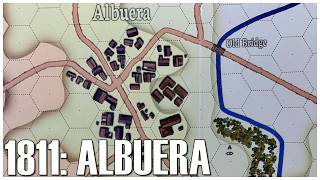
The physical production is one of the most frequently praised aspects. The game includes more than six hundred counters on five sheets, sized at three quarters of an inch, with status markers, formation markers, and double-sided step counters that show a unit losing strength as it is flipped to lower steps. The mounted maps measure 29 by 44 inches and use a shaded, somewhat abstract style that makes elevation clear, particularly on the hills. Reviewers singled out the map as easy to read, since the terrain in each hex is unambiguous, and the counter set as bright, crisp, and well detailed.
Potential Drawbacks
A Dense Rule Set With a Steep Learning Curve
The rules are the main concern. The reviewer described the series rule book as fairly text heavy, with a stacking section alone running about two pages once stacking order, limits, protection, formation limits, and training modifiers are included. This depth is the source of the simulation's realism, and the reviewer acknowledged that good examples and clear articulation help. Even so, the reviewer described the system as a meaty simulation that rewards players willing to invest in its detail, and the review did not present the rulebook as a barrier to the experience itself.
Setup Legibility and Solo Play
Two practical points were raised. The reviewer found the setup diagram in the battle book hard to read at its printed size and struggled to tell which unit was which, expressing a wish that it had been printed larger. The reviewer also noted that the game has no solitaire option and no bot to control the opposing side. While the activation system was described as friendly for solo play, a solitaire player would need to manage both armies personally. Neither point appears to be a major flaw, but both affect how easily the game can be set up and played alone.
If You Enjoy 1811: Albuera
Readers who enjoy 1811: Albuera will find the most direct continuation in the Fix Bayonets! series itself. The reviewer expressed the hope that the series would grow with additional volumes covering Napoleonic combat, so that players who learn the series rule book once can apply it across future battles. For players interested in a different Napoleonic battle system, Close Quarter Battles: Waterloo from Lock and Load Publishing was discussed in the same reviews as a tactical game at the half company and half battery level, with core rules intended to be shared across later modules. That approach mirrors the Fix Bayonets! idea of learning one rule set and applying it to many engagements, as covered in Zilla Blitz.
What Reviewers Are Saying
"Napoleonic combat, of course, is infamous for its formations and the variety of tactics and command structure, and this by all means is a full-fledged Napoleonic combat system."
— Zilla Blitz
"Sometimes you look at a game you say this is a labor of love in terms of production and attention to detail and gameplay this one looks like it's really good certainly deserving I think wargaming is is filled with um a lot of fantastic games that sometimes just don't get enough light on them and this one feels like it's in that category to me."
— Zilla Blitz
"Relatively modest price here too for a box that is just packed full of stuff: mounted map, tons of counters, player aids, a fully robust rule system. So if you're interested in Napoleonic conflict, this might be a game you want to check out."
— Zilla Blitz