


1862 War in Virginia Deep Dive
What the Community Thinks About 1862 War in Virginia
Reviewers at The Discriminating Gamer see 1862 War in Virginia as a compact member of the States of Siege family, a design style the reviewer says they have always enjoyed. Their main review awards the game an eight on the Cody scale and calls it quick, small, and a lot of fun. The reviewer is candid that the game is "nothing major, nothing groundbreaking," but the praise centers on how much tension a small box delivers. Zilla Blitz, previewing the game in a March 2025 video, compares it to the Pacific War 1942 and War of 1812 solitaire games already covered on that channel, while arguing that this release takes the card-driven opponent to a higher level of complexity.
Core Mechanics That Define 1862 War in Virginia
Card-Driven Union Advance
A single deck of cards drives the Union side. Each draw determines which Union armies advance along the tracks toward Richmond, and the Confederate player responds by spending the actions that the card grants. The Discriminating Gamer explains that each attack is a die roll that must beat the number of the army being attacked in order to push it back and advance your own forces. The unboxing reviewer also noticed that some cards carry bonuses for whoever holds them, such as a plus one DRM for attacks against the Union Valley Army or against Washington when adjacent, so "whoever has the card and the ability is going to get the bonus."
Political Pressure and Famous Commanders
The political pressure track is checked by totaling the Confederate armies on the board. The Discriminating Gamer describes how a total above 13 brings McClellan onto the board, giving a plus one DRM to the Union army nearest Washington, while a total below eight brings Robert E. Lee in with a plus one to all of the Confederate die rolls. The same review explains that the approaches to the capital are guarded as well: the defense of Washington is a six, a Stonewall Jackson card can open a path to it, the ironclad Merrimack forces the Union to roll before advancing along the James, and Richmond cannot be entered automatically.
The 1862 War in Virginia Experience
Quick, Pocket-Sized Tension
The Discriminating Gamer returns repeatedly to speed and portability, saying the game is one you can play very quickly and take on vacation in its small box. The unboxing reviewer estimated about 30 minutes of play, while Zilla Blitz described the solo game as one that plays in under one hour. Even in a short session, the reviewers describe the feeling of wanting to press forward on one front while being threatened on another, which keeps every turn feeling consequential.
Story Told Through Competing Threats
The Discriminating Gamer names the stories these games tell as one of the things the reviewer likes most about States of Siege designs, and says this one delivers them. The review describes wanting to advance toward Washington while the James demands attention, and frames the choices these games create as the reason they remain engaging. Zilla Blitz describes the design as entirely card-driven and is curious how the opposing side has been developed.
What Makes 1862 War in Virginia Stand Out
Period Photographs and a Battle Map on the Reverse
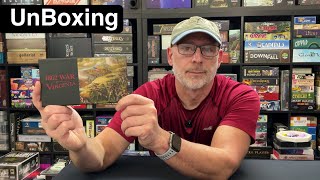
The unboxing reviewer at The Discriminating Gamer welcomed the use of real stills and old photos rather than painted artwork, and singled out the back of the board. That side shows the spots where battles took place in Virginia during the war, which the reviewer found a great and very cool addition, even while unsure whether that map is used in play. The historical presentation is a distinct part of the package that reviewers noticed before the first turn.
A Lean Box at a Modest Price
Zilla Blitz noted a box price of $35 and a board with four tracks leading to a central point, the city of Richmond. The unboxing reviewer at The Discriminating Gamer accepted that the box holds little, observing that these boxes usually do not contain much but still pack a punch. The reviewer also noted that all of the tokens fit into one small spot in the box, which suits the game's portable character.
Potential Drawbacks
Light Depth for Experienced Wargamers
The Discriminating Gamer concedes that the game is not a major or groundbreaking design. The unboxing reviewer also noted that the rules are light across this series, even though these games usually contain real depth in their decisions. Zilla Blitz hoped the design would add more meat and depth than the earlier solitaire titles, so players looking for heavier decision making should weigh that hope against the reviewers' own description of a small, quick game.
An Unproven Solo Opponent and Physical Components
Zilla Blitz was previewing the game and had not yet played it, so the card-driven Union opponent remains untested in those comments. The unboxing reviewer noticed some bends in the board, which were acceptable to them, and pointed out that tokens need to be punched before play, leaving a lid lift in the meantime. Those are minor physical notes, but they mean that the opposing AI's quality is the main open question from the early coverage.
If You Enjoy 1862 War in Virginia
Players who enjoy the Pacific War 1942 and War of 1812 solitaire games, as Zilla Blitz describes them, should find the four-track structure and card-driven flow familiar. Fans of States of Siege designs will recognize the central goal of holding a key location while pushing toward a rival capital, and the reviewers' praise for a quick, compact session makes this a good choice for a short game night or a trip. The historical photographs and battle map suit players who want a Civil War game with a strong sense of place.
What Reviewers Are Saying
"One of the things I like most about States of Siege games, and I very much like here, is the stories that it tells."
— The Discriminating Gamer
"this looks like it levels up the complexity and the gameplay for the AI a bit so it kind of takes it to the next level and ramps it up a bit here."
— Zilla Blitz
"But there isn't usually a lot in these boxes. But they pack a punch."
— The Discriminating Gamer