




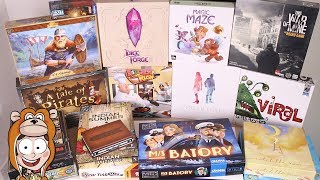
A Tale of Pirates Deep Dive
What the Community Thinks About A Tale of Pirates
Reviewers agree on what A Tale of Pirates is built around: a three-dimensional pirate ship on the table, sand timers as crew members, and an app that guides the players through scenarios. They disagree mainly about who will enjoy it. Actualol host John Perkis placed it fourth on Perkis‘s 2017 top twenty and described it as "a simple game but it all just works so well together and it‘s just a lot of fun." The Dice Tower host Tom Vasel called it "fun," but feared it "just hasn‘t been talked about too much." Vasel‘s later review of the game described it as "very entertaining and interesting," while noting that players have to learn the game through the app before it clicks.
The strongest reservation comes from Ryan, Nights Around a Table, who opened the unboxing by saying they did not expect much from pirate-themed board games. Ryan also said the back of the box, which advertises cooperative play, was a turn-off because they do not like cooperative games. The unboxing still ended on a positive note, as Ryan was surprised by how much the box contained and by the app that drives the scenarios.
Core Mechanics That Define A Tale of Pirates
Sand Timer Real-Time Actions
Each player uses a 30-second sand timer as a crew member. A player places the timer on a spot on the ship to perform an action, and that timer cannot be moved again until its sand runs out. Perkis explained that each player has only one timer, so a player who hesitates over a decision wastes time that could be used elsewhere. Perkis also noted that this design encourages discussion while the sand is running, because players have nothing else to do while they wait. Vasel and Perkis both describe the game as real-time, and the timers are what make it so.
The ship itself sets the constraints for these actions. Perkis described how the sail must be at half-mast before the ship can turn, how the crow‘s nest lets a crew member peek at face-down cards only when the ship is pointing toward them, and how the cannons aim toward fixed points on the port and starboard sides. Moving the ship can point those cannons at something else entirely, which can waste a crewmate‘s action. Damaged parts of the ship must be repaired before they can be used again. Because the game is built this way, the timers do more than set a clock; they turn every decision into a question about what the whole crew is doing at that moment.
App-Driven Scenario Campaign
The game is structured as a campaign driven by a companion app. Ryan explained that the rulebook sends players to the app to choose a chapter and begin with the first island of a map that Ryan had not known existed. Perkis said the game comes with ten scenarios, and that completing each mission unlocks sealed packs of cards and components. Those packs add new mechanisms and reveal parts of a story, so the game grows more difficult as it progresses, but players also receive more tools to help them. Perkis credited the designers, Daniel and Oskar, who also created 13 Days. Ryan chose not to open the sealed content in the video so that Ryan would not spoil it, which shows how much the campaign depends on discovery.
The A Tale of Pirates Experience
Urgent but Communicative Teamwork
Playing A Tale of Pirates feels hectic in a controlled way. Perkis contrasted it with Kitchen Rush, saying that A Tale of Pirates "doesn‘t get as hectic" and that it is "so communicative." Because each player can only act through a single timer, players talk constantly about where the ship should go, which cannon needs loading, and who should move next. Perkis stressed that nobody can act alone, describing it as "no quarterbacking." The publisher reportedly markets the game as a less stressful real-time game, and Perkis admitted to not knowing exactly what that meant, but noted that the claim would matter to players who avoid real-time games because of their pressure.
A Pirate Adventure Told Through Play
The game leans heavily on its theme. Ryan‘s first impression was of "cartoon pirates" and a big ship at the center of the table, and the box art sells that image directly. The campaign deepens it. Perkis said each mission includes a story in which the crew might need to rescue someone or complete a task, and the packs keep the tale moving forward. The pirate fantasy is therefore not only a visual hook but also the reason for each new scenario and mechanism that the app introduces.
What Makes A Tale of Pirates Stand Out
The Three-Dimensional Ship
Reviewers repeatedly point to the physical ship as the game‘s signature feature. Perkis called the 3D ship "awesome," and Ryan admired how the mast protrudes from the base so the ship can pivot and point in different directions. Ryan also praised the insert, which holds the ship and its components neatly. Because the ship is a physical object rather than a board, the act of turning and aiming becomes something players can see and feel, which makes the mechanics easier to understand during play.
A Well-Designed App and Campaign
Perkis singled out the app for praise, calling it "really well designed." Vasel also said the game is "very entertaining and interesting" once players learn how the app drives each scenario. Together, the app and campaign give the game a sense of progression that many small real-time games do not offer. Reviewers consistently treat the scenarios as the reason to keep playing, and the app as the thing that holds the scenarios together.
Potential Drawbacks
The Cooperative Format
The cooperative structure is the most divisive element. Ryan said cooperative games are not something they like "at all" and that the box‘s emphasis on cooperative play made them hesitant before they even opened the box. Ryan‘s concern is the reason this game may not suit every table. Perkis‘s experience shows the opposite reaction, with Perkis praising the way the game forces teamwork and prevents one player from taking over. Players who prefer competitive or individually driven play should expect this format to define the experience.
A Learning Curve and Limited Visibility
Vasel noted that the game requires players to "get into it" and learn how to play with the app, which is a higher barrier to entry than a typical sand timer game. Ryan also described the rulebook as short, with a supplement and an introductory guide, and was surprised to find that the core experience depends on a downloadable app. Vasel summed up the game‘s reach in a sentence that is hard to ignore: "this game hasn‘t got a lot of buzz." The game may therefore appeal most to players who will research it before buying.
If You Enjoy A Tale of Pirates
Players who enjoy A Tale of Pirates‘s sand timer mechanic will find a similar rush in Kitchen Rush. Perkis described Kitchen Rush as a real-time cooperative game about running a restaurant, where players place sand timers as workers and must wait for them to finish before moving them again. Kitchen Rush is more chaotic than A Tale of Pirates, so players who want the same timer structure with more frantic energy should start there.
Players who enjoy the cooperative chaos of A Tale of Pirates may also appreciate Overcooked. Ryan called Kitchen Rush a board game version of Overcooked, and both games reward teams that can coordinate tasks while the clock runs down. Overcooked offers a similar sense of shared urgency and communication, making it a natural next step for players who like the teamwork but want a different theme.
What Reviewers Are Saying
"A real-time game where you‘re working together by flipping timers to stop your ship with an app. It‘s fun, but I fear that it just hasn‘t been talked about too much."
— Tom Vasel, The Dice Tower
"You only have one and you can only do your action once the sand has run out, which means if you take time deciding what to do once your sand time has run out you‘re wasting time where you could be using it somewhere else. And it encourages you to discuss whilst your sand is running down."
— John Perkis, Actualol
"They talk about it being a less stressful real time game. I don‘t know exactly what that means, but if it can appeal to people that hate real-time games because of that stress then that makes me interested."
— John Perkis, Actualol