
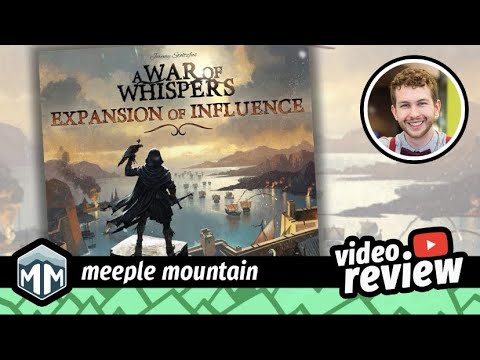













A War of Whispers Deep Dive
What the Community Thinks About A War of Whispers
Reviewers describe A War of Whispers, designed by Jeremy Stoltz and published by Starling Games, as a tense game of hidden influence. Five empires fight for control of the continent, but no player commands one of them. Each player is instead a secret society betting on the outcome and quietly pushing councils, armies, and cities toward the empires they secretly favor. The praise is consistent: the game rewards players who read the table well and makes open, predictable play costly.
The strongest agreement concerns the opening. Meeple Mountain host Tyler Williams has loved the game for years, but names the random loyalty assignment as the base game's biggest weakness. Before You Play makes the same point from a balance angle, noting that when several players draw the same empire, everyone chases one goal and the game becomes hard to balance. Where reviewers differ is mostly on pacing and on how much the expansion changes the experience. Tyler calls the expansion modules a fix that improves the base game without altering its formula, while Before You Play points out that some of the new material matters far more at higher player counts than in two-player games.
Core Mechanics That Define A War of Whispers
Secret Loyalties and Multiplier Scoring
Every player begins with a set of loyalty tokens, one for each of the five empires, and assigns them face down. At the end of the game, each loyalty is multiplied by the number of cities its empire controls. Before You Play explains that the best-supported empire scores four points per city, while a disliked empire can carry a negative multiplier, so a player may want that empire to collapse into ruin. Because everyone manipulates every empire, the scoring creates a constant tension between what you want and what you are willing to let others do. Reviewers note that loyalties can be revealed and swapped during the game, but doing so carries a penalty of one negative victory point for each revealed loyalty at the end, which keeps players honest about the commitments they make.
Council Seats and Empire Turns
Each round opens with players placing agents onto council seats in a worker placement step. Resolution then moves around the circle empire by empire. A player on a seat resolves its action, and when a seat is left empty, the next player seated to the right of that empire activates it instead. Before You Play describes the typical actions: adding banners to regions an empire controls, attacking an adjacent enemy region, or drawing cards from that empire's deck. Attacks are straightforward, with banners removed one for one, but forts force an attacker to lose an extra banner, which makes a fortified region a real obstacle. Reviewers also highlight the last seat in each empire, which lets a player swap with any other seat within that empire and so reshape the round's plans.
The A War of Whispers Experience
Hidden Scheming and Puppet-Master Tension
The feeling reviewers return to most is the sensation of pulling strings from behind the scenes. The Discriminating Gamer host describes finding secret alliances during play, where another player is pursuing the same empire as you on one front and working against you on another. That ambiguity keeps the table engaged even when the board looks quiet. A viewer quoted on Watch It Played captured the same mood by saying they had never felt more like a puppet master pulling strings from behind the scenes than in this game. The tension comes less from the rules themselves than from the uncertainty about what everyone else's loyalties are.
Friction, Betrayal, and Nasty Choices
The game also has a sharp, deliberately mean edge. Before You Play treats the Bureaucrats Guild, which removes one of your agents from the game and forces an opponent to lose one too, as a nasty option that can hurt badly, especially late in the game. Meeple Mountain host Board Game Brody adds that the expansion's alliance cards require a real act of trust, because the other player must accept an offer before it resolves. That mix of trust and risk gives the friction its flavor.
What Makes A War of Whispers Stand Out
Loyalty Card Sets That Fix the Opening
Reviewers consistently single out the loyalty card sets from Expansion of Influence as the most valuable addition. Instead of every player secretly choosing their allegiance freely, the cards are shuffled and dealt so each player starts with a distinct set of loyalties. Tyler Williams says this solved Meeple Mountain's biggest complaint about the base game. Before You Play makes the same argument from a balance perspective, noting that without the cards, several players can easily shuffle the same empire to the top and then compete for the same goal. The result is a start in which every player has a different empire to root for, while still leaving enough overlap to generate conflict.
A Modular Expansion Built to Be Optional
Reviewers praise how the expansion is designed. Tyler Williams calls it a modular expansion that does not change the formula but adds depth, letting groups use the Orca clan, the guilds, the loyalty cards, scenarios, or a drafting setup independently. The guild seats in particular draw attention. Each one offers a distinct tool, such as a peace token that blocks attacks in a region, a port that lets distant regions act as adjacent, or a bureaucrat action that removes an opposing agent. Before You Play notes that the modules are easy to add to the base game without much overhead, which makes the expansion approachable for groups that do not want a heavier game.
Potential Drawbacks
Opening Randomness and Dogpiling
The base game's opening is the most frequently cited weakness. When several players happen to ally with the same faction, the game can become linear, and one player may have a rougher, less enjoyable game as the others pile onto the same empire. Tyler Williams notes that this can make the game get a little linear and a little silly toward the end. The loyalty card sets are offered as the cure, but groups that prefer the original setup will still encounter this problem, and some reviewers see it as a reason to always use the expansion rather than a flaw the base game can avoid on its own.
Length and Two-Player Dynamics
Tyler Williams observes that the game already takes a good amount of time for what it is, and the expansion adds further layers that lengthen play. Before You Play highlights that agents remain on the board across rounds, so the game grows longer as it progresses. The same reviewers also note that the expansion's Orca clan and some guild effects feel much more impactful with three to five players than in two-player games, where the table is more open and the board is easier to read. Players who want a tight two-player game should expect the expansion's full potential to show up only in larger groups.
If You Enjoy A War of Whispers
Players who enjoy A War of Whispers's hidden loyalties and area control will find similar satisfaction in Dogs of War, which Watch It Played describes as a sneaky area control game in the same vein. Players who enjoy the game's competitive territorial play may also appreciate Commit: Blood and Sand, an area control staple that Pair Of Dice Paradise describes as being reintroduced with upgraded gameplay and clearer rules.
Players drawn to the game's betrayal and shifting alliances should consider the Game of Thrones board game, which The Discriminating Gamer describes as a very mean game of alliances that turn to betrayal once one player gets too far ahead. For a more cooperative contrast, Return to the Dark Tower offers a shared adventure in which players travel the land together before facing the tower. Isle of Cats, described by Pair Of Dice Paradise as a competitive card drafting and polyomino placement game, suits players who want a tighter puzzle built around fitting pieces together rather than reading other players.
What Reviewers Are Saying
"The loyalty cards probably were the best thing from a from a base quality of life improvement. I think that fixed my biggest complaint with War of Whispers was the the kind of random, arbitrary everybody picks their loyalty thing."
— Tyler Williams, Meeple Mountain
"What you find over the course of the game is you find these kind of secret alliances with some players who are trying to do the same things that you are on some of the factions, but then maybe on others you're at odds. It's a very, very fun game of hidden influence that I really enjoyed quite a bit."
— The Discriminating Gamer
"If you're playing a four player game and everybody shuffles and three of the players happen to shuffle the blue bear to be number one, then it's going to be hard to balance it because everybody's going to be gunning for one thing."
— Before You Play