
Game Info
Year
2001
Players
Age
Playtime
Publisher
Collection
Ratings
Creator Score
Mechanic profile
Waiting on more creator content
Vibe profile
Waiting on more creator content
Description
Alien races with varying powers compete to control twenty worlds. The Alien Race which establishes control over all of the Worlds wins the game.
The card deck used in the game includes three types of cards: Force cards, Race cards, and Event cards. Each player also requires a uniquely colored set of fifty or more Control markers. The game may be played on any hex map with the twenty World markers distributed as the players see fit.
Your quest for galactic conquest starts from the home world of your choice. In addition, you begin the game with three Race cards that define abilities, traits and powers that your alien race will possess throughout the game.
Featured Videos


Ask a Rules Question
All mentions
Browse transcript mentions, sentiments, pros/cons, mechanics, topics, quotes, and references.
Total mentions: 2
This page: 2
Sentiment:
pos 1 ·
mix 1 ·
neu 0 ·
neg 0
Showing 1–2 of 2
Video qmT64GWLXj8
Good Time Society Playthrough at 13:49 sentiment: positive

Click to watch at 13:49 · YouTube ↗
Overall sentiment (raw)
positive
Pros
- innovative blend of action programming and area control
- fast, accessible 1-hour play
- thematic appeal for history/empire lovers
Cons
- may require familiarity with features of heavier 4X games
- not as long or deeply asymmetrical as some classic 4X titles
Thematic elements
- 4X-style imperial growth with action programming and area influence
- Ancient empires in a compact 1-hour window
- Sardonic, meta-commentary with a focus on fast play
Comparison games
- Regulus
Mechanics (from transcript analysis)
- action programming — Players secretly select actions and reveal them in order to shape empire-building moves.
- Area Control — Players expand influence across the board to claim territories and achieve goals.
- shortened 4X — A 1-hour stream-friendly take on 4X concepts without long play times.
Video topics + discussion points
No key topics recorded for this video.
Quotes (from this video)
- Simultaneous worker placement.
- This is a new deck building game.
- They've smashed their goal.
- Is that 3x or 4x?
- That's our jack-up matchup.
References (from this video)
No references stored for this video.
Video DXCPuya7WKo
BoardGameCo Review at 0:00 sentiment: mixed
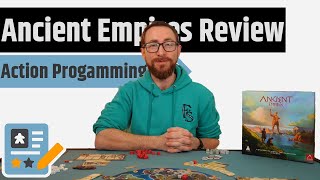
Click to watch at 0:00 · YouTube ↗
Overall sentiment (raw)
mixed
Pros
- Dynamic board with both preset and variable setups that increase replayability
- High variability from technologies, city-states, civilizations, and wonders creates diverse play patterns
- Accessible entry point for an epic-style experience in a mid-sized box
- Action-programming mechanic provides satisfying planning pressure and indirect interaction
- Balanced emphasis on area control rather than pure conquest
Cons
- Straddles a niche between 'tiny epic' and 'epic' that can feel misaligned for some players
- Not a quick box experience; scope and components can be heavier than ideal for a casual night
- Complexity and setup can be daunting for players who dislike heavy prep or multiple intersecting tracks
- May not resonate with players who dislike the 'tiny epic' design space or abstracted war gaming
Thematic elements
- Ancient civilizations vying for influence through action-programming, tech advancement, and territorial control.
- Across three ages of civilization-building on a dynamically varied board, with regions tied to civilizations, city-states, technologies, and wonders.
- procedural, competitive, with blind but resolved actions that shape a shared historical arc.
Comparison games
- Age of Civilization
- Battle for Rokagon
- Battle for Okagon
- Lords of Valor
Mechanics (from transcript analysis)
- action_programming — Players place order tokens face-down in their territories; tokens are revealed and resolved in a rotating order, producing immediate effects and shaping future possibilities.
- Area Control — Influence is gained in regions via token placement and subsequent resolution, with territory control driving benefits on tracks and regional power.
- area_control — Influence is gained in regions via token placement and subsequent resolution, with territory control driving benefits on tracks and regional power.
- city_states_and_faction_tracks — Control of city-states and civilizations advances you along distinct tracks, providing perks and strategic leverage.
- Hand Management — Players hold a hand of technology cards (up to five) and must manage discards to make room for new cards—the timing matters for engine-building.
- hand_management_and_discard — Players hold a hand of technology cards (up to five) and must manage discards to make room for new cards—the timing matters for engine-building.
- resource_and_tech_card_system — Collect resources to buy technology cards that provide bonuses and upgrade capabilities; tech cards help advance on various tracks and unlocks.
- Track Advancement — Control of city-states and civilizations advances you along distinct tracks, providing perks and strategic leverage.
- wonders_and_third_age_saturation — Wonders unlock in the third age and grant substantial benefits, influencing late-game scoring and strategy.
Video topics + discussion points
No key topics recorded for this video.
Quotes (from this video)
- in Ancient Empires, you're going to be playing it across three ages
- action programming across six rounds
- you'll be picking one of them to be your civilization at the end of the first age
- there's a dynamic board with a preset you can dive straight into, or mix up the elements
- it's an epic game experience on a smaller scale
- Tiny Epic is a very popular series with a lot of people
- this might not feel like a tiny epic box, but it definitely has tiny epic vibes
- I come in at a 3.5 out of five
References (from this video)
No references stored for this video.
Transcript Navigation
Showing 1–2 of 2