


















































Anachrony Deep Dive
What the Community Thinks About Anachrony
Anachrony stands as one of the most intellectually ambitious worker placement games in modern board gaming. The community recognizes it as a masterclass in thematic integration, where every mechanic serves the narrative of a post-apocalyptic world where time travel has become humanity's last hope. Critics consistently praise the bold design while acknowledging that its complexity and rule density demand significant cognitive investment. The game maintains a devoted following of players who value deep strategic puzzles, though reviewers note it is emphatically not for everyone, particularly those who dislike luck-dependent elements or prefer faster playtime.
Core Mechanics That Define Anachrony
Time Rifts and Resource Borrowing
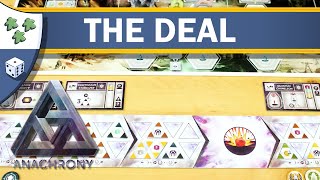
The signature mechanic that sets Anachrony apart is the ability to borrow resources from your future self. During the warp phase, players secretly place tiles on the timeline requesting specific resources. Later, during the paradox phase, players must repay what they borrowed or risk temporal distortion. This creates a push-your-luck element that genuinely matters thematically. Greedy borrowing carries consequences, as accumulating paradox tokens eventually transforms into anomaly tiles that block building spaces, eliminate workers, and cost precious victory points. The mechanism is elegant because it forces players to calculate genuine risk, not just move wooden tokens across a board. Every resource borrowed demands future action, creating a puzzle that extends across the entire game arc.
Worker Placement with Specialized Types
Unlike standard worker placement where any worker functions identically, Anachrony features four distinct worker types: scientists, engineers, administrators, and geniuses (who serve as wildcards). Each type excels at specific tasks. Scientists enable research, engineers provide construction discounts, and administrators prove superior at recruitment. This asymmetry forces players to consider not just where to place workers, but which workers belong where. Additionally, workers become fatigued after deployment, requiring water expenditure to refresh them. This seemingly simple resource management layer creates constant tension between pursuing immediate action sequences and maintaining workforce morale, adding a layer of political strategy within the economic puzzle.
The Anachrony Experience
Mind-Bending Strategic Depth
Playing Anachrony feels like navigating an intricate puzzle that shifts with each round. The game demands forward planning across multiple eras, forcing players to balance current needs against future repayment obligations. Early decisions cascade unexpectedly, and strategic approaches that seemed dominant crumble when opponents claim critical spaces or when the paradox die rolls poorly. The asymmetric factions, with their unique player boards and building layouts, ensure that no two games unfold identically. Each faction pursues different victory paths, meaning strategies that work for one Path rarely transfer directly to another. Players report a satisfying sense of mastery emerging only after several plays, when the interconnected systems begin to feel like conducting an orchestra rather than reading sheet music.
Thematic Immersion in Desperation
The post-apocalyptic setting permeates every action. Workers don't simply move freely, they require exo suits to venture into a hostile world. Resources feel genuinely scarce, and every action represents survival against a collapsing future. The game culminates in an impact event where evacuation mechanics replace traditional scoring, transforming the endgame into a desperate scramble to save your faction's population. This narrative arc creates emotional investment beyond typical point-salad euros. Players aren't abstractly optimizing efficiency, they are engineering a last-stand survival scenario where their infrastructure choices in round one determine whether they escape catastrophe in the final round.
What Makes Anachrony Stand Out
Asymmetric Faction Design
Four unique factions (with additional variants through expansions) play so differently that the game offers 32 distinct starting configurations. Each faction operates from a dual-sided player board where buildings connect in completely different spatial patterns. The Path of Dominance might spread horizontally while the Path of Harmony develops vertically, forcing fundamentally different infrastructure strategies. No cookie-cutter approach works across all factions. This asymmetry, combined with variable leader selections and evacuation conditions, means veteran players can explore fresh strategic territory across dozens of plays without encountering identical puzzle states.
Thematic Mechanics Over Abstract Subsystems
Every rule exists to serve narrative. Exo suits represent physical protection in a dangerous world, not just game tokens. Water consumption reflects workforce sustainability, not arbitrary resource balancing. The time travel mechanic doesn't feel grafted onto an engine-building skeleton; it forms the conceptual core where borrowing resources forces existential calculation. Even the building tiles serve thematic identity, with each structure type advancing faction-specific capabilities rather than offering interchangeable bonuses. This integration of mechanics with theme is exceptionally rare in heavy euros, where thematic flavor often decorates abstract systems. Anachrony reverses that relationship, making theme the foundation and mechanics the expression of theme.
Potential Drawbacks
Complexity Creates High Entry Barriers
The rulebook spans 51 pages, and understanding the game fully demands internalizing multiple interconnected systems simultaneously. Players cannot learn one piece at a time; the time travel mechanic, power core system, paradox die, timeline advancement, and asymmetric building puzzles must all click together before meaningful strategy emerges. First plays often descend into confusion as overlooked rules surface mid-session, derailing strategy entirely. Teaching Anachrony requires significant time investment, and new players report feeling lost through their initial game. The learning curve is steeper than most worker placement games at similar weight levels, making it a poor choice for groups seeking pick-up-and-play accessibility or regular casual nights.
Paradox Die Introduces Luck Into Strategic Design
The cornerstone of Anachrony's time-travel tension is also its greatest criticism. The paradox die can cascade bad rolls into catastrophic game downturns from which recovery becomes mathematically impossible. Some players report sessions where aggressive early borrowing resulted in unfortunate die rolls, reducing the remaining three hours to salvage attempts with zero path to victory. For players seeking pure strategy where superior planning always prevails, this luck element feels punishing and potentially wasted. A single die roll can negate hours of careful engine building. While thematic and mechanically innovative, the paradox die is a deal-breaker for players with low tolerance for variance in strategic games.
If You Enjoy Anachrony
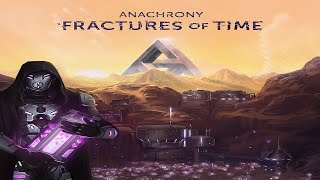
Seek out Fractures of Time, the large expansion that elevates the base game with additional factions and deeper time-travel mechanics. Barrage delivers similarly confrontational euro gameplay with emergent board states, though without thematic coherence. Galactic Cruise offers comparable weight with more forgiving components but hollow theme. For solo play, activate the Chronobot AI, which reviewers consistently praise as the finest automated opponent in board gaming, relentlessly aggressive and genuinely frustrating in the best way. Circadians First Light provides another asymmetric faction game with excellent AI opposition. If deep thematic integration appeals to you, explore obsession, The Networks, or Distilled for thematic euros that integrate mechanics and narrative at Anachrony's level.
What Reviewers Are Saying
"Anachrony has probably the best AI opponent in all of board gaming. The Chronobot is just a really terrifyingly annoying opponent. It's one of the first times I played a solo game that I felt like the AI was playing like a real player and the kind of real player I wanted to punch in the mouth."
— Dice Tower Solo Games
"Anachrony is a game where time travel genuinely drives the strategy. Every warp tile you place is a bet on your future self. You're borrowing resources now, which costs water to warp in, and you must repay them later or suffer paradox penalties and anomaly tiles. That's something that's very difficult to do, but Anachrony does time travel really, really well."
— Thematic Euros
"The game manages to offset just how well your opponents are doing so you're never kind of focused on denying them points or grabbing things away from them. You are building your own future. Behind all of that there's a good game and that's what I care about."
— Watch It Played Review