




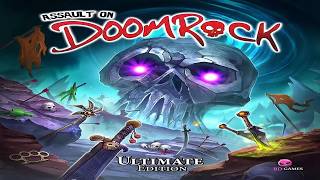




Assault on Doomrock Deep Dive
What the Community Thinks About Assault on Doomrock
Reviewers agree on what Assault on Doomrock is trying to be: a comedic, randomized fantasy adventure with a roguelike spine, where each run produces a different party and a different set of abilities. They disagree sharply on whether the game delivers on that promise. The most critical voice is Board Games UnLocked, whose dedicated review of the Ultimate Edition concludes the game is a below-average experience and not one the reviewer plans to keep. That reviewer had praised the game on an earlier review, and says a second playthrough changed their view.
The critical perspective is echoed elsewhere. Tom Bassel of A Pile of Mid Games found the game too messy to enjoy, describing it as a cooperative game that felt too wishy-washy in its combat. A Board Games UnLocked Gen Con recap in Board Games UnLocked called it atrocious and the weakest title its group brought, even while acknowledging elements of its roguelike nature.
The positive reviews come from people who value the game's structure and tone more than its combat. Rahdo Runs Through placed it at number ten on a top-ten list, praising its analog representation of fantasy combat and especially its adventuring half. Hungry Gamer called it a clever game that became far more satisfying after the new difficulty settings were added. Board Games UnLocked, in its top-100 coverage, also described the game as capturing the feeling of a video game roguelike such as Gunfire Reborn, where a run can be built into something busted. The overall picture is a game whose best qualities are its build variety and humor, and whose main liability is a combat and balance system that many reviewers found difficult to accept.
Core Mechanics That Define Assault on Doomrock
Randomized Journey Deck and Character Builds
Each run begins with character generation. As Board Games UnLocked explains, a player is given a class and then an adjective, such as the flying fairy, the sadistic fairy, or the oiled fairy, and that pairing sets the hero's first ability and comedic identity. The adventure itself is built from a journey deck of locations, sorted into towns, mountains, forests, and a small number of Doom Rock locations that serve as the goal. Players visit these locations to gather loot, which comes in common and rare tiers, along with ability cards that carry attribute requirements. The Snake Shot Crossbow, for example, requires two agility and one intelligence. Events and occasional secret locations round out the draw, and a time system during the journey phase determines when the next fight begins. The reviewer describes the result as a dramatically different build every time, with the caveat that the player has little control over which build they receive.
Grid-Free Positional Combat With Dice and Ability Cards
Combat is built around a simple spatial idea: heroes are either engaged with an enemy group or they are not, and there is no hex grid. Board Games UnLocked describes enemy turns as driven by a shuffled activation deck, with cards marked two, three, ace, and joker deciding what each enemy group does. Heroes have no natural actions. Movement, for example, requires rolling a three, with a limited number of rerolls. Ability cards are activated by rolling specific faces, such as a five for sparks, a one for parry, or a six for shock. Hungry Gamer captured the feel in a single phrase: "Dice tableau, dice placement, very abstract yet strangely specific positional combat." That same combination of abstraction and specificity is also the source of the game's most common frustration.
The Assault on Doomrock Experience
Comedic Chaos at the Table
Reviewers consistently describe a tone that is goofy, irreverent, and playful. Rahdo Runs Through highlights the game's sense of humor as one of its defining strengths, saying it "tries and succeeds to be funny in addition to everything else." The humor shows up in the character adjectives, in the wacky item and ability combinations, and in the way players can construct absurd builds. Board Games UnLocked's top-100 coverage describes the joy of cooperative play when a party gets a ridiculous new power and immediately starts planning around it. The fun is less about winning cleanly and more about watching a party become increasingly unhinged.
Roguelike Tension and Frustration
The game produces a strong roguelike cycle of hope and disappointment. A good draw of items and abilities can make a party feel powerful, and reviewers describe the satisfaction of assembling a run that works. But when the build fails, the feeling turns sour quickly. Board Games UnLocked's Gen Con recap compares the experience unfavorably to a Souls-style boss fight, noting that a run can take forty-five minutes or more and that players may not want to restart after a bad build. Where a roguelike like Hades lets a player die and immediately jump back in, Assault on Doomrock's longer runs make a poor draw feel like a substantial loss of time.
What Makes Assault on Doomrock Stand Out
Build Variety From Item and Ability Stacks
The most consistently praised feature is the sheer breadth of content. Board Games UnLocked's top-100 coverage notes that there are hundreds of ability cards and hundreds of items and chests, and that "everything kind of goes with everything." Rahdo Runs Through and Board Games UnLocked both point to the item and ability stacks as the source of the game's build diversity, with players able to carry multiple items and reshape their loadout against what they are about to fight. Even reviewers who disliked the overall experience acknowledged that the items themselves are neat, with examples such as the Pyromaniac's Kit and the Boxed Basilisk offering different tactical effects.
An Adventure Loop Worth Playing for Its Own Sake
Several reviewers say the journey half of the game is stronger than the combat. Rahdo Runs Through describes the cycle of traveling between locations, gathering resources, leveling up, and preparing for the next fight as "absolutely brilliant," and argues that this loop is what keeps the game engaging. Hungry Gamer's experience improved with the newer difficulty settings, which made the game more satisfying for a group that had previously found it overwhelming. The adventure loop gives players a sense of progress and discovery between fights, even when the combat disappoints.
Potential Drawbacks
Balance and Difficulty Scaling
Balance is the most serious criticism in the transcripts. Board Games UnLocked argues that the game is so unbalanced that it effectively runs at maximum difficulty at all times, with no scaling system of the kind found in Slay the Spire, Ascension, or Dead Cells to make the game harder once the core game is beaten. The reviewer describes the Act One Shadows as enemies with a stealth ability that is nearly impossible to answer without a specific item or journey result, and the Act Three Iron Maidens as enemies that snare heroes and then deal heavy damage. The reviewer's view is that the enemies are so busted that a player needs an unusually lucky build simply to have a chance. This is a substantive design complaint, not a matter of taste, and it is the reason that reviewer gave the game a four out of ten.
Rulebook Clarity and Dice-Gated Action
The second major concern combines an unclear rulebook with a combat system that depends heavily on dice. Board Games UnLocked says the rulebook is so poor that questions about enemy behavior go unanswered, and that the reviewer and their group only realized they had been playing incorrectly after reaching the third act. Enemy activation details, such as whether an enemy performs every effect on its card or only the first eligible one, remain a point of confusion. Because movement, attacks, and ability use all depend on specific dice results, a hero can spend an entire turn unable to act meaningfully. Board Games UnLocked's top-10 coverage likewise said that everything about the game was enjoyable except the combat, which the reviewer found wonky. Reviewers who enjoy the game tend to treat these problems as the cost of admission, while critics see them as the main reason to avoid it.
If You Enjoy Assault on Doomrock
Players who enjoy Assault on Doomrock's randomized builds and item stacks will find similar satisfaction in Hades, where each run's boons and build decisions give the same feeling of assembling something unexpectedly powerful, along with a more forgiving restart loop. Players who value its journey-driven roguelike structure and the satisfaction of building a deck over a run should look to Slay the Spire, which rewards the same kind of incremental build planning. The reviewer's complaint about difficulty suggests that Dead Cells may be a better fit for players who want roguelike progression with more predictable pacing. Fans of the game's comedic tone and its sense of humor will recognize that same energy in Clank! Acquisition Incorporated, which Rahdo Runs Through compared directly, and Ascension offers the deck-building satisfaction of constructing a growing engine across a long game.
What Reviewers Are Saying
"The main issue of having all this stuff is that it ultimately means nothing when you get into the actual combat because the journey phase is actually kind of fun."
— Board Games UnLocked
"While a sizable portion of this game is a brilliant tactical combat game, I absolutely adore it. But what I really love is the other half of the game when we're doing adventury things, traveling from location to location, getting ready for the next big fight."
— Rahdo Runs Through
"But it is a clever game. And with the new difficulty settings, I find it far more satisfying and fun."
— Hungry Gamer