









Back to the Future: Dice Through Time Deep Dive
What the Community Thinks About Back to the Future: Dice Through Time
Reviewers approach Back to the Future: Dice Through Time mainly as a love letter to the films, and most agree that the theme does much of the work. On Before You Play, the hosts describe it as a very light cooperative game with a family weight, one that can draw in players who rarely touch board games and fans who just want to spend time in the trilogy's world. Opinions split on difficulty. Some reviewers find the standard game tense and punishing, while others note that two-player games feel easier because fewer Delorean collisions occur. The consensus is that the game rewards a group that talks through its turns.
Core Mechanics That Define Back to the Future: Dice Through Time
Dice Actions and Spending
Each round, every player rolls their dice at the same time, then spends them in turn order. The face shown on each die determines what it can do. The flux icon moves a player to the same location in a different year, the arrow moves within the current year, and the lightning icon rerolls unspent dice. The wrench can be spun to act as any single icon when resolving an event, and the Doc Brown face removes two paradox tokens from the board. The Mr. Fusion action lets a player spend two matching faces as one die result. Dice are a limited resource, so every spend is a planning decision that the whole table feels.
Out of Time and Paradoxes
The out-of-time marker is the clock that ends the game. It advances each round based on the year with the most outstanding events, plus any paradox tokens in that year. Paradox tokens land on event locations at the end of the round, and running into another player's Delorean creates the kind of meeting that causes trouble. Returning an item to its correct year and location moves the marker back one space and reveals an Einstein token, which any player can use on future turns. Einstein tokens are the main way the group can recover from a bad roll.
The Back to the Future: Dice Through Time Experience
A Cooperative Puzzle Under Time Pressure
Play feels like a dice puzzle. Players draw event cards, place them in the right locations, and then plan how their dice can reach each one. Early turns matter because a slow start pushes the out-of-time marker up quickly, and the reviewers on Rolling Dice & Taking Names describe the game as hard for a cooperative title. The pressure lets players talk through combinations, decide who should carry which item, and plan a route together.
Theme and Nostalgia
The game is built around the trilogy, and the hosts on Rolling Dice & Taking Names say the theme works in the mechanics as well as the setting. Items must be returned to the correct year, and the cards cover the same eras as the films. Reviewers who grew up with the movies report that the cards spark memories of specific scenes, which adds to the fun even when a round goes badly.
What Makes Back to the Future: Dice Through Time Stand Out
Rippling Dice Through Time
The most praised mechanic is rippling. A player can leave an unspent die at their location, and any player who reaches that location later can use that die's face. Reviewers say this is rarely seen in other games and that it creates real choices about which dice to leave behind. It also mirrors the films, where Doc leaves the Delorean in the past for Marty to find, and players enjoy deciding who will use the dice they leave for teammates.
Artwork That Avoids the Actors
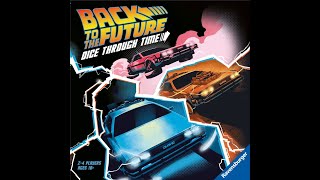
The artwork is stylized rather than based on film stills. Biff has no face, and the event art shows recognizable moments, such as the hoverboard chase and the clock tower, without depending on actor likenesses. Reviewers on Before You Play call the art charming and say the paradox tiles and Einstein tokens look good on the table, while Rolling Dice & Taking Names points out that the design avoids licensing costs for actors while keeping the spirit of the films.
Potential Drawbacks
Punishing Early Mistakes
The game has little forgiveness. Reviewers warn that a weak start in the first two rounds can make the rest of the game hard to recover from, and the penalty for two Delorean pieces meeting is steep. Players who do not grasp the flow early may find the time track racing ahead before they understand the mechanics.
Luck and Length
Dice luck is a major factor, and Einstein tokens only soften it. The harder difficulty modes add more items instead of more threats, so they make the game longer rather than meaner. Reviewers also note that the game lacks the ramp-up mechanic common in cooperative titles like Pandemic, which makes it a lighter experience but also a less escalating one for players who want the tension to grow over time.
If You Enjoy Back to the Future: Dice Through Time
Players who enjoy a classic cooperative structure with a clear ramp-up and shared threats will find a natural benchmark in Pandemic, which reviewers use as the gateway cooperative game this title is compared against. Those who want a lighter cooperative experience built around racing against a rising threat with shared resources should look at Forbidden Island. Players drawn to the dice-driven resolution of events will find a similar feel in Elder Sign, a cooperative game where rolls decide what can be resolved, which reviewers say shares the spirit of clearing events here.
What Reviewers Are Saying
"it's thematically it really works well together"
— Rolling Dice & Taking Names
"the artwork is great yeah"
— Before You Play
"I'm a sucker for Back to the Future. It is my favorite film of all time"
— Scratch Off Board Games