
With a bright Peep from the whistle, a full Chuff from the pistons and a powerful Clank from the drivers, America's first steam locomotive moves down the steel rails of the Baltimore & Ohio Railroad in Baltimore in 1830. This strategic railroad game extends from the first of America's railroads through the golden age of steam, where pioneering rail barons knit together the fledgling United States with iron roads, realizing the full power of the nation's mighty heartland. Each player takes the roles of railroad presidents and their wealthy investors, betting that their capital gambles will pay off handsomely. Baltimore and Ohio is not a game of luck or chance, but a competitive struggle of wits, savvy and guile. With the resources at hand, should you focus on further expansion, technological breakthroughs or emerging markets? This modern classic has all the challenges faced by the empire building capitalists that created a superpower.
Eddie Robbins' Baltimore & Ohio is a no luck, no auctions, 3+ hour, grand strategic economic slugfest of a train game, for 3-6 players. It was part of the Winsome Games' 2009 Essen Set, has been licensed to Eagle Games and will be released by Eagle in 2010.
The railroads in the game are:
Baltimore & Ohio
Boston & Maine
Chesapeake & Ohio
Erie
Illinois Central
New York Central
New York, Chicago & Saint Louis (aka Nickel Plate)
New York, New Haven & Hartford
Pennsylvania
Wabash
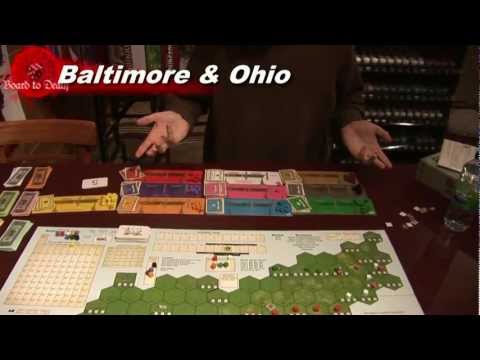
Images


- Intensive and complex train game
- Deep financial and stock market elements
- Well-organized components and board
- Concise and easy-to-follow rulebook
- Engaging gameplay that led to wanting to play again immediately
- The board is visually unappealing ('ugly')
- Requires a calculator due to being math-heavy
- Long playtime
- Train board game, railroad companies, stock market
- Eastern and Central United States
- Ticket to Ride
Mechanics (from transcript analysis)
- Area Control — Players can take control of companies by owning more than half of the stock.
- economic engine building — Players build up their companies and portfolios to generate profit through servicing cities and collecting dividends.
- Resource Management — Money is used to manage railroad companies and buy capital equipment (train cards).
- Route Building — Players place cubes to represent train lines, connecting cities and expanding into coal fields.
- Set Collection — Collecting train cards of different technology levels determines maintenance costs, serviced cities, and income potential.
- stock market simulation — Players buy and sell stock in railroad companies, aiming to build the best portfolio, with stock values fluctuating based on company performance and player actions.
Video topics + discussion points
Quotes (from this video)
- the goal of the game isn't really to build the best company it's to build the best portfolio
- there are all sorts of dirty Financial tricks you can play with this game
- the board is a a little ugly unfortunately I had a friend who described it as being very Microsoft Office 97
- you really need a calculator for this game
- personally this was a nine for other people it may not be as enjoyable but I absolutely loveed this
References (from this video)
- classic, approachable entry in the rail-game space
Mechanics (from transcript analysis)
- Network/Route Building — build a rail network while engaging with stock-based actions.
- rail network with stock-like incentives — build a rail network while engaging with stock-based actions.
Video topics + discussion points
Quotes (from this video)
- it's a 10 out of 10 game
- every play is so different
- I love dual gauge