/pic1066791.jpg)
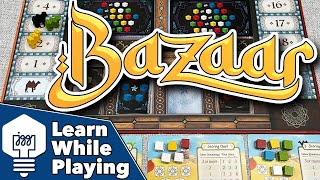
The components of Bazaar include a whole bunch of little chips, in five colors. At the start of the game, two equation cards are randomly chosen. Each equation card has five equations on it, for a total of ten equations that will be in effect for the duration of the game. The equations state equivalences between certain combinations of colors, for example:
Red = Green Green
Green Yellow = Blue Blue Red
Four target cards are turned up, each with some combination of five chips represented on the target card (so a typical target card might be Green Green Blue Blue Blue).
On your turn, you roll a colored die to randomly pick a colored chip for yourself, or you can make one exchange of your colored chips based on the equations. The goal is to end up with the right combination of chips to get one of the target cards. You want to do this quickly – and even more importantly, with as few chips left over as possible after you've purchased the target card – because this is how you score points.
The original version is part of the 3M Bookshelf Series.

Samarkand - Learn While Playing!

- quick trading game within the box set
- fast-paced trading and selling
- trading market setting
Mechanics (from transcript analysis)
Video topics + discussion points
Quotes (from this video)
- this is a work replacement Style game that very much reminds me of dwellings of el reveal
- I like Tableau building I like interesting work replacement systems
- I am quite looking forward to digging into this game to see exactly how it works
- I genuinely don't really understand and honestly I wouldn't say I'm particularly compelled by the mechanics that are explained so far
- this game has this interesting River idea where six cards will put face up in the middle of the table
References (from this video)
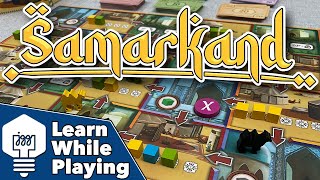
- Samarkand
Mechanics (from transcript analysis)
Video topics + discussion points
Quotes (from this video)
- This is essentially a race to 500 money.
- Rolling the die costs five money.
References (from this video)
- Dynamic conversion system with multiple options per turn
- Star-based scoring adjustments add strategic depth
- Increasing scoring pressure as stacks deplete creates tension toward the endgame
- Samarkand
Mechanics (from transcript analysis)
- Card-based scoring — Players complete wear cards by matching resource cards in their area to gain victory points. The points depend on the number of excess resources remaining.
- Compound Scoring — Players complete wear cards by matching resource cards in their area to gain victory points. The points depend on the number of excess resources remaining.
- dice-based resource generation — On a turn, a die is rolled to determine which resource color is gained from the supply, including a wild face that can take any available cube.
- End-game condition via stack depletion — There are stacks of wear cards; the game ends immediately when a second stack is depleted.
- Resource conversion — Players spend specific colored cubes on conversion cards to produce other colors.
- Resource storage limit — Players can hold a maximum of 10 cubes; excess cubes are discarded to the bank to enforce the limit.
- Star-based scoring adjustments — Some cards have stars; when stacks are depleted, scoring is modified as if those cards had extra stars.
- Tiebreakers — If players are tied on victory points, the tiebreaker goes to the player who has completed the fewest wear cards.
Video topics + discussion points
Quotes (from this video)
- welcome to the John gets games tutorial
- in addition to that if you'd like to directly support this Channel and gain access to an exclusive podcast feed where you can hear audio versions of all of the Vlogs that I make
References (from this video)

- interesting hand-management with market tension
- engaging bidding mechanic
- a bit fiddly at times
- could be procedural for some players
Mechanics (from transcript analysis)
- hand management / set bidding — Players manage a hand of cards for set collection, bidding on future cards and market dynamics.
Video topics + discussion points
Quotes (from this video)
- I am color blind and sometimes we just have to wing it
- it's not at the Forefront of why I enjoy gaming
- life is generally a bit busier for me now
- I would rather play someone else's game that I don't have or I've not played before
- I find his games a little bit too loose
- the expo is normally a good day out, I enjoy it, it’s a shopping day
References (from this video)
- Historical significance
Mechanics (from transcript analysis)
Video topics + discussion points
Quotes (from this video)
- Shelf 16 is kind of a an odd mix here
- This shelf has twice as many games as most shelves
- one of my favorite two-player games, but it's very difficult to learn and play
- Fantastic abstract strategy game
- Such a classic game and I like it a lot
- I don't know why I like it so much, but I do
- one of the most beautiful dexterity/party games there are
- There are so many games on the shelf
References (from this video)

Mechanics (from transcript analysis)
Video topics + discussion points
Quotes (from this video)
- The two by the way was Kingdoms for Lauren which is actually I think liked by others but I felt that you had to break your teeth on the rules to get to a game that was a whole lot of messiness.
- I really did not love Kingdoms for Lauren but I respect that it's a game that will work for others.
- The highest the highest individual score given out in 2022. So that's the 3.5 is the most common rating given.