
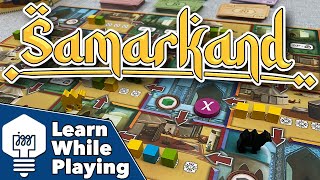
A trading game in which you don't trade with the other players. Instead the commodities are displayed on the board in a number of "nomad camps." If your move brings you to a camp, you must present a gift to the camp -- then you can trade your cards for any cards in the camp. You can also buy goods from the deck at "oasis" squares. Once you've amassed a number of a particular commodity, you head for the city where that commodity is bought. There are a few other details to complicate matters, but basically everyone repeats this process until someone has the 500 cash in hand to win the game. Samarkand is an entertaining exercise with no especially brain-taxing strategies to figure out and makes a good family game.
This game is sometimes called Bazaar II, because Schmidt Spiele originally published this game under the name Bazaar, even though Bazaar is a completely different game. Both games are by Sid Sackson.

Samarkand - Learn While Playing!

- classic Sid Saxon action game vibe
- reprint with updated production
- trade and market dynamics
- classic action/trading game environment
Mechanics (from transcript analysis)
Video topics + discussion points
Quotes (from this video)
- this is a work replacement Style game that very much reminds me of dwellings of el reveal
- I like Tableau building I like interesting work replacement systems
- I am quite looking forward to digging into this game to see exactly how it works
- I genuinely don't really understand and honestly I wouldn't say I'm particularly compelled by the mechanics that are explained so far
- this game has this interesting River idea where six cards will put face up in the middle of the table
References (from this video)
- Multiple strategic paths (upgrading to rarer cubes, chasing big payouts at cities, and flexible movement).
- Payouts at cities escalate quickly, offering high rewards for larger sets.
- Oasis draws provide a way to accelerate cube acquisition and diversification.
- Rolling the die costs money on every turn, which can erode profits.
- The bag can run out, forcing discard down to 12 cubes and potentially losing valuable resources.
- City sale rules can lead to penalties or elimination if a player cannot pay.
- The marketplace and blocking token add complexity and timing considerations.
- trade and money accumulation through collecting and selling goods; upgrading to rarer cubes
- Board with merchants traveling, nomad camps, oases, and cities to travel between
- instructional/tutorial
Mechanics (from transcript analysis)
- Bag and drawing / discard — The bag contains cubes; drawing reduces the bag; when the bag runs out, players must discard cubes behind screens to a max of 12.
- Bag Building — Landing on an Oasis lets you spend money to draw 1 or 4 random cubes from the bag; cubes go behind your screen.
- Cities and selling sets — Cities allow selling sets of cubes to gain money; a set can be all of one color or multiple colors; payouts scale with set size.
- Market Pricing/Manipulation — Selling to a city places a market token on that city; the token moves after a sale, blocking that spot until another sale occurs.
- Market token / blocking — Selling to a city places a market token on that city; the token moves after a sale, blocking that spot until another sale occurs.
- Movement options — On a turn you can move your camel exactly once, or roll a die and move the exact number shown (five money to roll).
- Nomad camps and greeting gifts — Landing on Nomad sites requires giving a cube as a greeting gift, then allows trading cubes with those in the camp.
- Oasis actions — Landing on an Oasis lets you spend money to draw 1 or 4 random cubes from the bag; cubes go behind your screen.
- Set Collection — Cities allow selling sets of cubes to gain money; a set can be all of one color or multiple colors; payouts scale with set size.
Video topics + discussion points
Quotes (from this video)
- This is essentially a race to 500 money.
- Rolling the die costs five money.