/pic4306846.jpg)

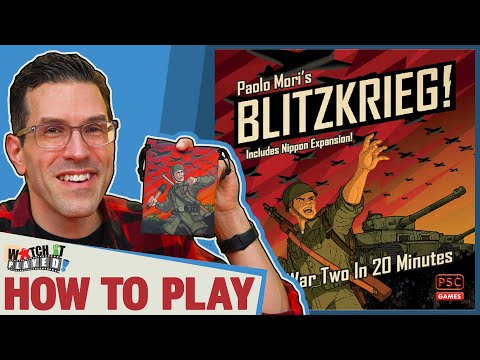
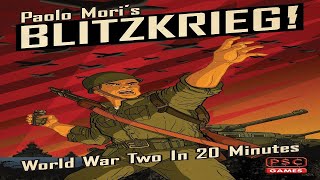





Blitzkrieg!: World War Two in 20 Minutes Deep Dive
What the Community Thinks About Blitzkrieg!: World War Two in 20 Minutes
Reviewers describe Blitzkrieg!: World War Two in 20 Minutes as a masterclass in elegant game design, delivering enormous strategic depth within a deceptively simple framework. The game's reputation centers on its ability to create meaningful tension and constant decision-making between two players across multiple arenas of conflict. Commentators consistently praise how the game respects the player's time while rewarding tactical thinking. Many reviewers highlight the surprising variety and replayability that emerges from a compact ruleset, calling it one of the strongest two-player-only games available today. The 20-minute playtime claim holds up consistently across reviews, with players noting that games rarely exceed thirty minutes even with teaching included.
Core Mechanics That Define Blitzkrieg!: World War Two in 20 Minutes
Bag-Building and Hidden Information
At its heart, Blitzkrieg! operates as a bag-building game where each player starts with identical unit tokens representing armies, navies, and air forces. Players draw three tokens into their hand behind a player screen, keeping their composition secret. On each turn, a player selects one token from hand to place on the board, triggering the action on that space before drawing a new token. This mechanic creates a hidden-information layer that shapes every decision: players must reason about what units their opponent likely holds, what they might play next, and how to position pieces accordingly. The bag pulls also introduce gentle randomness without eliminating agency. Some spaces in the game force an opponent to lose tokens, returning them to the bag, which further complicates hand management. This simple cycle of drawing, playing, and acting generates surprising tactical richness as players balance deploying strong units now against maintaining options for future turns.
Tug-of-War Across Multiple Theaters
The board divides into five distinct theaters of war, each with its own battle track. When a player places a token, they move a central marker along that theater's track toward their side based on the token's value and position bonuses. Think of each theater as a separate tug-of-war, with the marker sliding back and forth between the two sides. When a campaign row fills completely, the game checks which side of the marker controls that space. Whoever controls the marker scores victory points equal to that campaign's value, plus any bonus points if the marker has reached certain thresholds. The clever tension emerges from players needing to decide whether to press an advantage in one theater, hold the line in another they're losing, or redirect effort entirely to an uncontested area. Players cannot win all five theaters, so managing which battles to fight and which to concede becomes core to the strategy. Some unit types carry special abilities that affect how these battles unfold, adding layers of calculation to each placement.
The Blitzkrieg!: World War Two in 20 Minutes Experience
Quick to Teach, Challenging to Master
The teaching footprint is remarkably small. Players can learn the entire system in roughly seven minutes, and the game moves quickly from there. Unit placement is visually intuitive: armies go on brown land spaces, navies go on blue sea spaces, and air forces can go anywhere. Each space displays its effect clearly on the board itself, so players reference the physical game rather than rulebooks. This accessibility belies the decision density hiding underneath. Experienced players find themselves constantly evaluating whether to commit strong tokens early to establish dominance or hold them back to respond to opponent threats. The game creates a Breezy veneer that feels effortless to play, yet every turn matters deeply. Turns flow quickly, turnover is snappy, and the entire experience maintains momentum from opening placement through final victory calculation.
Constant Tension and Interactive Gameplay
Reviewers consistently describe Blitzkrieg! as a game that generates palpable tension throughout play. Because players share symmetric starting positions and draw from the same bag types, information asymmetry becomes weaponized. Watching your opponent place units tells you what they no longer hold, what threats might be incoming, and which theaters they've abandoned. The interactive element runs deep: certain board spaces force opponents to bomb tokens out of their hand, removing options available next turn. Other spaces let players draw additional tokens, accelerating hand development. This creates a push-and-pull dynamic where offense and defense become intertwined. Sometimes the best play is to press an advantage hard, forcing your opponent to react. Other moments call for abandoning a losing theater to launch a surprise offensive elsewhere. This constant recalibration, the need to read your opponent's hidden hand through their plays, and the back-and-forth for control of shared battle tracks generate an Intense experience that rewards attention and punishes autopilot decisions.
What Makes Blitzkrieg!: World War Two in 20 Minutes Stand Out
Surprising Depth from Elegant Simplicity
The game achieves something rare: complex decisions made simple. The core turn loop never changes: draw from bag, play to board, resolve space effect, move marker. Yet cascading choice emerges from these fundamentals. Players must weigh unit strength, position bonuses, opponent hand inference, multiple theater battles, and long-term hand development across three or four minutes of actual play time. Special unit types add wrinkles without overcomplicating the core: generals and admirals get stronger in theaters where you've already placed armies or navies. Elite units carry higher values but prevent resolving certain space effects. This is a game where rules-light truly means accessible to new players, not shallow for experienced ones. Each theater generates its own micro-game, and the interplay between theaters creates macro-strategic puzzles. Reviewers praise the way a simple framework can support this level of engagement, making Blitzkrieg! feel weightier than its component count or rulebook thickness would suggest.
Multiple Paths to Victory and Strategic Variety
Blitzkrieg! does not funnel players toward a single path to 25 victory points. Players can dominate one or two theaters completely, claiming all victory points from their campaigns. Alternatively, players can spread their tokens across multiple theaters, winning several battles narrowly but accumulating points through bonus thresholds and contested theaters where both sides score. Some matches reward aggressive early play; others reward patient positioning. The bag-pulling introduces natural variance that rewards adaptability over rigid planning. The inclusion of the Nippon expansion on the back of the board adds alternative unit types and asymmetry, ensuring that players cannot memorize a single winning approach. Reviewers note that they return to Blitzkrieg! repeatedly because each game feels distinct. The frozen hand composition, random bag draws, and shifting board state create scenarios that reward different strategic priorities from game to game.
Potential Drawbacks
Hidden Information Can Create Frustration
The bag-building mechanic, while elegant, introduces moments of legitimate randomness that some players find frustrating. A string of weak token draws can leave a player with few good options, while an opponent draws into powerful combinations. Since players cannot see the bag's full composition until tokens emerge, losing stretches can feel punishing rather than earned. The hidden information behind opponent screens also means that occasionally a player discovers they have misread their opponent's hand entirely, making a play that seemed clever into one that backfired spectacularly. For players who prefer games with perfect information or more forgiving randomness, this aspect can create moments of disappointment.
Theme May Not Resonate with All Players
The World War II military theme, while fitting the "20 minutes" conceit and creating natural mental hooks for the game's mechanics, can turn away players who prefer different settings or feel uncomfortable with wargame aesthetics. The abstract nature of the gameplay (tug-of-war markers rather than simulated combat) means the theme remains relatively light, but the branding and artwork still center on World War II military terminology. Players seeking games with other historical periods, fantasy settings, or entirely abstract designs might find the package presentation less appealing, even if the underlying system would engage them. The thematic fit, while strong for strategy-focused players interested in history, narrows the potential audience.
If You Enjoy Blitzkrieg!: World War Two in 20 Minutes
Reviewers who love Blitzkrieg! often gravitate toward Air, Land and Sea, another Paolo Mori design with similar tug-of-war structure across three theaters, though with card play instead of token drawing. Players should explore Caesar! and Dogfight, companion designs in the "in 20 minutes" series that use nearly identical systems but transpose the theme to ancient Rome and dogfighting pilots respectively. Hanami Koji offers comparable interactive depth through a split-you-choose mechanism where players control what their opponent can access. For those drawn to bag-building and hidden information, Jaipur delivers set-collection gameplay with strong hand management and racing mechanics. Targi, a worker-placement game for two players, shares Blitzkrieg!'s philosophy of small ruleset masking tactical richness. Finally, Hail Caesar! (the other game in the two-player tug-of-war series) offers nearly identical mechanics applied to Roman conflict, letting players explore whether the system resonates independent of Blitzkrieg!'s specific theme.
What Reviewers Are Saying
"It's really smooth to play just drawing a token from the bag, I'm using one of the tokens in front of you to place on the board and resolving its effects not only for its numerical value but also for the bonus on the actual spot itself. And yeah really cool game and you can really hurt your opponents by trying to thin out that hand and giving them fewer options you can invest in having more tokens in your pool and it just there is so much going on here with such a simple framework and that tension from start to finish is fantastic."
— Chairman of the Board
"This game has a really great um attention as you are just constantly poking and prodding going on the offense going on the defense times the best defense is an offense in this game where if somebody goes really hard on one of the tracks instead of trying to pull that track back you just say okay well fine I'll go over here and I'll do a big thing over there."
— JestaThaRogue
"They really went back and forwards as to which one to pick and that's why we are grouping it together. For both of them there are restrictions on where your chips can go and I think that adds a lot as well because when I'm looking at a theater I'm like oh Sean could win that but I don't have anything that could go there then that can make it a little bit tricky."
— Allies or Enemies