














Blueprints of Mad King Ludwig Deep Dive
What the Community Thinks About Blueprints of Mad King Ludwig
Reviewers largely agree that Blueprints of Mad King Ludwig works as a relaxed, creative puzzle that rewards careful planning. Paula of Watch It Played, whose Table for One series covers solo play, approached the game as a tangle of geometry and scoring that keeps a solo player engaged across all ten rounds. Brody of Let's Table It focused on how approachable the drawing is, noting that tracing paper makes a finished castle look polished even for players who do not consider themselves artists. Jenna of The Board Game Garden enjoyed the sketching so much that the final scoring became the least satisfying part of the session. Ian of Where There's A Wilz, There's a Play ranked the game among their favorite solo experiences of 2025 and praised the vellum sheets. The main point of disagreement concerns complexity. The scoring has many separate categories, and the moat and downstairs rules take some time to internalize.
Core Mechanics That Define Blueprints of Mad King Ludwig
Tile Placement
Tile placement is the center of the game. Designed by Ted Alspach and published by Bezier Games, the game asks each player to sketch the room they chose onto a personal blueprint so that at least one of its entrances connects to an entrance already on the sheet. Rooms may never overlap existing drawings. Rodney of Watch It Played explains that a room is complete only when every one of its entrances connects to another entrance, and that a doorway touching the edge of the lot or leading into empty space stays open. Paula's solo playthrough shows how this plays out in practice. A large outdoor room placed early created so many open doorways that it became a regret, while a later sleeping room that allows doors to be moved finished a stalled blue room. Reviewers treat the entrance matching as the core of the puzzle, and the rewards for completing each color of room are what give that puzzle its direction.
Card/Chit Market
Each round a market of room cards is revealed, equal to the number of players plus two. Players take one card, sketch it, and leave the rest. Rodney describes how the leftover cards move into a reserve pile beside the room deck, where they are not gone for good. Completing a red activity room later lets a player draw from that reserve instead of the market, which turns discards into a resource. Paula's solo variant treats the reserve as a rival player. Every room left behind competes against Paula's own totals for King's favor goals such as the total size of downstairs rooms or the number of outdoor rooms, so each pass carries a cost. In one comparison, a tie with the reserve on the outdoor room count scored nothing for Paula, which made the discard pile feel like a real opponent.
The Blueprints of Mad King Ludwig Experience
Serene
Much of the appeal lies in a quiet, deliberate rhythm. Paula described coloring in the rooms as very meditative and noted that most of that coloring was cut from the video because it was so calm to do. Jenna, who had recently taken up adult coloring, called the activity therapeutic and relaxing, and the game's cycle of choosing a room, tracing it, and filling it with color suits that mood. Because a player can slide a corner of the sheet under a card and trace the room, the drawing stage rarely feels stressful, even when the layout gets crowded.
Triumphant
The game also delivers strong moments of achievement, especially when one placement completes several rooms at once. Paula's session built toward a late turn where a blue sleeping room completed a difficult book-shaped red room, finished an outdoor room, and advanced a living room toward completion. Rodney notes that completing a room gives a reward that can be used immediately or saved, and that a food room's extra turn can be chained into further completions. Paula ended with 191 points, and the final tally reflected how many of those chained rewards had landed in the right places.
What Makes Blueprints of Mad King Ludwig Stand Out
Tracing Paper Sketch Sheets
Reviewers consistently praise the vellum-style sketch sheets. Brody says the sheets work as tracing paper, which makes a finished castle look good enough for the king himself. Ian values how the sheet lets players slide a room card underneath to see its exact outline, and how the room shape remains visible while drawing. Rodney confirms that the material is transparent, so a corner can be lifted and traced without ruining the layout. Several reviewers say that the feared difficulty of drawing detailed rooms never materialized, and that the game's design lets players create without needing artistic skill.
A Solo Mode That Plays Against Its Own Discards
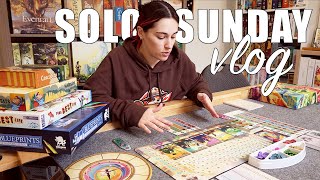
Paula highlights that the solo mode is not a stripped-down version of the multiplayer game. Players draw thirty random room cards to form the deck, discard any card carrying the solo-exclusion symbol, and compare their results against the reserve pile rather than against an artificial opponent. Paula explained that the goal is to beat your own previous score, which gives the mode a clear sense of progress. Because every game uses a different random deck, the layouts and scoring opportunities also change from session to session.
Potential Drawbacks
Scoring Takes Real Effort to Learn
The final scoring is the most frequently raised concern. Jenna admitted to not being completely sure how the final scoring worked before the first session, and said the moat rules were initially confusing. Rodney's walkthrough shows how many separate categories must be tallied, including completed outdoor rooms, moats that score rooms behind them, bonus cards, courtyards, and King's favor ranks. Reviewers suggest that the first game is best treated as a learning session, which Jenna did, and that the chart on the back of the solo sheet helps place a score in context.
Layout Dead Ends and Random Draws
The drawing rules can trap a player. Rodney explains that once a downstairs room is on the sheet, every later downstairs room must connect to another downstairs room, so a player with no open downstairs entrances cannot take those cards at all. Paula repeatedly faced this problem, saying that a large outdoor room was a bad idea because its doors could not be matched, and that a planned downstairs placement might be a terrible decision. The random room deck means some games produce workable layouts while others leave players with rooms that do not fit anywhere, and reviewers say that this variance is part of the challenge rather than a flaw.
If You Enjoy Blueprints of Mad King Ludwig
Players who enjoy the tile-placement puzzle of Blueprints of Mad King Ludwig will find a familiar appeal in Castles of Mad King Ludwig, the closely related title that shares the same castle-building theme and entrance-matching approach. Players who enjoy the planning and layered scoring will also find a good match in Trekking the World. Ian of Where There's A Wilz, There's a Play recommends looking specifically for the second edition, which replaced the first edition's approach with dual-use cards, region-based souvenirs, and a coin dial for tracking money. Ian says the second edition is an entirely different game that rewards long-term planning, which is the same satisfaction that draws reviewers back to Blueprints of Mad King Ludwig.
What Reviewers Are Saying
"Ultimately this is a game where players can create and even for those that don't feel like they are creative this game still let you be creative and in this creation of plans for Castle that you know you just can't help but feel good about it even if you don't win the game."
— Let's Table It
"I loved drawing in all of the rooms on this little like Vellum sheet and trying to score as many victory points as possible. I just was not paying attention to a lot of the cards that were going into the pile of the AI they ended up beating me in like three or two of the different objectives that you were going for."
— The Board Game Garden
"Because it just got that interesting room and I like the fact that the vellum paper you slide it in so that you can see what the room shape is."
— Where There's A Wilz, There's a Play