


Boardquest: Tales of Liria Deep Dive
What the Community Thinks About Boardquest: Tales of Liria
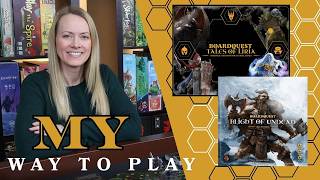
Boardquest: Tales of Liria is the fantasy game from Ramezware with RPG elements for one to four players, and the few community videos covering it each catch a different slice of what it offers. Kimberly of Tabletop Tolson reviews the second edition reprint, which bundles the Blight of the Undead expansion and raises the player count to six. Kimberly's enthusiasm is for the solo and cooperative storybook scenarios, and Kimberly found the base game's competitive play notably less satisfying by comparison.
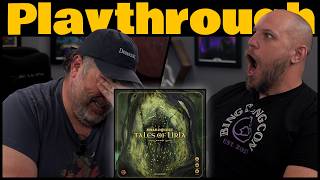
The Brothers Murph present a two-player orcs versus humans match. Their video is a lively, play-by-play tour of forts, heroes, and dice rolls, and it works as an introduction to the competitive side of the game. Rather than delivering a final verdict, they invite viewers to share their own opinions in the comments.
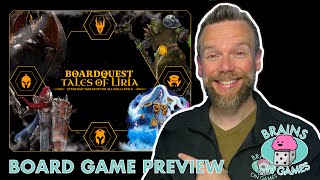
BoardGameCo has not yet tabled the game. The channel took it on as a favor with modest expectations, with an upcoming campaign still on the way, so its perspective is a preview rather than a hands-on assessment.
Taken together, the storybook, scenario-driven content is what Kimberly singles out as the stronger half of the design, while the base game's head-to-head conflict is the part Kimberly found less satisfying.
Core Mechanics That Define Boardquest: Tales of Liria
Area Control
Territory is the central tension of the competitive game. The Brothers Murph explain that players win either by conquering five forts or by eliminating the opposing hero. A unit or hero standing on a neutral fort can use an action to conquer it, while an action on an enemy fort flips it to neutral, so control can change hands repeatedly. Each conquered fort raises income, which makes a single fort immediately important to the economy. Units reduce income when they are on the board, so every troop placed trades against the gold needed to recruit the next one. Tabletop Tolson describes the same system as feeling more like capture the flag, with a push and pull over forts that eventually turned into character elimination.
Scenario-Based Play
The storybook scenarios are the mechanic reviewers discuss most warmly. Tabletop Tolson describes the Defenders of Lyra and Scourge of Lyra books, each containing five self-contained scenarios that build on the origin story. Every scenario has its own setup instructions, map, enemy roster, and win and loss conditions. In the opening scenario, The Hunt, the goal is to defeat all enemies, and the game is lost if the player's main character dies. Enemies act in initiative order and always move toward the nearest hero, which Tolson notes makes the solo enemy turn easy to run. Different scenarios bring different characters, maps, and creatures, so the book structure gives the campaign its variety.
The Boardquest: Tales of Liria Experience
Focused, Cooperative Storybook Warmth
Tabletop Tolson describes the storybook mode as compact and focused. Scenario setup is laid out in the book, and the trackers, player aids, and level-up reference cards are close at hand, so the reviewer says "everything is essentially set up for you." Tolson plays the scenarios alongside a spouse and describes talking through strategy together, and also finds solo play with the story easy to set up. The result feels like a guided tale to work through rather than a contest to win.
Tense Competitive Push and Pull
The competitive mode produces a different feeling. Turns move quickly, since each unit or hero gets a single maneuver action per turn, and the choice of what to do with that action carries weight. The Brothers Murph's match is full of close rolls, with attacks landing one point short of what was needed and fights swinging back and forth as units are lost and heroes level up. Tabletop Tolson found that the constant contest over forts pushed toward eliminating rivals, and the reviewer did not find that satisfying. The tension is real, but it is aimed at other players rather than at a shared goal.
What Makes Boardquest: Tales of Liria Stand Out
Acrylic Standees and Modular Tiles
Tabletop Tolson singles out the acrylic standees, which are large enough to read clearly on the table. The reviewer's example is Gregor the Mighty, whose sword is bigger than the figure holding it. The board is built from modular tiles, and each terrain tile states what movement and actions it allows or prevents, so the map differs from one game to the next. The Brothers Murph also show how terrain shapes play, since moving into a forest, mountain, or water space stops a unit's movement for that turn.
Adjustable Difficulty Within the Campaign
Tabletop Tolson notes that the scenarios let players adjust difficulty. The setup offers a marketplace gold amount based on whether the player chooses easy, normal, or hard, and the reviewer used that gold to buy a long sword and shield for Gregor. Tolson also points out that the difficulty can be changed as the player goes. The expansion adds two asymmetric factions, more monsters, and a new campaign, and it allows team versus team play for larger groups.
Potential Drawbacks
Competitive Play Can Feel Like Attrition
The base game's head-to-head mode is Kimberly's clearest criticism. Kimberly found the direct conflict over forts and the fighting between players less satisfying than the storybook content, while acknowledging that the mode may suit other players. The Brothers Murph's match shows the same pressure: destroyed pieces are removed from the game permanently, and when a hero claims a fort, that uses up the hero's turn for other actions. Players who want a relaxed, narrative experience may find the competitive mode a poor fit.
Setup Effort and Dice Variance
Tabletop Tolson notes that the campaign requires hunting for components and preparing everything before play, although the reviewer found it worthwhile once the scenario is ready. Combat relies on rolling two dice against a defense value, so luck plays a large role, and The Brothers Murph repeatedly rolled results one point short of a hit. Their video also includes an on-screen correction: the negative skill effects show a die icon with four pips, but the rule is a normal attack that compares the roll to defense, not a roll of four. That mix-up is a reminder to check the rules carefully on first play.
If You Enjoy Boardquest: Tales of Liria
Tabletop Tolson places the game beside several long-running favorites, and those titles share its strongest qualities. Jaws of the Lion offers a campaign-driven, scenario-based experience with character growth that suits the solo and cooperative style the reviewer prefers. Gloomhaven is the reference point Tolson uses for the feel of the game, with its dungeon-crawl structure, party progression, and story delivered through scenarios. Kinfire Chronicles: Night's Fall provides a similar mix of cooperative or solo play and story-led scenarios with tactical combat. Players who enjoy the storybook side of Boardquest: Tales of Liria will likely find these titles appealing for the same reasons.
What Reviewers Are Saying
"It feels so much more compact. It feels focused. Everything is essentially set up for you."
— Kimberly, Tabletop Tolson
"You can win two ways, but one by taking five forts. We each start with one, or by eliminating the other person's hero. So get a little too overzealous and get up front and they're just get beat to crap."
— The Brothers Murph
"I find that just a little bit more satisfying than the kind of butting heads in the direct conflict that you get with the capturing forts and then fighting against your fellow players. Not for me as satisfying."
— Kimberly, Tabletop Tolson