





Byline Deep Dive
What the Community Thinks About Byline
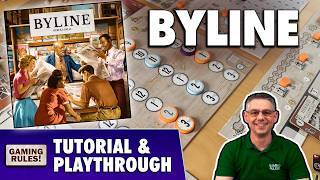
Byline casts players as independent reporters in the 1960s, chasing leads, verifying sources and selling finished stories to rival newspapers. Tom Heath of slickerdrips covers it in a two-player game and in a separate solo game against the bot Woodward (solo playthrough). The Gaming Rules! three-player playthrough follows Stuart, Chris and Paul through a table that includes a dummy player blocking spaces.
The shared view is that Byline rewards careful scheduling and punishes loose timing. Gaming Rules! stresses that this is "not a standard euro game where the player with the most victory points wins," because the victory points are the cash itself and everyone starts with nothing. Both channels present the theme as a real draw, but they also describe a learning curve around the pub and the editor's bonuses that takes a session or two to absorb. Designer Derek Levelvel self-published the game through their own company, Figment Box Games, and Gaming Rules! notes that it was originally planned for Kickstarter before those plans changed.
Core Mechanics That Define Byline
Hourly Worker Placement
Each day every player has seven hours, and the board is a grid of actions that each consume a set number of them. Tom's two-player game shows the basic rhythm: a coffee break costs one hour, while gathering sources costs three and assignments require consecutive hours. Placement order matters because actions resolve in time order from left to right. Taking an early slot can claim an action before a rival gets there, and the first player to a coffee break takes first position for the following round. Gaming Rules! explains a visual shorthand for multi-hour actions: the light side of each marker shows where the action resolves, and the dark side shows the hours spent. In a three-player game, dummy discs block slots, and Gaming Rules! notes that even a player who goes first can find a planned spot occupied.
Sources, Verification and Deadlines
Assignments from the news board name a newspaper, a deadline hour and the sources required for the story. Sources come as photographs, leaked documents, interviews, tip-offs, research tokens and official reports, and most arrive unverified. Tom points out that unverified sources cannot go into a published story, and that the verify action rewards arriving early: the first player there verifies one source, the second player verifies two and so on. Deadlines are strict in the two-player game, while Tom notes that higher player counts allow an hour's grace at the cost of some bonuses. Missing a deadline has consequences. In Tom's two-player walkthrough, a planned 9:00 hand-in collapsed because the research token had not been gathered, and assignments that slide off the board cost reputation. Figment Box Games' pub action also converts resources: a player can trade a verified source, two unverified sources, two official reports or three research tokens for a better reward.
The Byline Experience
Juggling Deadlines Under Pressure
Both channels describe a game where every hour feels contested. Tom's two-player game shows the constant recalculation, as a rival's placement can block the verify slot a player needed, and a sensible plan can be ruined by one missing token. Gaming Rules! reacts with visible frustration when a carefully planned day collapses, and the table debates whether spending reputation to keep a plan alive is worth the cost. The pressure comes from the fact that every plan has to fit inside seven hours and inside the calendar of each assignment. When a schedule works out, the payoff is satisfying, and when it fails, the loss is immediate.
Newsroom Immersion and Reading Rivals
The journalism theme comes through in the way the game makes you chase uncertain information. Tom describes collecting sources as building a network of feelers, saying, "I'm out there getting feelers," while the rival relies on official channels. Gaming Rules! notes that players can anticipate one another's choices, since taking research early hints at which sources a rival might take later. The board also feels like a newsroom, with circulation tracks for the Post, Herald, Examiner and Tribune, and stories that read like headlines from the period, including army experiments, urban riots and a satellite launch. The rivalry is less about direct attacks and more about reading the table and getting to the right story first.
What Makes Byline Stand Out
A Solo Mode With Adjustable Difficulty
Tom's solo playthrough against Woodward shows how much the single-player game is built out. The player boards carry four difficulty levels, the setup cards can be paired at different strengths, and optional challenge cards add conditions such as reaching a reputation level, placing a set number of story discs or finishing several stories from one paper. Woodward takes the first round automatically and uses decision cards to pick sources and assignments by priority. Tom notes that the bot can spend reputation to place on top of a player's disc at a deadline, which makes it a real competitor rather than a scripted opponent. Gaming Rules! describes the solo mode as fully developed, with its own set of extra cards, though the hosts had not played it themselves. Tom won the solo game narrowly after correcting a scoring slip for the bot, and they stress that the difficulty combinations give plenty of room to tune the challenge.
Story Bonuses and Circulation-Driven Payouts
Two features make the scoring feel like a newspaper economy. Headline stories do not pay a fixed amount. Gaming Rules! explains that the payout depends on where the paper's circulation marker sits, so publishing early lifts the value of later headlines for that paper. Reputation thresholds unlock editor's bonuses, which let a player claim a reward up to the reputation level they reached. The story bonus grid pays at game end, and Tom explains that each disc there is worth the highest reputation reached multiplied by the disc count. This gives every game a long-term plan on top of the daily schedule, because a disc placed early can be worth several points by the finish.
Potential Drawbacks
Intertwined Rules That Take Time to Learn
Reviewers point to the pub and the editor's bonus as the hardest parts of the rulebook. Gaming Rules! calls the pub "probably the most complicated action in the game," because its icons offer several exchanges at once. The editor's bonus is described as the most complicated rule, since the bonus available depends on the story type, the newspaper's circulation and the reputation threshold reached. The dummy discs in a three-player game add another rule to track, and the Gaming Rules! hosts admitted they had never needed the printed player aids that summarize submission bonuses. Experienced tables may find the interplay rewarding, but new players will spend early turns checking the rules.
Reputation Penalties and Pub Costs
Reputation is both a resource and a penalty, and the bookkeeping confused players in several places. Spending reputation to verify a source at submission is a legitimate option, but one of the Gaming Rules! hosts described having to "lose two reputation to pretend that these sources are verified," which reads more like a shortcut than a rule. Gaming Rules! also paused over whether reputation beyond the top space scores anything, and checked the rule book, finding that extra reputation converts to direct points. The pub can also drain reputation quickly, and Tom's two-player game shows a player spending reputation to take assignments, leaving less margin for later deadlines. Gaming Rules! further notes that a player who must lose reputation but cannot will lose points instead, which is easy to miss during end-of-round cleanup.
If You Enjoy Byline
If the appeal for you is scheduling a fixed pool of hours against other players, Byline offers worker placement where placement order is itself a strategic decision, and where taking the coffee break reshapes turn order for the next round. If you enjoy themes that drive the mechanics, the newsroom setting with circulation tracks, scoops and deadlines gives every action a reason to exist. If solo variety matters to you, the four board difficulty levels, paired setup cards and optional challenge cards give a single-player game enough adjustable pressure to replay. Time-blocked actions, deadline-driven resource management and a solo mode built to be tuned are the elements both channels return to most often.
What Reviewers Are Saying
"When it comes to actually submitting your story, you can spend a reputation to immediately verify a source. I want to keep hold of my reputation in this game, so I didn't go for that. But it is an option you've always got."
— slickerdrips
"Marty's relying on what the establishment are telling him. I'm out there getting feelers. Don't know that any of this is real yet, but we will."
— slickerdrips
"This isn't a standard euro game where the player with the most victory points wins. It sort of is, but the victory points is the cash and everybody starts off with no money whatsoever."
— Gaming Rules!