



Catvale Deep Dive
What the Community Thinks About Catvale
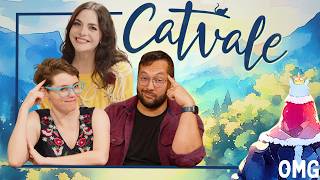
Catvale is a sandbox euro adventure from the publisher FUdice for three to six players, in which ambitious cats explore a hex map and compete for prestige after a harsh winter. The reviews so far fall into two groups. Good Time Society played a full session with host Bailey Meyers, Phil Korea, and Amy Don, and came away enthusiastic about the artwork and the table atmosphere, while also describing a game whose mood swings and dice luck can change a turn quickly. Board Stupid covered the game from a pre-release vantage point after seeing it at UK Games Expo. Its hosts praised the ambition of a one-person project that had been in development for six or seven years, and they were drawn in by the artwork and the scope of the design, but they had not yet played it. Both groups agree that the presentation is exceptional. They differ mainly on how much complexity the design can carry comfortably.
Core Mechanics That Define Catvale
Action Dice and Committed Actions
Each round moves through cleanup, breakfast, planning, and adventure phases. During planning, players roll their action dice and set one die aside as a defense die. Good Time Society explained that a committed die is spent on a main action and then sits out for the rest of the turn, so its face value determines how much that action yields. Committing a three to gather produced three sticks in the session, and fishing with a committed die brought in fish in proportion to its value. Side actions form a separate budget, and extra turns can be bought with fish, which the hosts treated as the central currency. Because every roll forces a choice between gathering, building, questing, and fighting, the reviewers repeatedly noted that a bad roll shapes the whole round.
The Harmony and Chaos Mood Track
Growth points at the end of each season are split between two cubes, one for harmony and one for chaos, and the cubes cannot occupy the same space on the track, so players must decide where each point goes. Good Time Society stressed that the mood shifts through cards, combat, and quests, and that it directly affects growth, since the players said their behavior in a season would change what they gained. Reaching thresholds on either track unlocks permanent passive bonuses, such as an extra resource every time a cat gathers or additional movement each turn. The host also observed that a table that stays too calm can be pushed back toward chaos to avoid penalties, which turns the mood track into a constant balancing act across spring, summer, and autumn.
The Catvale Experience
Cozy Art Against Cutthroat Table Talk
The atmosphere is built on contrast. The visuals are soft and inviting, and Good Time Society described the art as perfectly cozy yet cute and badass, adding that it was contributed to by a group of art students, a backstory the host found especially charming. At the table, the same cats who admired the scenery spent the session making peace promises, breaking them, and debating who had earned a prestige point. The result feels friendly on the surface and increasingly treacherous as bounties, fish thefts, and fights accumulate.
Escalating Tension From Quests and Fights
Shared quests such as digging a tunnel through a mountain or triggering an avalanche benefit the whole table, but participants can be asked to give up dice or prestige, and the players argued openly about who should pay the cost. Combat runs on an attack dial and a defense dial, with fate dice and playable tokens alternating between attacker and defender, and ties go to the defender. Good Time Society's session turned into a run of bounties, a broken truce, and a fight decided by a single point of difference. The hosts described this build-up of stakes as the source of the game's energy, with each cat's risk rising as the season progresses.
What Makes Catvale Stand Out
Artwork and Theme
Art is the most consistent point of praise across both channels. Board Stupid described the project as a sandbox adventure with anthropomorphic cats in a knightly, Robin Hood inspired style, and said that once they saw the artwork, the game "looked absolutely charming." Good Time Society singled out a Kickstarter exclusive cat named Cherry, whose ability proved useful during the session, and the hosts expressed a clear intention to back the crowdfunding campaign. The theme is also deliberately silly, with building names, adventure cards, and quest descriptions that reward reading aloud.
Tile Map Exploration and Portals
Board Stupid highlighted the tile based map that changes from game to game and gives players a choice between aggressive and exploration focused play. In the session, portal tiles allowed cats to move between portals without spending movement, and marking a tile with a die claimed it as territory. At the end of each season, players score prestige for every set of three marked tiles, and a cat standing on a tile it marked during a fight gains a free reroll. Reviewers presented this as the engine that keeps the sandbox from feeling repetitive, since every move can alter the map and the scoring.
Potential Drawbacks
Heavy Load and Learning Curve
Board Stupid's central concern was that the game might be too heavy. Its hosts listed a dense mix of systems, including rolling dice, combat, resource management, building, adventure cards, and action points, and they said there seemed to be a lot happening at once. Good Time Society also needed rule clarifications during its session, including when effects from cleanup end and how defense tokens and cards alternate between players. The hosts described the rules as learnable, but they noted that the mood and combat systems take several turns to internalize, so the first game is likely to be a teaching experience.
Luck and Random Adventure Cards
Dice and adventure cards introduce substantial variance. Good Time Society's players rolled poorly on several turns, and a gather roll that produced nothing became a running joke. Adventure cards that resolve immediately can swing the table sharply, including spiked milk that cost a cat a pride point and a mosquito wand that targeted a cat chosen by elimination. One player summed up the frustration by noting that adventure is not always fun. The reviewers acknowledged the upside as well, since some draws granted fish, buildings, or prestige, and a single fate die can turn a fight. Players who prefer predictable planning may find the randomness hard to accept, although the same randomness produced the session's most memorable moments.
If You Enjoy Catvale
Players who enjoy sandbox adventure games with a tile map that changes from one play to the next will recognize the exploration core, where the board develops through portals, marked territory, and shared quests rather than a fixed track. Those who like committing dice to actions and living with the outcome of each roll will find the action dice system satisfying. Readers who appreciate a cozy visual style paired with a sharp table rivalry, where promises are made and quickly broken, should also find the tone appealing. Board Stupid framed the central question as whether the game would land between fun and too heavy, so readers who want an accessible theme supported by deeper decisions are likely to be the best fit.
What Reviewers Are Saying
"The art in this game is so good. It's perfectly cozy and also kind of cute and badass. I love it."
— Good Time Society
"You got a tile based map that will be different each time. You can choose to be sort of more aggressive and bloodthirsty or more of an exploration type play."
— Board Stupid
"This could be really fantastic or it could be like way too heavy or it could be somewhere in between. So, we're really excited to try this game out."
— Board Stupid