


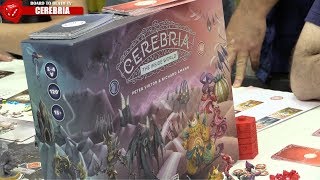








Cerebria: The Inside World Deep Dive
What the Community Thinks About Cerebria: The Inside World
Reviewers who have actually played Cerebria: The Inside World tend to land somewhere between deep affection and clear-eyed acknowledgment that the game never caught on with a wider audience. Quackalope calls it a game they genuinely love while admitting they understand why it struggled commercially when it launched from Mind Clash Games. The Secret Cabal Gaming Podcast describes a host who is a committed fan of the publisher and was drawn in by a convention demo, loving the artwork and the Inside Out-style premise of controlling a person's emotions. The Broken Meeple, running through a personal favorites countdown across two separate episodes, calls it the least popular title from Mind Clash's catalog by most players' standards, yet still ranks it as their third favorite game the publisher has made. Tim Chuon frames it in more personal terms, as one of the games hardest to let go of during a collection purge because of the memories and photography tied to it.
The disagreement is less about whether the game is good and more about who it is for. The Broken Meeple is explicit that the team-versus-team structure makes it unpopular with many players and genuinely difficult to find opponents for, while Quackalope points to the same tension, a design that mixes cooperation and competition at once, as the likely reason the game never found a bigger audience. Both still keep coming back to it anyway.
Core Mechanics That Define Cerebria: The Inside World
Team Versus Team Area Control
The Broken Meeple lays out the structure plainly: games run as a 1v1 or 2v2 team setup, with one side playing positive emotions like love and delight and the other playing negative emotions like sorrow and sadness. The two sides compete to build a structure in the middle of the board while controlling dreamscape areas that grant bonuses and more emotion cards. In partnered games, teammates can openly discuss strategy, but since the opposing team can hear everything, players have to balance being useful to a partner against giving away too much information, which The Broken Meeple says gives the game a distinct team versus team feel unlike most area control designs.
Evolving Emotion Cards
Cards are played onto the board to control areas and unlock discounts and special powers, and The Broken Meeple's second entry on the game explains that weaker emotions can be unlocked into "greater emotions" that are considerably more powerful, a system the reviewer compares directly to Pokemon evolving into a stronger form. On top of the card system, each player's personal board offers several different tracks to level up, though no single player can push every track at once, forcing a choice between speed, summoning cards quickly, or reaching those greater emotions sooner.
The Cerebria: The Inside World Experience
A Slow, Heavy Puzzle With Long Turns
The Secret Cabal Gaming Podcast describes the game as hard to explain and warns that there can be real time between turns as players work out what to do, calling it extremely challenging to play well and full of puzzling. The Broken Meeple echoes this from its second countdown appearance, noting the rules front-load a lot of information and that it is a bit of a learning curve and a lot to get into, though once a session is underway the turns themselves go relatively smoothly.
Tense, Semi-Open Team Communication
Because teammates sit across from an opponent who can hear every word, The Broken Meeple describes a careful back-and-forth where partners have to plan together without becoming so cryptic that their own teammate cannot follow, since the other team is always listening in and can adjust accordingly. That constant low-grade tension, deciding how much to say out loud, is part of what the reviewer says sets the team versus team feel apart from a typical cooperative game.
What Makes Cerebria: The Inside World Stand Out
A Theme Carried Entirely by Its Art
Quackalope singles out the world, the design, the storytelling, and the artwork as the parts of Cerebria that stuck with them even while other elements of the design struggled to land. The Secret Cabal Gaming Podcast devotes a separate episode specifically to the game's art direction, describing it as a drastic change in style compared to the publisher's other titles, almost like a twisted child's storybook, and calling the artwork beautiful. Tim Chuon's attachment runs so deep that the game was one of the first they ever drove out to photograph for its own sake.
Gorgeous, Customizable Miniatures
The Broken Meeple highlights the physical presentation directly, calling out gorgeous miniatures and a wide range of ways to customize a player's characters across the course of a game, on top of an optional balance faction expansion that adds a third team for more advanced play.
Potential Drawbacks
A Confusing Mix of Cooperation and Competition
Quackalope's strongest criticism is structural: the game creates an environment where players are mixing cooperation and competition together, working with teammates in some regards while working directly against them in others, layered on top of victory conditions that combine building a central structure, scoring points, and recruiting and upgrading cards. They say this twisted sense of design is exactly why they understand the game struggled commercially despite loving it personally.
Hard to Learn and Hard to Get to the Table
The Secret Cabal Gaming Podcast admits the game is hard as hell to explain, and The Broken Meeple's later ranking adds that it does not get enough buzz or recognition and keeps turning up on discount sales, which it attributes partly to the learning curve and partly to the team versus team format simply being a tough sell. The Broken Meeple also notes directly that finding people willing to play it is tricky, outside of one or two regulars willing to commit to a side.
If You Enjoy Cerebria: The Inside World
The Broken Meeple places Cerebria alongside Anachrony as one of Mind Clash's heavier euro designs, noting that most players reach for Anachrony first even while the reviewer personally gives Cerebria just as much credit. Tim Chuon, weighing which heavy games to keep in a shrinking collection, considered Septimus a likely replacement for Cerebria's spot on the shelf, suggesting the two scratch a similar itch for the kind of lengthy, involved euro design Mind Clash is known for.
What Reviewers Are Saying
"I understand why this game struggled when it came out. It was big and bulky, had a twisted sense of game design, creating an environment where players were mixing together, where players were kind of working together in some regards and absolutely working against each other in others."
— Quackalope
"I saw it at a convention once and I love the artwork. I love the concept, the theme that you're basically, it's inside out the game where you're playing these factions of good or bad or neutral emotions and trying to control this person, you're building this person's personality."
— The Secret Cabal Gaming Podcast
"This game I have so many emotional feelings to is one of the first games that I took photos of. I went out and so this game is all about different emotions, and it's inside out the movie in board game form, so you have, I forget, happiness, anger, and hatred, and all those cool emotions."
— Tim Chuon