











Compania Deep Dive
What the Community Thinks About Compania
Compania has generated substantial enthusiasm across the board gaming community. Reviewers consistently praise the game's elegant blend of simultaneous action, worker placement, and resource management within a compact playtime. The consensus is decidedly positive: this is a Euro game that respects players' time while delivering meaningful decisions and strategic depth. Board Game Sanctuary calls it a "highly interactive euro" that creates a "tense and suspenseful gameplay experience." Meanwhile, reviewers from Rolling Dice & Taking Names and The Dice Tower echo appreciation for how the game balances quick play with satisfying mechanical depth. The game's novel approach to dice placement has impressed even experienced players, many of whom ordered it immediately after their first play.
Core Mechanics That Define Compania
Hidden Dice Placement
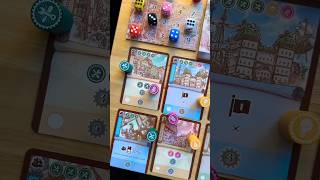
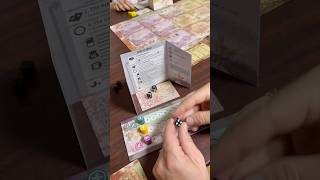
At the heart of Compania lies its distinctive take on worker placement. Rather than placing workers directly on action spaces, players secretly assign dice behind player screens, with each die's pip count determining how many cubes will be committed to each location. This hidden information creates a bidding dynamic where players must anticipate rivals' moves without direct knowledge of their choices. The process feels intuitive yet demands constant strategic thinking: which locations will opponents target? How can you secure the resources you need while denying them to competitors? Once players reveal their selections simultaneously, everyone places colored cubes on the board based on their dice assignments, and the player with the most cubes at each location gains access to that action. Designer Yog Akasi employs this mechanic to create a system where success hinges on reading the table and making calculated gambles.
Engine Building Through Card Combinations
The second half of each round shifts focus to the company phase, where players construct their income engines using building cards. These cards can be layered, with extensions placed beneath base cards to create more efficient resource combinations. A player might place an amusement park that generates money whenever they control certain board areas, then enhance it with an extension that increases the payout or reduces resource costs. This stacking mechanic encourages players to search for synergies between cards, creating satisfying moments when a carefully planned combination finally triggers. The challenge is that card draws are partially random, so successful players must adapt their strategies to the cards available while managing the resources they produce through worker placement.
The Compania Experience
Streamlined Tension
Compania compresses the engine-building fantasy into roughly 75 minutes of simultaneous play. There is no downtime between your turns because everyone acts at once. Players experience a rare quality in Euro games: you're constantly engaged, thinking ahead while other players are also thinking ahead, creating a rhythm where tension and momentum build together. The blind dice placement heightens this tension. Did your neighbor guess where you'd place workers? Will they block your strategy with more cubes than you anticipated? This uncertainty, combined with the simultaneous resolution, generates a different kind of player interaction than traditional sequential play. The game does not require players to wait passively; instead, they're mentally simulating scenarios and preparing their next move while others lock in theirs.
Accessibility Through Clarity
Despite its strategic depth, Compania teaches quickly and plays cleanly. The action icons are straightforward, the player aids are functional, and the turn structure repeats consistently across nine rounds. The game's accessibility makes it equally engaging for experienced gamers and newcomers. Many reviewers highlighted surprise at how swiftly they understood the rules and how rapidly subsequent games moved. First rounds may feel slow as resources are scarce, but by round three, players are building engines and the pace accelerates. The game rewards learning without punishing newcomers, making it suitable for family gaming and hardcore enthusiasts alike.
What Makes Compania Stand Out
Dice Placement Innovation
Compania's core innovation strikes reviewers as genuinely fresh. The notion that dice pips represent worker counts rather than serving as a traditional roll-and-move mechanism feels novel even in a hobby saturated with worker placement variants. Players praise how the system allows for player agency: you choose exactly which pips show, not gambling on a die roll. Yet the mechanism remains constrained by a limited total (players start with a five-pip maximum), forcing meaningful trade-offs. Grant Lyon from Grant's Gamerecks highlights how this "hidden dice placement" creates moments where players must anticipate opponents' moves, making the bidding dynamic far more interactive than it initially appears. The Dice Tower reviewers emphasize that this mechanical elegance sets Compania apart from conventional worker placement designs.
Simultaneous Play Without Downtime Sacrifice
Most games that embrace simultaneous play do so at the cost of strategic depth; Compania achieves both. The simultaneity accelerates playtime without requiring players to accept excessive randomness or limited decision space. Board Game Dad remarks that "everything that I enjoy about an engine builder is just streamlined into simultaneous play," and this assessment captures why Compania has resonated widely. Reviewers consistently note that even with four to six players, games finish in the target timeframe. Rolling Dice & Taking Names praises the game's ability to hit that "mediumweight strategy that plays relatively quickly" sweet spot that many hobbyists seek. The hidden dice placement ensures that every player's turn is meaningful even when resolved simultaneously, a balance many games fail to strike.
Potential Drawbacks
Card Draw Dependency
The game's primary vulnerability is luck of the card draw. Building cards come in three resource types, and players draw from a shuffled deck. A player who commits to a strategy early (say, building primarily with pink resources) may find that future rounds offer no pink cards, forcing a costly pivot or accepting a suboptimal tableau. Rolling Dice & Taking Names highlights this openly: over multiple plays, some players drew cards perfectly aligned with emerging strategies while others faced resource droughts that derailed their plans. This is not a design flaw so much as an intentional decision that adds volatility. Players who dislike games where preparation can be undone by poor card distribution may find this frustrating, though others view it as a source of replayability and the need for adaptive thinking.
Limited Strategic Agency in Card Play
Board Game Dad identifies another consideration: the game can feel like "you're going to play the hand that you're dealt." While the worker placement phase offers deep interaction and choice, the company phase depends partly on which cards you've drawn. This differs from games where every turn presents a wide array of options. Some players embrace this constraint as a refreshing departure from decision paralysis; others prefer games where strategy dominates luck. The game mitigates this through the investment system, where players can purchase special abilities, but these require upfront capital. Skilled players can win despite unlucky draws by maximizing resource generation through careful area control, yet the card-dependent elements remain noticeable.
If You Enjoy Compania
Players drawn to Compania's strengths should explore titles that emphasize similar qualities. If you prize the hidden information and bidding tension, Innovation and Lord of the Rings: The Confrontation offer asymmetric gameplay with meaningful deception. If the engine-building appeal resonates most, Splendor and Cascadia provide satisfaction through card synergy with lighter rules overhead. For those captivated by simultaneous play that avoids downtime, Galaxy Trucker and Magic Maze deliver interactive moments without turns grinding to a halt. Players who appreciate the rapid worker placement feel may also enjoy Ticket to Ride or Carcassonne, which resolve quickly at higher player counts. Grant Lyon's recommendation captures this: Compania fits best for players who love "mediumweight strategy that still plays in 90 minutes or less," a category that also includes Azul, Calico, and 7 Wonders.
What Reviewers Are Saying
"It's the interplay between the different characters, the area control of your worker places on the different locations on the main game board that really creates this indirect, tense, and suspenseful gameplay experience."
— Board Game Sanctuary
"I think the thing I love about this the best is this is a simultaneous action Euro game that you can easily play with four players in an hour and that was a big appeal to me."
— Rolling Dice & Taking Names
"Everything that I enjoy about an engine builder is just streamlined into simultaneous play. You don't have to wait for other people to do their turns. You get to build that momentum from having your moves combo off of each other, the sequences of cards that you get to play."
— Board Game Dad