


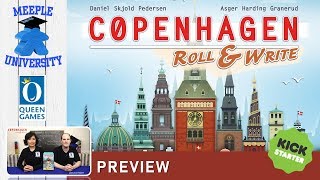
Copenhagen: Roll & Write Deep Dive
What the Community Thinks About Copenhagen: Roll & Write
Copenhagen: Roll & Write has generated genuine enthusiasm from board game reviewers for its clever intersection of fast-playing dice mechanics and meaningful spatial decision-making. The game reimagines the original Copenhagen board game by replacing card drafting with dice rolling, creating a lighter and quicker experience that retains the building-placement puzzle at its heart. Reviewers appreciate how the game compresses engaging decisions into a 20-minute playtime while maintaining genuine player interaction throughout. Getting Games highlighted the appeal of a dice roll-based game where every player remains active even on others' turns, while Meeple University emphasized the precision required to navigate the game's unforgiving luck factor through tactical bonus usage.
Core Mechanics That Define Copenhagen: Roll & Write
Dice Rolling with Polyomino Placement
Each turn begins with the active player rolling five dice, each showing one of five colors plus a wild face. The player selects all dice of a single color (or any combination including the wild), and the total count determines which polyomino tile they can draw. A roll of two purple dice allows a two-square purple tile; four or five dice of any color lets players claim the larger tiles that only appear once per game before vanishing from the board. The tile then gets drawn onto the player's building facade scoresheet, where strategic placement becomes critical. Other players don't sit idle during this phase. Instead, they examine the leftover dice and mark off one box on colored tracks that unlock special abilities. This ensures continuous engagement and creates a form of mild player interaction even when it's not your turn.
Spatial Puzzle and Building Decoration
The core puzzle challenge unfolds on each player's building facade scoresheet. When drawing a polyomino tile, players choose one square to fill as a brick wall, with all others becoming windows. Rows and columns score one point when complete, with the value doubling if that row or column contains only windows. Larger combos emerge through the coat-of-arms special spaces scattered on the sheet: completing these spaces grants bonuses like adding two marks to bonus tracks or placing additional windows that can trigger cascading completions. Reviewers noted the satisfying depth this creates, with Kovray comparing the puzzle feel to Second Chance and appreciating how "trying to create those rows that give you really a lot of bonus points" becomes the central strategic tension.
The Copenhagen: Roll & Write Experience
Quick and Tactical
The 20-minute playtime creates a snappy rhythm that keeps attention high and decision fatigue low. Yet despite the brevity, meaningful choices abound. Each turn presents genuine tradeoffs between securing a favorable tile now versus banking bonus powers that may prove crucial later. The game concludes once any player accumulates 12 or more points, with ties broken by whose building facade is most completely filled. This ending condition ensures that grinding out tiny victories feels insufficient; the puzzle must flow together cohesively.
Strategically Demanding Despite Luck
Meeple University's observation that "the unmitigated die rolls in Copenhagen can be quite brutal" crystallizes the game's core tension. Unlucky rolls leave players with limited options, potentially forcing unwanted tiles onto their facades or providing nothing useful to grab. Yet the game offers a rich toolkit of special bonuses to mitigate this randomness: red stars fund rerolls, blue stars let players place windows without walls, purple stars allow wall placement at any time, green stars treat two colors as one on a given roll, and yellow stars unlock reuse of unique tiles. Meeple University emphasized that "skillful use of these bonuses is critical to a player's success," meaning luck is never an excuse for passive play. Instead, forward planning becomes essential; players must decide when to spend limited bonus powers and anticipate which scenarios might demand them most.
What Makes Copenhagen: Roll & Write Stand Out
Continuous Player Interaction Without Blocking
Many roll-and-write games reduce other players to passive observers between turns. Copenhagen inverts this by letting all non-active players engage simultaneously. When the active player rolls and selects dice, the remaining players inherit the leftover dice and immediately mark off progress toward special bonuses. This creates a delightful flow where every roll presents opportunities for everyone. Getting Games specifically praised "rolling style games where you do something and your opponents all get to do something on your turn," emphasizing that this constant interaction elevates the experience. No player waits long between decisions; the downtime that plagues many roll-and-writes is nearly absent.
Puzzle Elegance in a Small Box
The facade scoresheet is beautifully economical. It serves as building canvas, track manager, and scoring board all at once. The polyomino tiles that players draw represent the actual dimensions being decorated, creating immediate visual feedback. Completing rows and columns delivers satisfaction through simple row-and-column bonuses, yet the coat-of-arms bonus spaces create cascading opportunities that reward planning two or three turns ahead. The theme of decorating a Copenhagen waterfront building translates directly into mechanics: players aren't just pushing cubes or drawing abstract shapes, they're genuinely designing a building's window and brick layout, complete with the option to create whimsical asymmetries.
Potential Drawbacks
Brutal Dice Dependency
The game's reliance on unmitigated dice rolls means that a string of poor rolls can leave players feeling penalized through no fault of their own. While the bonus system offers mitigation, it requires advance spending to be effective. A player unlucky early might find themselves without accumulated bonuses when they most need them. This creates a resource-management layer that adds depth but also means some players may experience runs of frustration, particularly in their first play before understanding optimal bonus spending sequences.
High Replay Variability from Luck
Because the tile market is permanently depleted as players claim the four and five-square pieces, and because dice rolls determine which tiles appear, any given game of Copenhagen can play quite differently. Some players may never get access to high-value tiles while others score them consistently. While this variance fuels replayability, it also means that a player's final score heavily reflects their luck streak rather than purely their strategic acumen. Scoresheets that feel close all game can swing dramatically depending on late-game dice fortune and bonus availability.
If You Enjoy Copenhagen: Roll & Write
Players drawn to Copenhagen: Roll & Write will likely appreciate Second Chance, which shares the spatial puzzle satisfaction and building-block placement feel without the dice element. For those who want more dice rolling and variable bonuses, the larger roll-and-write catalog offers games like Cartographers and Lanterns: Dice. For the player interaction angle, Getting Games' enthusiasm suggests checking out other games where opponents remain engaged throughout, such as Deep Blue or Welcome to New Las Vegas. The puzzle-centric design space also appeals to fans of lighter euro games with elegant theming.
What Reviewers Are Saying
"The unmitigated die rolls in Copenhagen can be quite brutal, making a skillful use of these bonuses critical to a player's success."
— Meeple University
"I really like rolling style games where you do something and your opponents all get to do something on your turn."
— Getting Games
"I really like spatial puzzles. It reminds me a little bit of Second Chance and kind of filling those graphs, but it has an added element of twist of trying to create those rows that give you really a lot of bonus points."
— kovray