/pic4037705.jpg)

/pic4037705.jpg)





































Cryptid Deep Dive
What the Community Thinks About Cryptid
Cryptid has earned a devoted following among board game enthusiasts who appreciate pure deduction mechanics without gimmicks. Designed by Hal Duncan and Ruth Veevers and published by Osprey Games, the game generates genuine excitement among players who enjoy solving logical puzzles collaboratively. Reviewers consistently highlight its elegant design despite an abstract appearance. Many emphasize that while the components are modest and the board deliberately plain, the intellectual challenge and satisfying "aha" moments drive repeated plays. Each session offers a fresh intellectual challenge thanks to the modular board setup that creates hundreds of possible scenarios.
Core Mechanics That Define Cryptid
Deduction and Logical Elimination
At Cryptid's heart lies pure deduction: every player holds a piece of the puzzle through their secret clue, and only one hexagon on the board can satisfy all the clues simultaneously. Players must work through spatial reasoning, eliminating impossible locations by asking questions about specific coordinates. When another player responds with yes or no tokens, the answer reveals what their clue must be. Board Game Sanctuary praises this system for how "based on their response they're going to give you some information either that cryptid is not there based on their clue." The satisfaction comes from logically deducing not just where the creature is, but what everyone else's hidden information must be. This creates natural competitive tension as players race to be first to claim the creature's location.
Grid-Based Question Strategy
Success depends on strategic questioning within the map's hex grid. Players must understand spatial relationships and ask probing questions that reveal the maximum information about opponents' clues. Some clues reference terrain features like desert, water, swamp, and forest, while others reference proximity to standing stones or animal territories. Reviewers highlight that this mechanic forces players to think several moves ahead, considering both where the creature might be and what information each question will extract. Board Game Sanctuary notes there is also "a little bit of deception in terms of trying to throw people off the track," since the two-action structure on your turn means you can strategically choose questions that mislead opponents about your own clue. The questions are constrained enough that teaching the game is straightforward, yet open enough that hundreds of different puzzle setups feel genuinely distinct.
The Cryptid Experience
Cerebral and Thinky Engagement
Cryptid delivers an intensely intellectual experience that commands full mental engagement. Reviewers describe it as feeling like solving a logic puzzle while racing against opponents. The Broken Meeple calls it "a tightly packed short strong punching game that really just gives you that feeling of deduction but also satisfying fun." It plays quickly, often finishing in 30 minutes even with newer players, yet the puzzle itself feels substantial. The experience is solitary in that each player is primarily solving their own logical problem, yet collaborative in how information gradually accumulates at the table. The game rewards deep thinking and careful deduction, creating moments where players experience genuine revelations about the hidden clues.
Accessible Mysteries Without Social Pressure
Unlike social deduction games that require bluffing and lying, Cryptid relies on honest information exchange through yes and no tokens. This makes it welcoming to players who dislike the stress of hidden roles or deception. Reviewers contrast Cryptid favorably with games like Cluedo, noting that Cryptid's pure logic approach eliminates the luck of board movement and makes victory contingent entirely on reasoning ability. The game respects player intelligence and rewards preparation, making it feel fundamentally fair even when one player discovers the answer first. No Rolls Barred praises the "pure deduction without gimmicks" and the "clever hex-grid clue system" that keeps the focus on logical reasoning rather than social manipulation.
What Makes Cryptid Stand Out
Modular Board with Hundreds of Setups
The game's six hexagonal tiles arrange in different configurations for each scenario, creating genuine variability across the five scenario books. Each arrangement combined with different clue combinations means players cannot memorize solutions or fall into predictable patterns. Reviewers appreciate that even replaying the same scenario book feels fresh because the board layout changes the spatial relationships entirely. The digital companion app extends this further, as The Broken Meeple notes, offering "a near-infinite range of puzzles." This modularity makes the game feel like an infinite puzzle generator rather than a fixed experience.
Minimal Components, Maximum Gameplay
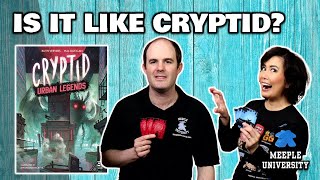
Cryptid achieves its intellectual depth with remarkably simple components: hex tiles, clue books, yes and no tokens, and colored discs. Reviewers note that the game's physical plainness actually enhances focus on the puzzle itself. There are no cards to manage, no hidden role cards to shuffle, no complex iconography to parse. This simplicity makes it portable and quick to set up, yet the resulting puzzle can challenge competitive gamers and casual players alike. The design proves that sophisticated gameplay need not depend on lavish production values. As Meeple University observes, the game delivers "mind-blowing gameplay despite simple components" with a "clever deduction puzzle with impressive clue design."
Potential Drawbacks
Abstract Aesthetics and Limited Visual Appeal
Multiple reviewers acknowledge that Cryptid's board looks deliberately abstract and visually plain. The hexagonal grid with simple colored regions lacks thematic illustration or elaborate artwork. However, reviewers emphasize this is by design: the abstract nature keeps focus on the logic puzzle rather than distracting narrative elements. The Broken Meeple puts it bluntly, noting the game "is basically a bunch of little colored blocks on a very bland looking map, it's not exactly a looker." Despite the plain appearance, people are drawn to play the game when they see it demonstrated, suggesting the intellectual appeal overcomes initial visual impressions.
Teaching Clarity and Player Mistakes
The single consistent frustration voiced by reviewers concerns the difficulty some players have understanding what the clues mean. Even when rules are explained clearly, some players misinterpret how "within two spaces of X" or "on swamp" functions spatially. These mistakes cascade through the game since all deductions depend on correct information exchange. Reviewers note this is less a flaw with the game and more a test of whether players can maintain focus on spatial logic. Our Family Plays Games highlights this dynamic, noting the game works best with thoughtful players willing to carefully track information rather than casual players seeking light entertainment.
If You Enjoy Cryptid
Similar games worth exploring include The Search for Planet X, which uses app-based logic puzzles with comparable spatial reasoning. Alchemists combines deduction with worker placement and real-time theory publishing. Mysterium offers cooperative deduction through abstract card interpretation. Decrypto demands logical connections between word-based concepts. Codenames provides team-based deduction in a lighter format. Players who appreciate pure deduction mechanics uncluttered by randomness or elaborate theming will find resonant experiences in these titles, where logical reasoning determines success entirely.
What Reviewers Are Saying
"What I really love about this game is there's a little bit of deception in terms of trying to throw people off the track. On your turn you can do one of two things which is so simple, and that's basically asking another player is the cryptid in the location that you've asked them. Based on their response they're going to give you some information, and based on how they answer your questions you can make deductions about what their rule might be."
— Board Game Sanctuary
"Mind-blowing gameplay despite simple components. The clever deduction puzzle with impressive clue design really makes this one shine. Initial impression based on components can be misleading, but once you start playing it all clicks together."
— Meeple University
"This is such a tightly packed short strong punching game that really just gives you that feeling of deduction but also satisfying fun. The level of interaction that really happens at the table is great. People see it and they instantly want to play it, it's kind of weird, it has a hidden appeal."
— The Broken Meeple